
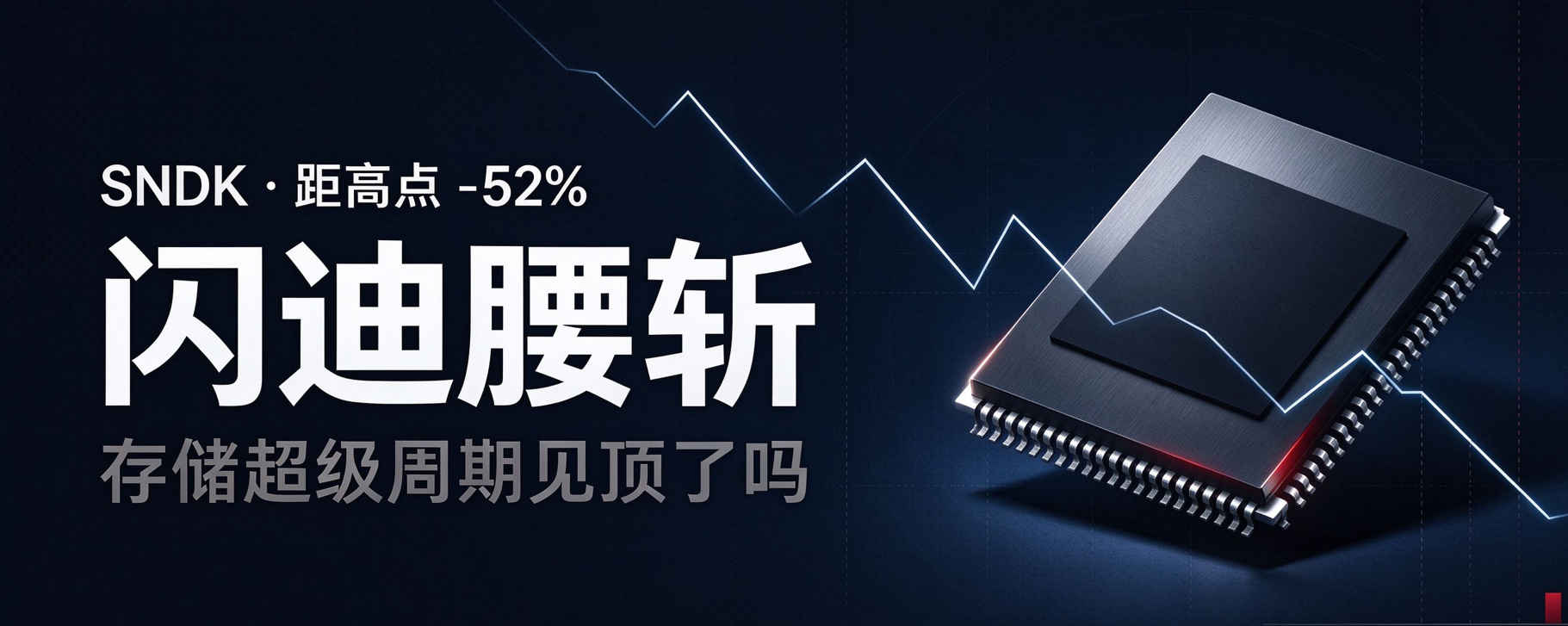

#SDNK NAND is a type of flash memory chip. “NAND” originally refers to the “NOT AND” logic gate in circuits. The memory chips built from it are what store data in familiar devices like solid-state drives (SSDs), phones, USB drives, and SD cards.
It’s not the same thing as memory (DRAM).
• DRAM (memory): Loses data when the power is off; stores 1 bit using a capacitor. It’s extremely fast but has low capacity, and is used as working memory—Micron, SK hynix, and ChangXin (CXMT), listed in China and the U.S., mainly make this.
• NAND (flash memory): Retains data when the power is off; stores data by trapping electrons in a “floating gate.” It’s slower, but has higher capacity and lower cost, making it suitable for long-term storage.
So SanDisk only makes NAND and has almost nothing to do with DRAM, while ChangXin makes DRAM. The market has hit SanDisk with the negative impact of “ChangXin expanding capacity”—but the logic doesn’t quite add up.
Why NAND is an “extremely cyclical business”
1. It’s a commodity: A 512GB NAND chip made by Samsung, Kioxia, Micron, SK hynix, or YMTC is almost indistinguishable from the others. Its price depends on supply and demand, not the brand.
2. Once capacity comes online, it can’t just be switched off: A fab has to run at full capacity to spread out its costs. Cutting production means unit costs soar, so manufacturers would rather slash prices than stop production. That’s why prices can double in a year—or be cut in half.
3. Supply is highly concentrated: There are only five or six players globally (Samsung, Kioxia + Western Digital, Micron, SK hynix/Solidigm, and YMTC). Whoever expands capacity can drive down prices across the entire industry.
This explains what happened to SanDisk
In 2025–2026, AI servers sent NAND demand soaring, while supply couldn’t keep up. Prices surged, SanDisk’s gross margin hit 85%, and quarterly EPS reached $55—classic signs of financial performance at a cyclical peak (profits came from price hikes, not efficiency). Once “price increases’ contribution to growth fell from two-thirds to 40%,” it meant volumes were still there, but prices were close to running out of room to rise. The market then started pricing in “profits are due to fall”—the fundamental reason the stock halved in two months.
In short: NAND is the “pork of the electronics industry”—demand depends on AI and replacement cycles for phones and servers, while prices depend on the capacity decisions of the five major manufacturers. Buying SanDisk is essentially a bet on the NAND price cycle, not on one company’s operational capabilities. So when following the stock, watch NAND spot prices and manufacturers’ capital expenditure guidance, not its PE ratio.
The global decline in consumer purchasing power is already having a major impact on SanDisk, as phone sales alone show. Worse than “weak sales” is this: A November 5 report from TrendForce said that, due to weak PC and phone sales, OEMs have begun cutting costs and downgrading specifications. This means the rise in storage capacity per device—which was a key factor offsetting declining shipments in the past—could be interrupted: volumes are falling, and capacity per device is also declining. That’s a double hit to consumer demand. This is where weak consumer demand can cause real structural damage to NAND.