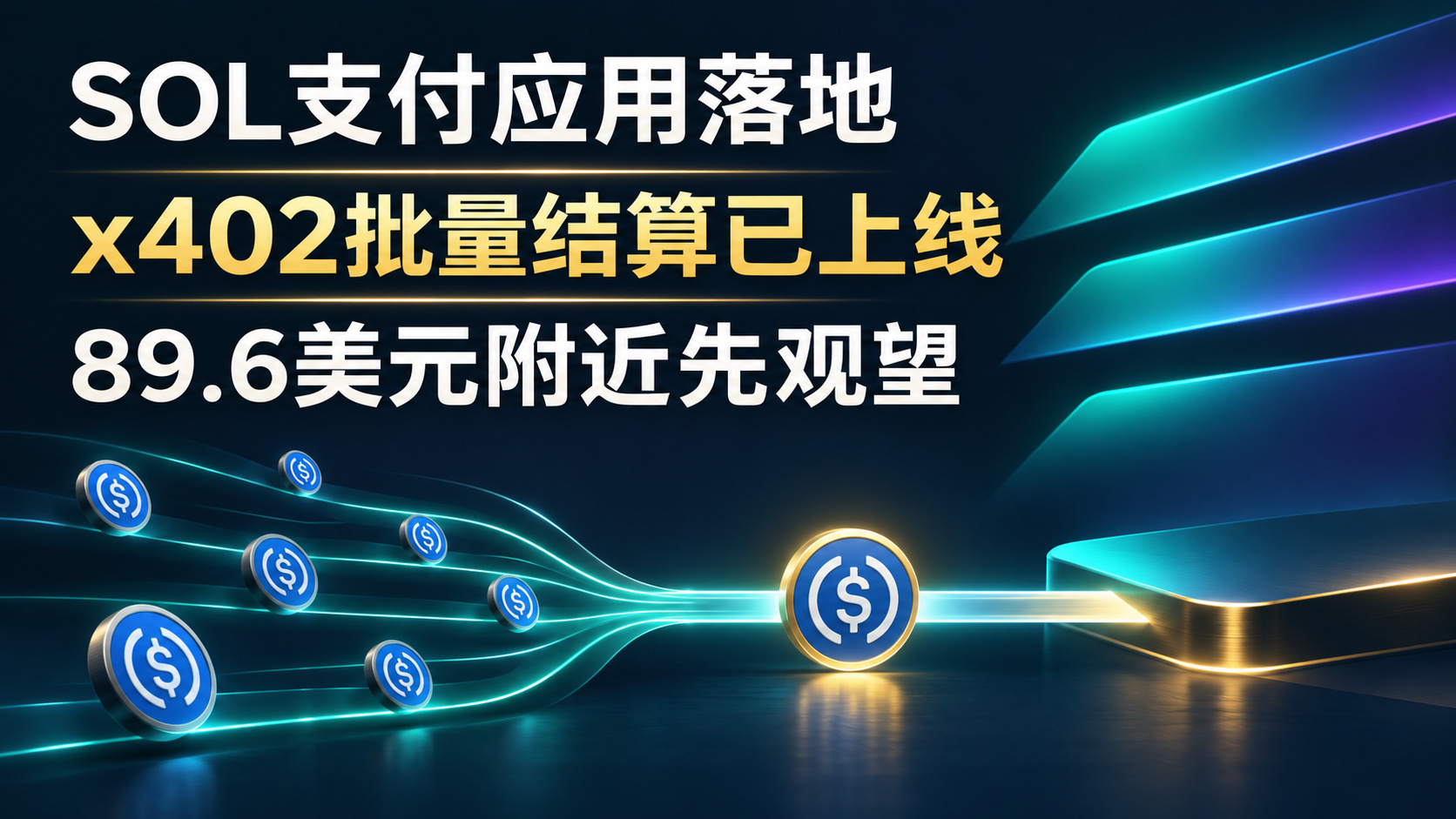
New evidence for the SOL payments narrative|x402 batch settlement is live|First watch for support near $89.60
My view is to pay attention to real-world application, but not to chase a rally just because of the words “AI payments.” In its October ecosystem roundup published on November 6, the Solana Foundation listed x402 batch settlement by PayAI and BlockRun on Solana. Cross-checking PayAI’s official October 22 announcement: its solution lets agents deposit USDC upfront, then generate off-chain payment receipts for multiple API calls and claim them on-chain in batches at regular intervals, rather than sending a separate on-chain transaction for every call. PayAI explicitly says its Solana version is available in production, but is subject to limits on the number of channels and deposit amounts. This is a monthly roundup of an existing product, not a new feature just announced on November 7; I won’t dress up an earlier launch as breaking news today.
Why could this affect the crypto market? If machine calls are frequent and each transaction is small, putting every transaction on-chain could make fees and settlement operations outweigh the transactions themselves. Pre-funded accounts, off-chain receipts, and batched on-chain claims can reduce the friction of frequent settlement. For Solana, this is evidence of stablecoin usage and application demand; if providers expand their services, it could increase real payment demand. However, the payment asset is USDC, and USDC that developers deposit upfront for channels does not mean they are buying SOL. Batching could even reduce the number of on-chain transactions per call, so transaction counts alone can’t be used to infer revenue. PayAI also notes that some implementations depend on trust in service operators. Limits and fund security need to be checked individually, and broader adoption still depends on sustained usage and actual settlement volumes.
How has the market reacted so far? At the time of writing, the latest SOL/USD trade on Kraken was around $89.62, below today’s open of $90.02. The intraday low was $89.55 and the high was $90.55, while the rolling 24-hour high was $91.47. This snapshot shows that prices remain weak; it doesn’t mean PayAI’s roundup drove a rally, nor can all of the day’s price movement be attributed to it. The Farside table for seven SOL funds on November 6 showed combined net outflows of about $24.2 million, reflecting weak institutional flows under that dataset’s methodology, but not spot selling at this exact moment. SOL appeared on Binance Square’s six-hour Most Searched list, but was not marked as a Rapid Riser. None of the current rising topics is directly tagged to this payment mechanism, so I’m mentioning only the coin actually being discussed.
If I were trading this myself: I wouldn’t enter now. I’d only consider testing the direction with unleveraged spot, with a position capped at 0.3% of total capital. I’d wait for SOL to first reclaim $90.55 and hold it on a retest, then look for confirmation that at least one of the following has measurably improved: subsequent payment data or fund flows. If there’s only a spike in news-driven attention, I’d remain out of the market. If triggered, I’d first target $91.47 and take half off as price approaches. I’d hold the rest toward the $93 area, but close proactively if the rally stalls. I’d place a stop about 2.5% below the entry price, or enforce it more strictly if price breaks below $89.48. If official data confirms that usage has not been sustained, fund net outflows widen, or price falls back below $89.48, I’d withdraw the bullish view and close the remaining position. If the plan never triggers, there’s no trade—and no profit to speak of.
#SOL
The above is solely my personal market observation and does not constitute investment advice.