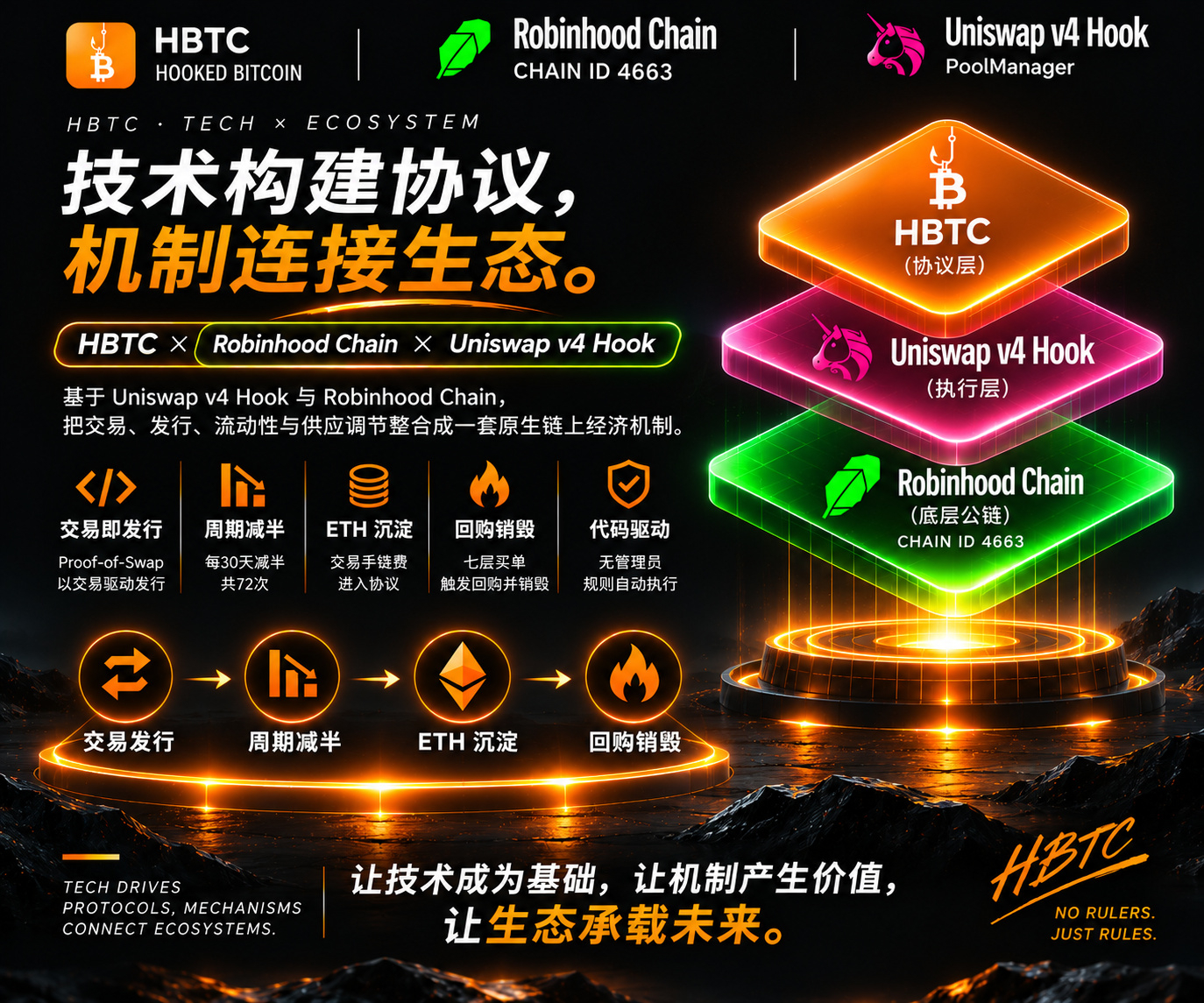
$HBTC’s four-layer relationship: $ETH is the blood, Robinhood Chain is the soil, the v4 Hook is the bones, and the $BTC rules are the soul
① ETH: Not wrapped BTC, but a native coin denominated in ETH
HBTC is an natively issued ERC-20 on Robinhood Chain, not a cross-chain representation of BTC. It inherits Bitcoin’s issuance discipline (a hard cap of 21 million and halving), but converts “hash power” into an ETH cost—each swap pays ETH as a toll according to the fee rate, and only the buy direction counts toward the current period’s Work. This “ETH anchor” is an anchor for issuance thresholds and participation accounting, not a guarantee or reserve.
② Robinhood Chain: It provides the stage, but its limits must be made clear
Deployed on Robinhood Chain, an Ethereum L2 with mainnet chain ID 4663 and ETH for gas. The chain aims to bring traditional markets and RWAs into open finance, with Ethereum compatibility. ⚠️ But even if HBTC has no owner in its own contract, it cannot escape the governance of the underlying chain—which is governed by an eight-member Security Council, uses permissioned validators, and has a sequencer operated by Robinhood.
③ Uniswap v4 Hook: Not a trading plugin, but an issuance machine
HBTC packs its issuance system, difficulty adjustment, and liquidity defense into a single Hook (OreHook), making “the pool is the mint, fees are hash power, and limit orders are burns” possible. OreHook has been deployed on mainnet; Blockscout marks it as fully verified and non-proxy. The standard LP fee is 0; fees are collected separately by the Hook as a Toll. It is classified as a Token Launch / Programmable Tokenomics Hook; its core is issuance rules, not an LP tool.
④ Putting it all together
ETH provides the unit of account and cost, Robinhood Chain provides the soil and access, the v4 Hook puts issuance into the pool, and Bitcoin’s halving puts it on a clock. Buy → Toll becomes Work → determines that block’s output → Toll goes into the Burn Net to place buy orders below → orders are filled and burned. Issuance, liquidity, and value recirculation are compressed into the lifecycle of a single Hook.
This is an experiment in native currency on a new blockchain—not a shadow of BTC or a derivative of ETH.