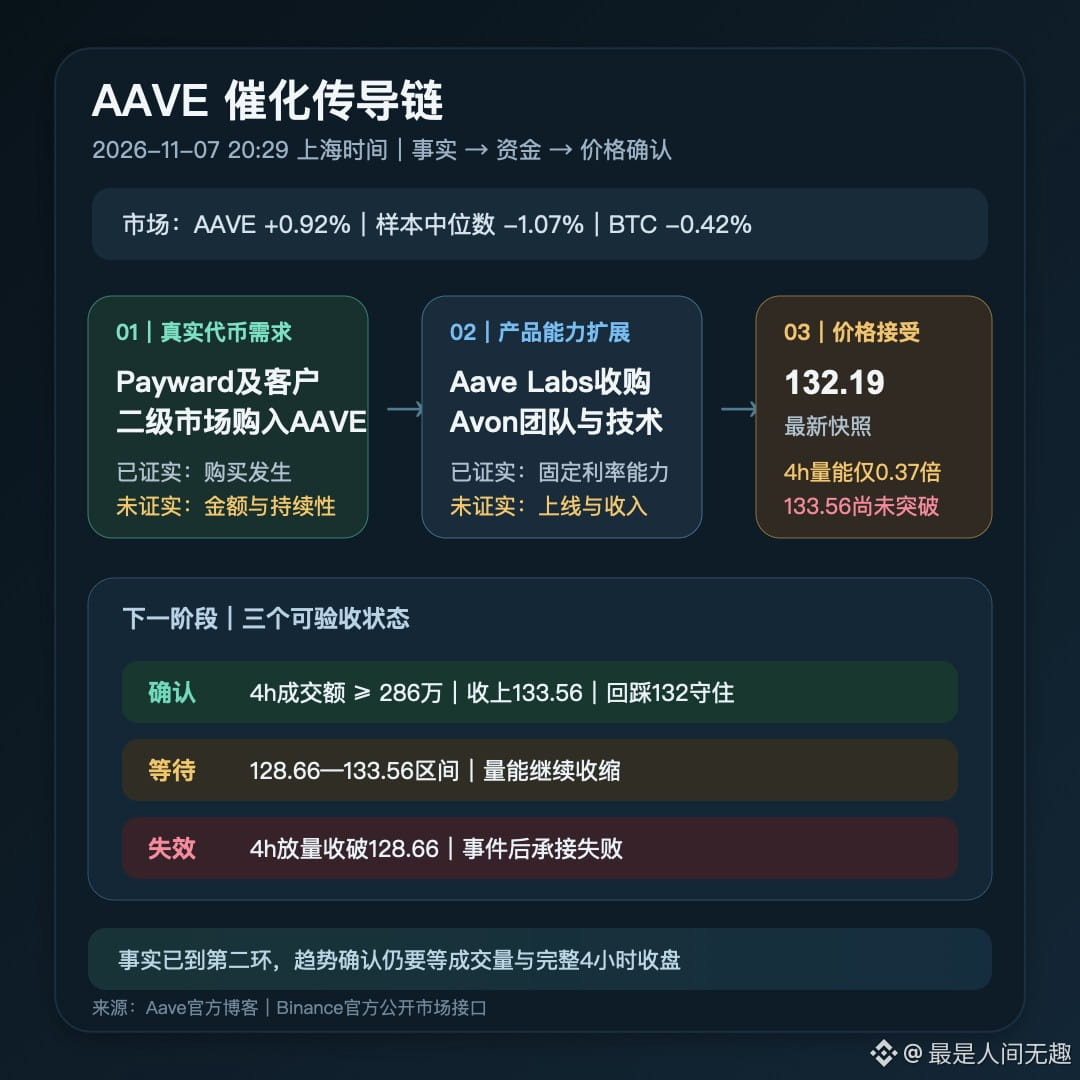
Two catalysts converge—why is $AAVE up only 0.92%?
At 20:29 Shanghai time, 15 of 21 highly liquid Binance spot USDT pairs were down and 6 were up, with a median move of -1.07%. $BTC was down 0.42%, while AAVE rose 0.92% to 132.19 USDT. Relative strength has emerged, but there are still two uncompleted confirmations between “there’s news” and “a tradable trend is taking shape.”
First, let’s break down the catalyst chain.
The first link is actual token demand. On November 5, Aave officially confirmed that a fund affiliated with Payward and its clients had purchased an undisclosed amount of AAVE on the secondary market, and said they might continue buying in the future. The purchases that have already taken place are a fact; how much was bought, whether buying will continue, and how much this affects circulating supply are still unknown. “May continue” should not be presented as a confirmed flow of funds.
The second link is product capability. On November 6, Aave Labs announced the acquisition of Avon’s team and technology, including fixed- and variable-rate lending protocols and an on-chain order book. The team will join Aave and continue development. This raises the possibility of expanding fixed-rate products in the future, but the company has yet to provide verifiable figures for when the products will launch or how much deposits or revenue they will generate.
The third link is market acceptance. AAVE’s rolling 24-hour high was 133.56 and its low was 128.66. The latest completed 4-hour candle opened at 132.01 and closed at 132.00, with turnover of about 1.05 million USDT—just 0.37 times the median of about 2.86 million across the previous 24 completed 4-hour periods. Turnover in the latest completed 1-hour candle was about 394,000. Although that was 1.44 times the 24-hour median and the candle closed higher, AAVE still hasn’t broken above 133.56. Buying is present over the short term; higher-timeframe confirmation is absent.
Here’s how I’d assess it:
Bullish path: Turnover in a completed 4-hour candle returns to above about 2.86 million USDT and the candle closes above 133.56, followed by a pullback that holds near 132. If price then gets above 137.03, that would show the two catalysts are translating into acceptance at higher prices.
Base case: Price stays between 128.66 and 133.56 while volume continues to contract. That would mean the market recognizes AAVE’s relative strength but is still waiting for evidence of product progress or new inflows.
Bearish path: A completed 4-hour candle closes below 128.66 on higher volume, signaling that post-event buying support has failed; in that case, the view that “the catalysts are forming a price floor” would be invalidated. Conversely, my cautious view would be invalidated if price holds above 133.56 on higher volume and stays above it after a retest.
The risks aren’t limited to the broader market: the purchase amount hasn’t been disclosed, there’s no commitment to further buying, and an acquisition doesn’t mean products and revenue will materialize immediately. Weekend liquidity is thinner, making intraday breaks especially prone to misleading signals.
Before opening $AAVE , first check whether real-time 4-hour turnover is approaching 2.86 million USDT, then watch the close relative to 133.56 and the retest near 132. Which link in the catalyst chain has been reached should be determined by the data, not the headline.