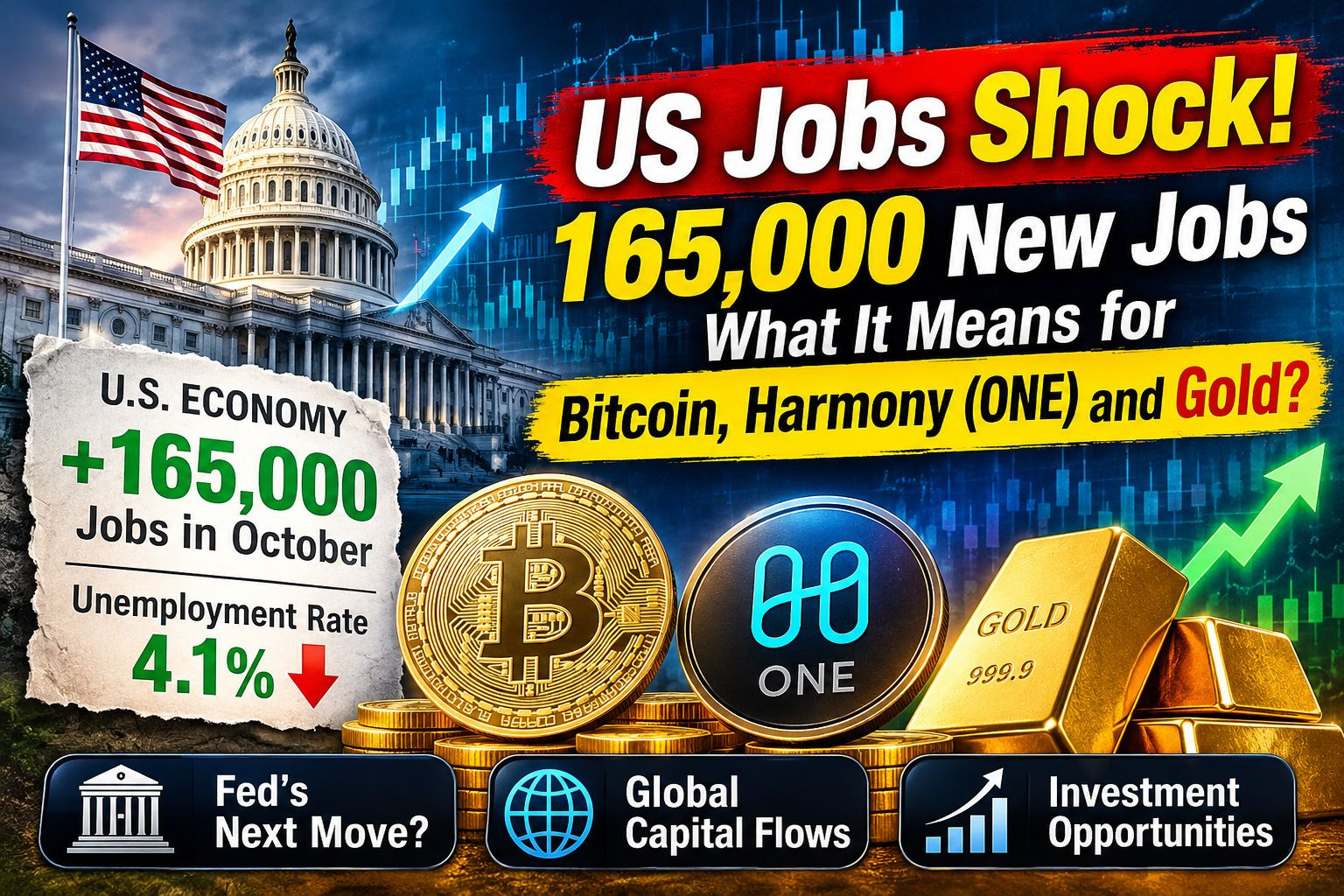

Wall Street expected 65,000 jobs. America delivered 165,000. But here's the bigger question: Could a stronger US economy become a hidden threat to Bitcoin, a challenge for gold, and an unexpected opportunity for selected altcoins?
The US economy added 165,000 nonfarm payroll jobs in October 2026, more than double economists' expectations of 65,000. At the same time, unemployment fell to 4.1%, below the 4.2% forecast.
Released on November 6, the report delivered a clear message: the American labour market remains stronger than many investors anticipated.
September's payroll growth was also revised upward from 29,000 to 60,000.
For financial markets, this changes the conversation around Federal Reserve policy, interest rates and global liquidity. The implications extend well beyond Wall Street, particularly for Bitcoin, gold and speculative digital assets.
1. The Fed's Monetary Policy Is More Than an Economic Decision
To understand the significance of this report, investors need to look at the dollar's position in the global financial system.
Since the collapse of the Bretton Woods fixed exchange-rate system in the early 1970s, the US dollar has maintained its central role in international trade, financial settlements and global reserves.
That gives the Federal Reserve enormous influence over international capital flows.
When US interest rates rise, dollar-denominated assets become more attractive. International investors may shift capital towards US Treasury securities, while emerging economies face higher borrowing costs and potential currency pressure.
The October employment figures strengthen the argument for keeping monetary policy restrictive.
A resilient labour market gives the Fed less urgency to cut rates, particularly if inflation remains above its target.
The political and economic incentives are clear: Washington wants to preserve confidence in the dollar and control inflation, while the Fed must balance price stability against employment.
For global investors, the consequence is straightforward: stronger US economic data can tighten financial conditions across the world.
2. Where Will Institutional Capital Move?
Institutional investors rarely react to a single headline in isolation. They compare expected returns, liquidity, volatility and the opportunity cost of holding different assets.
The latest jobs report creates three important market dynamics:
US Dollar: Expectations of higher interest rates can attract international capital towards dollar-denominated investments.
US Treasuries: Higher yields make government bonds more competitive against assets that generate no regular income.
Crypto Market: Tighter liquidity can reduce speculative demand, increase volatility and put leveraged positions under pressure.
However, capital rotation does not mean investors will abandon crypto permanently.
If inflation begins to cool while employment remains healthy, the Fed could eventually have room to ease monetary policy without triggering serious economic weakness.
That would create a different environment for risk assets.
The direction of institutional ETF flows, Treasury yields and the dollar will therefore matter more than the employment headline alone.
3. Bitcoin (BTC): Institutional Demand Meets Monetary Pressure
Bitcoin is no longer driven exclusively by retail speculation.
Spot ETFs, institutional custody, derivatives and professional portfolio allocation have connected BTC more closely to traditional financial markets.
This makes Federal Reserve policy increasingly important.
A stronger US labour market can support economic confidence, but if it delays interest-rate cuts, it may also limit the liquidity available for speculative investments.
Bullish scenario:
If inflation moderates despite strong employment, the Fed could eventually move towards monetary easing. Lower real yields and improved dollar liquidity could support Bitcoin.
A recovery in spot demand and sustained ETF inflows would strengthen the bullish case.
Bearish scenario:
If employment and wage growth remain strong while inflation stays elevated, the Fed may maintain restrictive conditions for longer.
That could pressure BTC through weaker risk appetite, persistent ETF outflows and leveraged liquidations.
The important signal is not simply whether Bitcoin rises or falls after the jobs report.
Investors should watch whether institutional buyers return and whether spot demand can sustain a recovery.
4. Harmony (ONE): A High-Risk Opportunity Behind a Changing Ecosystem
Harmony (ONE) offers a different investment proposition.
Bitcoin's market direction is heavily influenced by global liquidity and institutional demand. ONE, on the other hand, carries additional risks related to its own ecosystem and development strategy.
Harmony's transition from its original Layer-1 network towards an Ethereum-based ERC-20 token is particularly important.
The project has also outlined a new direction involving its AI-video initiative, the Remix Economy.
This creates a potential new investment narrative, but investors should distinguish between a promising announcement and measurable adoption.
Bullish case:
A successful transition, stronger Ethereum-based integration and genuine ecosystem activity could improve ONE's long-term market positioning.
If crypto liquidity improves, speculative capital could also return to smaller-cap assets.
Bearish case:
Network transition risks, previous security concerns, limited adoption and uncertainty surrounding the new business model remain important challenges.
A broader crypto rally cannot automatically solve these problems.
For investors, ONE is better viewed as a high-risk speculative position rather than a direct beneficiary of stronger US employment.
Real ecosystem activity, liquidity and sustainable demand should determine whether its investment thesis improves.
5. Gold (XAU): Higher Interest Rates Versus Geopolitical Uncertainty
Gold is facing two competing forces.
On one side, stronger US employment supports the argument for higher interest rates for longer.
Higher Treasury real yields increase the opportunity cost of holding gold because the metal does not generate interest. A stronger dollar can also create additional pressure on international gold demand.
But the longer-term picture is different.
Central banks continue to view gold as a strategic reserve asset. Concerns about sanctions, currency concentration and geopolitical fragmentation provide reasons to diversify reserves beyond traditional financial instruments.
This is where geopolitics becomes particularly important.
Gold's strategic value is not determined exclusively by Federal Reserve policy. It also reflects how governments assess financial security, reserve diversification and exposure to geopolitical risks.
Short-term bearish factors:
Higher US Treasury real yields.
Stronger dollar.
Reduced expectations of immediate monetary easing.
Long-term supportive factors:
Central-bank reserve diversification.
Geopolitical tensions.
Concerns about sovereign and currency concentration risks.
A short-term correction in XAU does not necessarily invalidate its longer-term investment case.
6. The Geopolitical Capital-Flow Map
One US employment report can influence portfolios thousands of kilometres away through a chain of financial decisions.
The transmission mechanism:
US employment exceeds expectations (165K vs 65K).
↓
Markets reassess the Federal Reserve's interest-rate outlook.
↓
Expectations of higher-for-longer rates strengthen.
↓
The dollar and Treasury yields gain support.
↓
Global borrowing costs and the opportunity cost of capital increase.
↓
Institutional investors reassess their risk exposure.
↓
Potential portfolio impact:
$BTC : Liquidity pressure in the short term, with recovery potential if institutional demand returns.
$ONE : Greater volatility and funding sensitivity, alongside project-specific execution risks.
$XAU : Near-term pressure from higher real yields, balanced against longer-term geopolitical and reserve-diversification demand.
This is how a domestic US economic release can influence investment decisions in Asia, Europe and emerging markets.
7. The Contrarian View: Could Strong Employment Actually Be Bullish?
There is another reasonable interpretation.
A stronger labour market supports consumer spending, corporate revenues and economic growth. It can also reduce recession fears and improve confidence across financial markets.
That is a legitimate bullish argument for the broader economy.
However, it does not automatically translate into bullish conditions for Bitcoin or gold.
The problem is the potential monetary-policy response.
If strong employment keeps inflationary pressure elevated, the Fed may have less room to cut interest rates. Higher borrowing costs can weigh on risk assets even while the broader economy performs well.
This distinction matters.
Economic strength and financial-market liquidity are not always moving in the same direction.
Investors who understand that difference may be better positioned to manage the next phase of market volatility.
What Should Investors Watch Next?
BTC, ONE and XAU represent three different investment exposures.
Bitcoin offers exposure to digital scarcity and institutional crypto adoption.
Harmony represents a speculative opportunity tied to ecosystem restructuring and future execution.
Gold remains a strategic asset for investors concerned about monetary uncertainty and geopolitical fragmentation.
The next important signals will be US inflation data, Treasury real yields, Federal Reserve communication, dollar strength and institutional capital flows.
The central question is whether the US economy can remain strong without forcing the Fed to maintain restrictive monetary conditions for much longer.
What is your strategy in this changing market? Would you prefer Bitcoin (BTC), take a calculated risk on Harmony (ONE), or increase exposure to Gold (XAU) as geopolitical uncertainty grows? Share your analysis in the comments.
Disclaimer: This article is for educational and informational purposes only, not financial advice. Crypto and commodity markets involve significant risks. Always conduct your own research (DYOR), manage position sizes carefully and avoid excessive leverage.



#JobsReportRaisesHikeOdds #CryptoAnalysis #Geopolitics #Binance #cryptouniverseofficial