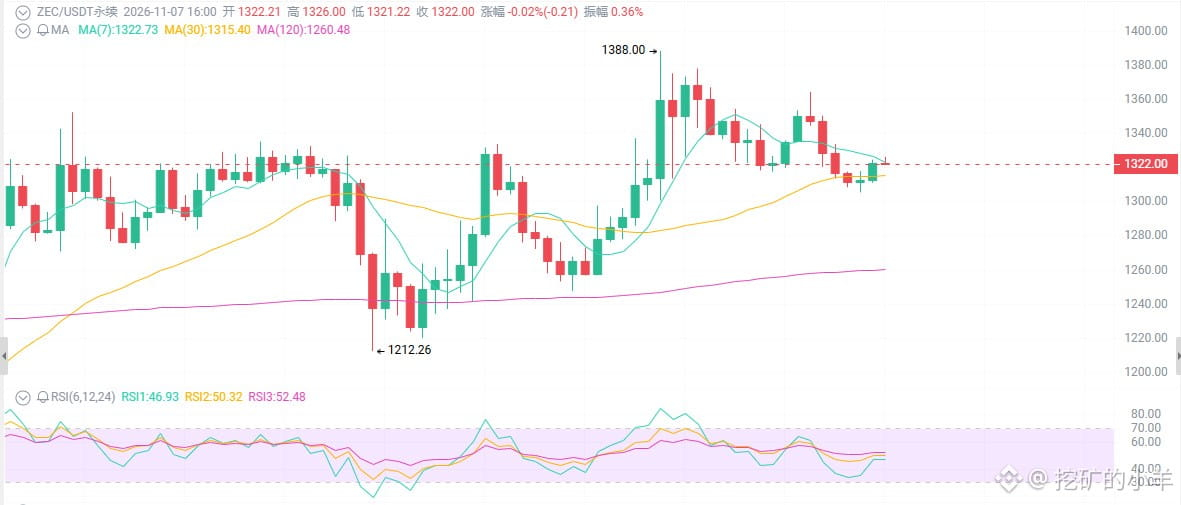
ZEC at $1,320—are you going to wait until it hits $2,000 before chasing it?
While everyone across the crypto world is watching AI coins and meme coins, ZEC quietly climbed from $1,200 to $1,380, carving out a rally of its own despite BTC’s choppy action. The NU7 upgrade just went live on mainnet, cutting block time from 75 seconds to 25 seconds and locking 60% of fees into the network reserve—and what happened? The price dropped as soon as the upgrade rolled out. Is this the final shakeout in a “buy the rumor, sell the news” move, or has the privacy narrative completely lost its shine?
First, the surface story: the upgrade went live, but the price pulled back.
It surged to $1,380–$1,390 from November 4 to 6, then dropped back to consolidate around $1,320. A lot of people are panicking: Is the good news already priced in? Is it time to get out?
The charts tell you the medium-term uptrend is still intact. $1,320 is just in the upper-middle part of the trading range, and strong support at $1,280–$1,300 is holding firm.
First thing: NU7 isn’t a minor upgrade—it’s ZEC’s most significant overhaul in a decade.
Block time has been cut from 75 seconds to 25 seconds, tripling confirmation speed.
Even more significant is the fee allocation: 60% goes into the network sustainability reserve, while miners get just 40%. At the same time, the old Sprout privacy pool has been frozen, permanently sealing off $16 million in old funds.
Are you still looking at it through the outdated lens of “privacy coins are just for the gray market”? The stricter the regulation, the more valuable genuinely usable privacy tools become.
Second thing: It ranks 10th by market cap, but hardly anyone around you actually owns it.
ZEC has a market cap of $21–22.5 billion, ranking 10th. Its circulating supply is about 17 million coins, with a hard cap of 21 million; the halving schedule remains unchanged.
DOGE has a market cap of $13.4 billion and ranks 10th. ZEC is even bigger. But when you scroll through X and chat groups, how many KOLs are talking about ZEC? Almost none.
After NU7, speed has improved. Whether real-world usage can catch up is the key metric to watch next. If usage takes off, ZEC’s story won’t be “an old coin making a comeback”—it’ll be “privacy infrastructure getting repriced.”
Third thing: the technicals tell you this is now a battleground between buyers and sellers.
Daily/4H: Rebounded from the $1,200 low, surged to $1,380–$1,390, then pulled back to consolidate. Short-term EMAs are in a bullish alignment, and the RSI is neutral (40–55), with no overbought signal.
Strong support: $1,280–$1,300 (recent retest zone) → $1,240–$1,260 → $1,200–$1,220 (ironclad floor)
Resistance: $1,350–$1,380 (dense cluster of recent highs) → $1,400+
Pattern: Post-upgrade flag consolidation. A breakout above $1,380–$1,400 and a sustained move above that range could open the way to $1,450–$1,500 or even higher. Only a decisive break below $1,280–$1,300 would warrant a reassessment.