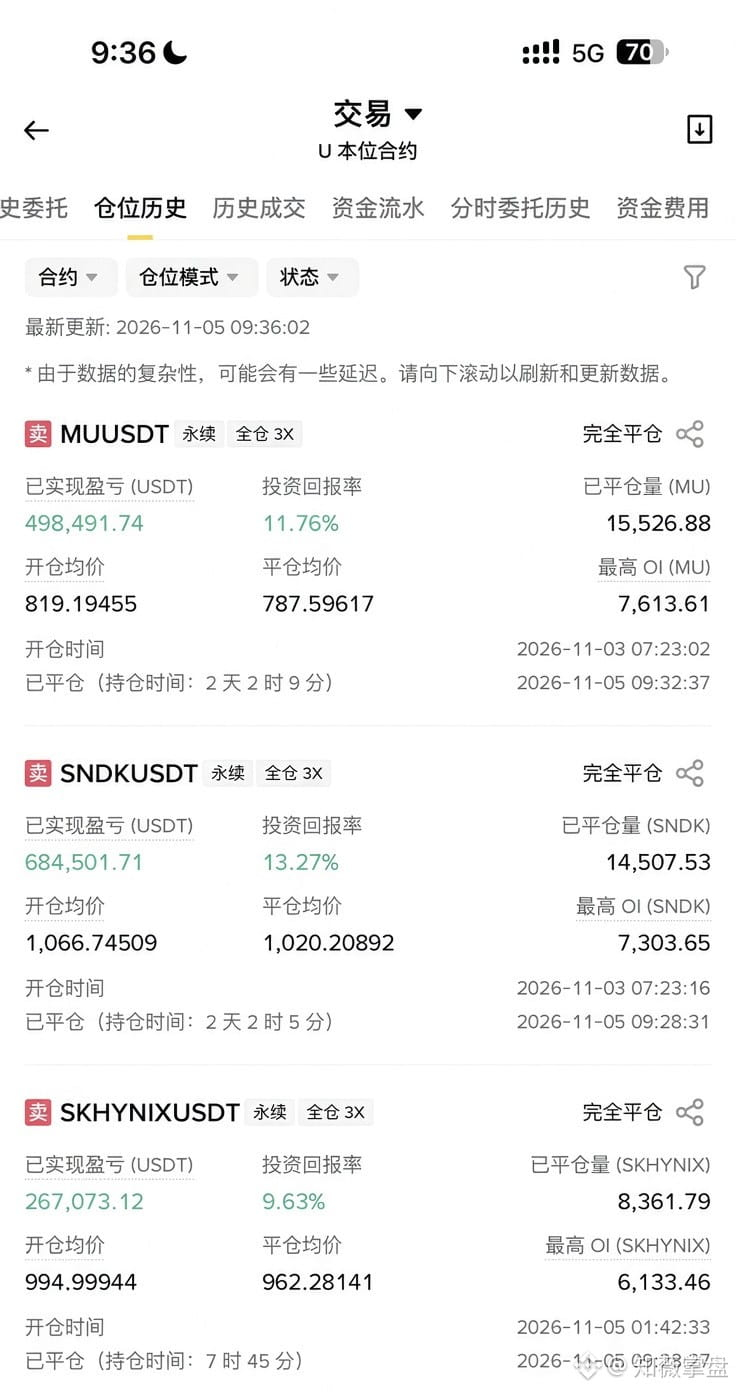
A few little-known facts about crypto that 99% of people don’t know—and they lose money without knowing why.
First, your average cost after adding to a position isn’t necessarily 7.5U.
For example, you buy 10,000U worth of a coin at 10U, then buy another 10,000U worth at 5U. Ignoring fees, your average cost is actually about 6.67U. That’s because you get different amounts of the coin in each purchase—don’t just average the prices.$SNDK
Second, earning 1% a day sounds easy, but doing it consistently is incredibly hard.
If you start with 100,000U and compound 1% every day for 250 trading days, the numbers suggest you could end up with about 1.2 million. But that assumes you make money every day, never have a drawdown, and pay no fees. Real-world trading doesn’t work that way.
Third, a high win rate doesn’t necessarily mean you’ll make more money.
A 60% win rate with take-profit and stop-loss levels both set at 10% isn’t enough information on its own. Position size, the risk-reward ratio, fees, and losing streaks all affect the final result. You can’t just say that 100 trades will earn you a fixed 300%.$MU
Fourth, higher leverage isn’t always better.
Leverage magnifies gains, but it also magnifies losses. Don’t treat 20x as the “just right” standard, and don’t assume 100x is merely for the bold; when the market moves against you, losses and liquidations can happen very quickly.
Ultimately, choosing coins and reading indicators are one thing, but managing position sizes and losses matters just as much.
Spot trading carries risks, and futures trading calls for even greater caution. Don’t just think about how much you could make—first consider how much you can afford to lose.
The hardest part of crypto has never been catching one big trade. It’s sticking to your rules when you’re close to giving up.$SKHYNIX
The market will always be there, but whether you can survive and slowly make your way back depends on discipline, not emotion.@知薇掌盘
#非农就业数据推升加息预期