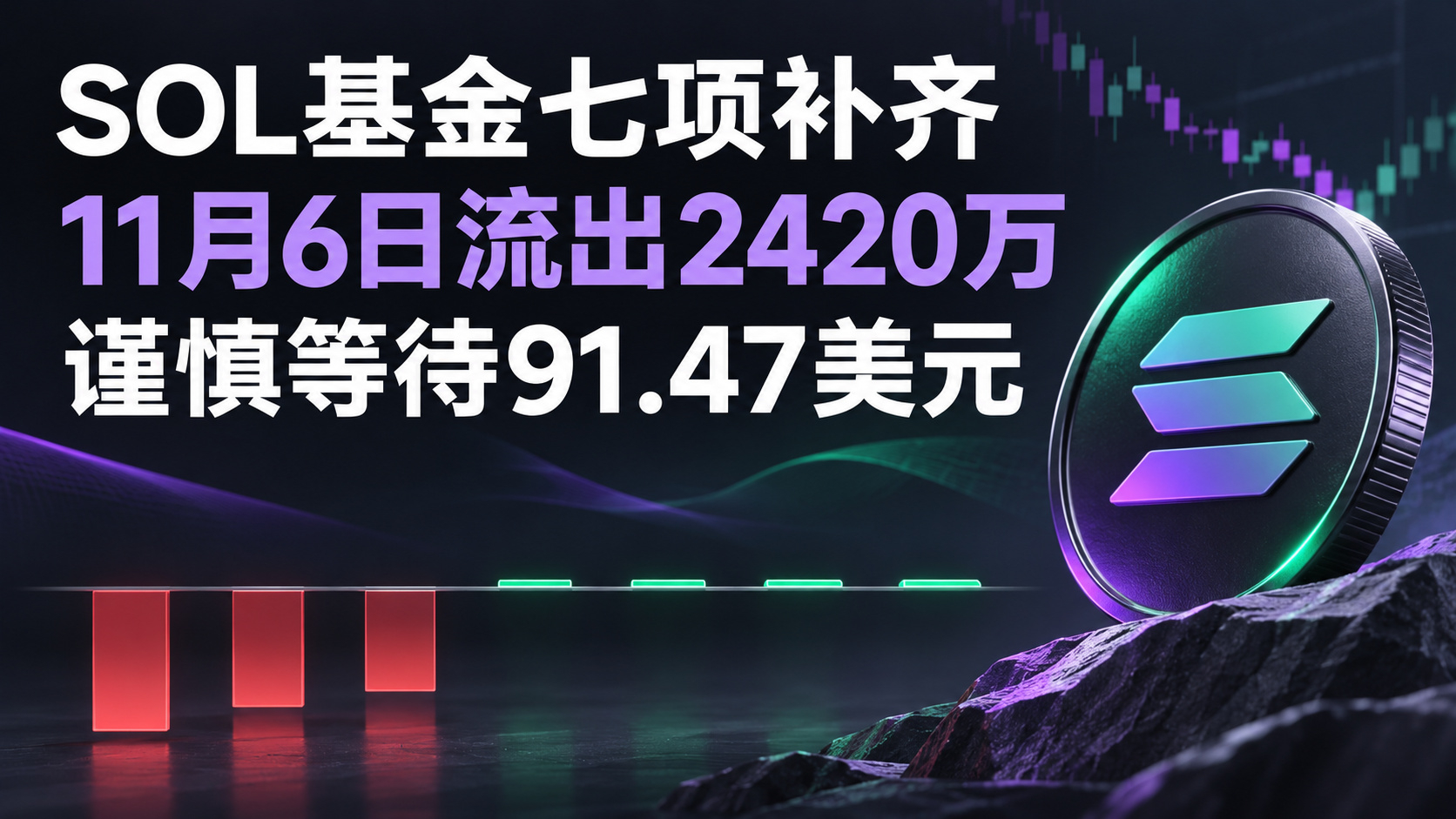
Seven SOL Funds Now Fully Reported | $24.2M Total Outflow on Nov. 6 | I’m Sticking to My $89 Discipline
My stance is cautious. I don’t treat the completed disclosure as a second, additional outflow. In Farside’s U.S. Solana fund flow table, the previously missing figure for VanEck VSOL on Nov. 6 is now listed as zero, so all seven funds now have figures for that day. BSOL saw a net outflow of $14.4 million, MSOL $4.4 million, and GSOL $5.4 million; the remaining funds—VSOL, FSOL, TSOL, and SOEZ—were at zero, for a total net outflow of $24.2 million. I previously wrote “the reported funds total -$24.2M; VSOL pending.” I can now clearly describe that same figure as the total for all seven funds in the table that day. It should not be counted again, and VSOL’s zero should not be interpreted to mean that the fund holds no SOL. VanEck’s website confirms that VSOL provides exposure to SOL and can stake some of its assets. Zero net subscriptions or redemptions in a single day simply means there was no net change in fund flows.
Why does this matter for the market? Funds offer traditional investors a way to gain exposure to SOL, and sustained net redemptions could weaken marginal demand. But the daily total is not equivalent to an immediate, same-sized sell-off on exchanges: subscriptions and redemptions, market making, asset settlement, and spot trading happen at different stages. The funds also differ in direction and size, so the outflow from the largest fund, BSOL, should not be generalized to mean all institutions are withdrawing. Nor should yesterday’s fund flows be attributed to the recent merge of Web3.js build-tool changes. Faster compilation is an engineering efficiency gain; fund flows reflect investor behavior. The two need to be verified independently.
The market is showing some pressure, but there is no confirmed breakdown. At the time of writing, SOL/USD was around $89.84 on Kraken, with today’s open at $90.02, an intraday low of $89.65, and a high of $90.55; the rolling 24-hour low was $88.82 and the high was $91.47. The price is slightly below the daily open and has been fluctuating around $90, but it has not broken below the 24-hour low. I see $90.55 as the first level that would confirm a rebound, and $91.47 as a stronger upper level. On the downside, I’m watching $89.65 first, then $88.82. If $88.82 is decisively broken, I can no longer dress up the decline as a “pullback.” If the fund data is revised later, I’ll recalculate using the revised version rather than defend an outdated narrative.
SOL funds are not directly represented among the Plaza’s current trending topics, so I’m only tagging the coin actually being discussed. Solana’s official status page currently shows no active network incidents, so this analysis centers on fund flows and price support, not rumors of a network outage. To overturn my cautious view, SOL would at minimum need to reclaim $90.55 with supporting volume, then challenge $91.47. A more reliable signal would be to see whether outflows stop growing on the next trading day. A single rebound does not automatically mean institutions are returning.
If I were trading this myself, I would sit out for now, with a 0% position and only a spot long as a possible setup. I would enter a test position only if two consecutive one-hour candles close above $91.47, the price holds above $91 on a retest, and volume improves. I would risk no more than 0.35% of my total capital and use no leverage. My first target would be $93, where I’d trim half; my second target would be $95, but I’d close the remaining position if momentum weakened. I’d place a hard stop at $89.80 after entry. If $88.82 breaks first, I’d cancel the plan outright. If the conditions aren’t met, there’s no trade; my review will record only verified price action and disclosures.
#SOL
This is solely my personal market observation and does not constitute investment advice.