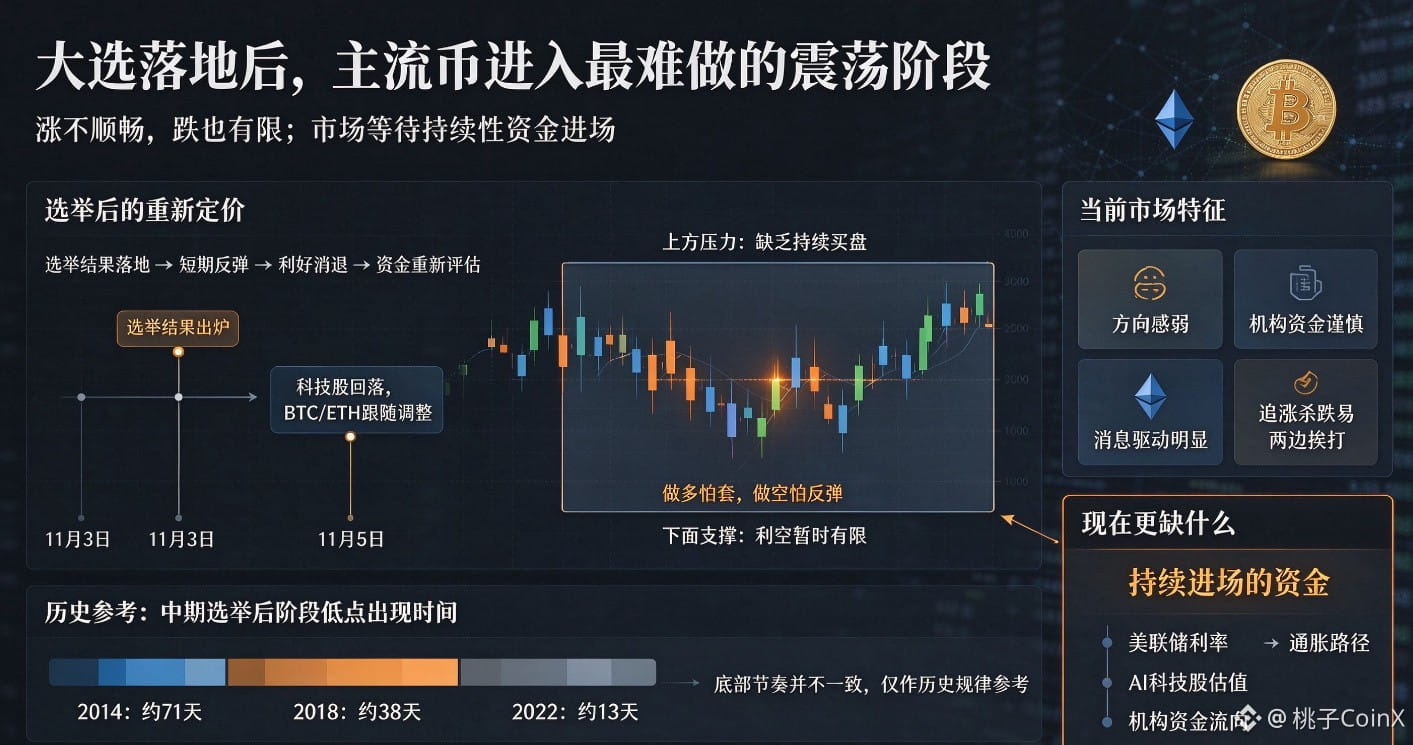
$BTC After the election results came in, major cryptocurrencies entered one of the toughest periods of sideways trading!
Lately, the most obvious feeling in the crypto market has been this: prices can't break higher, but they can't fall much further either. Going long risks getting trapped, while going short risks a rebound. The market is simply wearing traders down with one swing after another!
BTC, ETH, and other major cryptocurrencies lack sustained directional momentum, and institutional investors are becoming more cautious about entering the market. In the short term, the market is increasingly driven by economic data, policy news, and capital flows. One headline sends prices surging, and the next sends them tumbling. Chasing rallies and selling off in a panic can easily leave you taking hits on both sides.
A look at how markets have performed after past U.S. midterm elections reveals a noteworthy pattern: the end of an election doesn't mean a rally will start right away. Instead, it may usher in a period of repricing.
Historically, Bitcoin underwent notable corrections around the 2014, 2018, and 2022 U.S. midterm elections. However, the timing of the lows varied: they occurred approximately 71, 38, and 13 days after the elections, respectively. It's worth noting that U.S. stocks have generally performed relatively well over the medium to long term after midterm elections—but that doesn't mean markets rise immediately every time an election ends.
Now let's look at the 2026 midterm elections. After the results were announced on November 3, the market briefly rebounded, but the recovery didn't last. On November 5, U.S. tech stocks fell sharply, and Bitcoin and Ethereum followed suit, erasing almost all of the gains sparked by the election news the day before.
This goes to show that what the market lacks most right now isn't news—it's sustained inflows of capital!
The election results are in, and short-term political uncertainty has shifted, but questions surrounding Federal Reserve interest rates, inflation, AI tech stock valuations, and institutional capital flows remain unresolved. A couple of positive headlines alone are unlikely to sustain a prolonged rally in major cryptocurrencies.