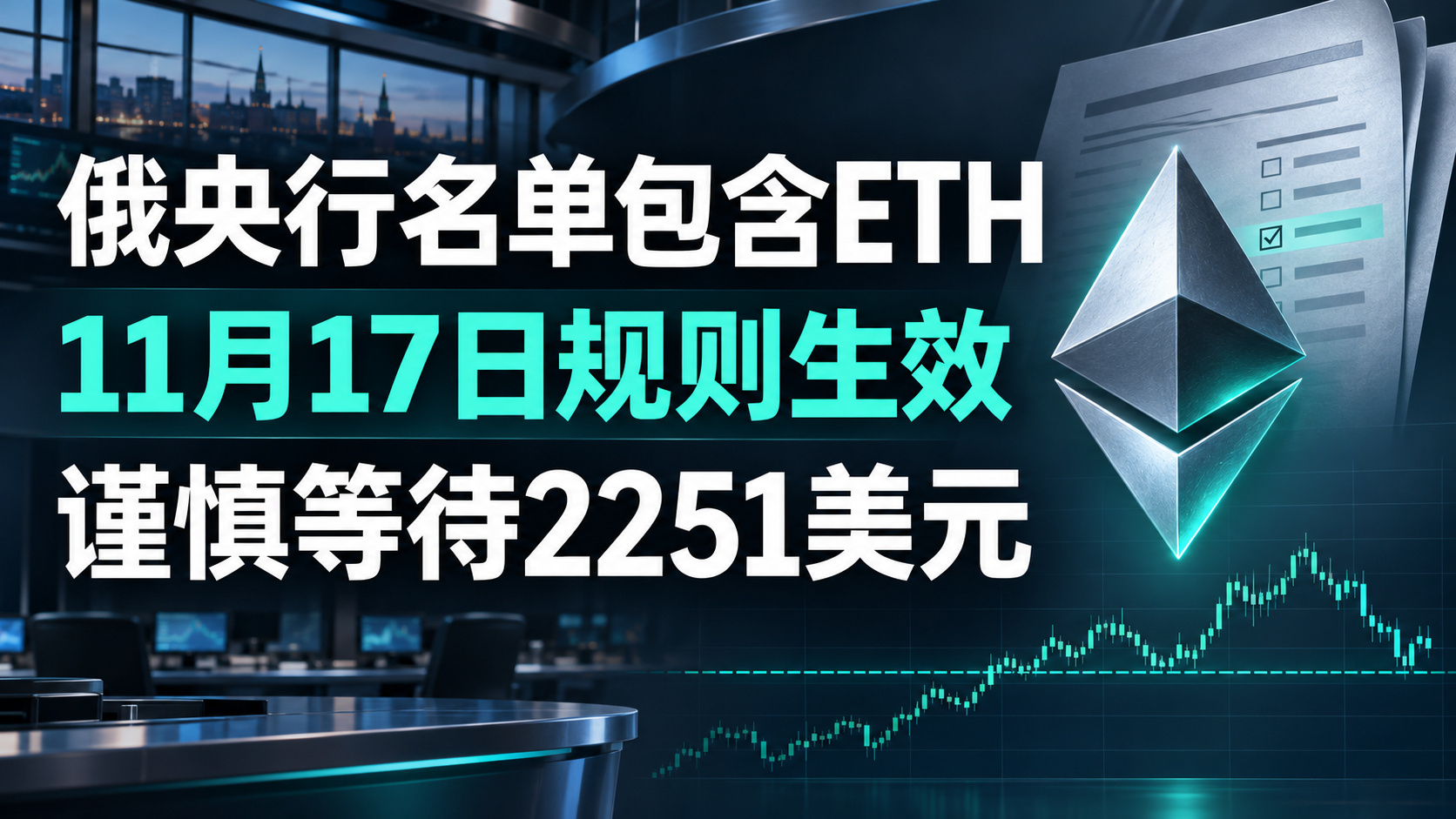
Russian Central Bank’s retail investor list includes ETH | Rules take effect November 17 | I’ll wait for $2,251 to hold
My stance is cautiously neutral. Binance Square’s trending topic “#RussianCentralBankListsBTCandOtherAssetsforNonqualifiedInvestors” directly concerns ETH, but many retellings mention only BTC, making it easy to overlook Ether’s specific legal status. In its November 6 announcement, the Bank of Russia said the list of assets that non-qualified investors may access under the new rules includes Bitcoin, Ethereum Ether, and USD Tether; the accompanying regulatory directive also lists ETH individually. The rules take effect on November 17. Investors must first pass a risk assessment, and non-qualified investors face an annual purchase limit of 300,000 rubles through a single intermediary. This is an access framework for specific investors and intermediaries in Russia—not global approval of ETH, and not an unrestricted buying opportunity that is already open today.
What matters to me is the mechanism, not the slogan that “being listed means an immediate price rise.” The rules give compliant intermediaries a clearly defined range of assets, potentially providing limited access to some local investors who previously could not participate. But that can translate into actual trading only if platforms enable access, clients complete the required assessment, and funds are available. The 300,000-ruble limit is an annual cap per intermediary; it should not simply be multiplied by the population to estimate potential buying. U.S. ETH fund flows are a separate market. Russian access should not be conflated with U.S. ETF subscriptions and redemptions as if they were the same institutional funds, nor should ETH’s inclusion on the list be taken to mean that new Ethereum Foundation technology has been deployed.
The current price does not give me strong confirmation. At the time of writing, Kraken ETH/USD is around $2,237.53, with today’s open at $2,235.40, an intraday low of $2,235.39, and a high of $2,247.36; the rolling 24-hour low is $2,201.26 and the high is $2,250.60. The price is only slightly above the daily open and still has room to reach the 24-hour high. In Farside’s November 6 ETH fund row, some figures for ETHA, ETHB, and other funds are still missing; the reported components currently add up to net outflows of $3.6 million, which should not be treated as the final market-wide total. That means future, limited access in Russia on one side and an incomplete U.S. fund-flow table on the other—neither is enough to prove there is sustained net buying right now.
I see $2,250.60 as the confirmation level above, with $2,247.36 the first level the price needs to clear intraday; below, I’m watching $2,235.39 first, then $2,201.26. If the price breaks above $2,251 and then falls back toward $2,235, that would suggest the news narrative has not translated into sustained support. If subsequent fund reports show larger outflows, I would also become less optimistic. Conversely, I would upgrade my assessment only if actual trading, price structure, and subsequent flow data all support one another. After the rules take effect, it will also be important to verify whether intermediaries have actually opened access to ETH; permission to offer it should not be mistaken for substantial trading already taking place.
If I were trading myself, I would stay out for now, with a 0% position, and keep only a spot long as a possible setup. I would enter a test position using no more than 0.4% of total capital, without leverage, only if two consecutive one-hour candles close above $2,250.60, a retest holds above $2,247, and volume improves. The first target is $2,280, where I would take half off; the second is $2,310, and I would close the remainder if momentum weakens. I would set a hard stop at $2,230; if the price first breaks below $2,235.39 and continues lower, I would cancel the plan outright. If the implementation details change or the price conditions no longer hold, I will reassess. I will never describe a plan whose conditions have not yet been met as a profitable trade.
#俄央行为非合格投资者列明BTC等 #ETH
This is solely my personal market observation and does not constitute investment advice.