$UNI: A Research Question: A Leaderboard Is Only the Starting Point: Without Rushing the Conclusion
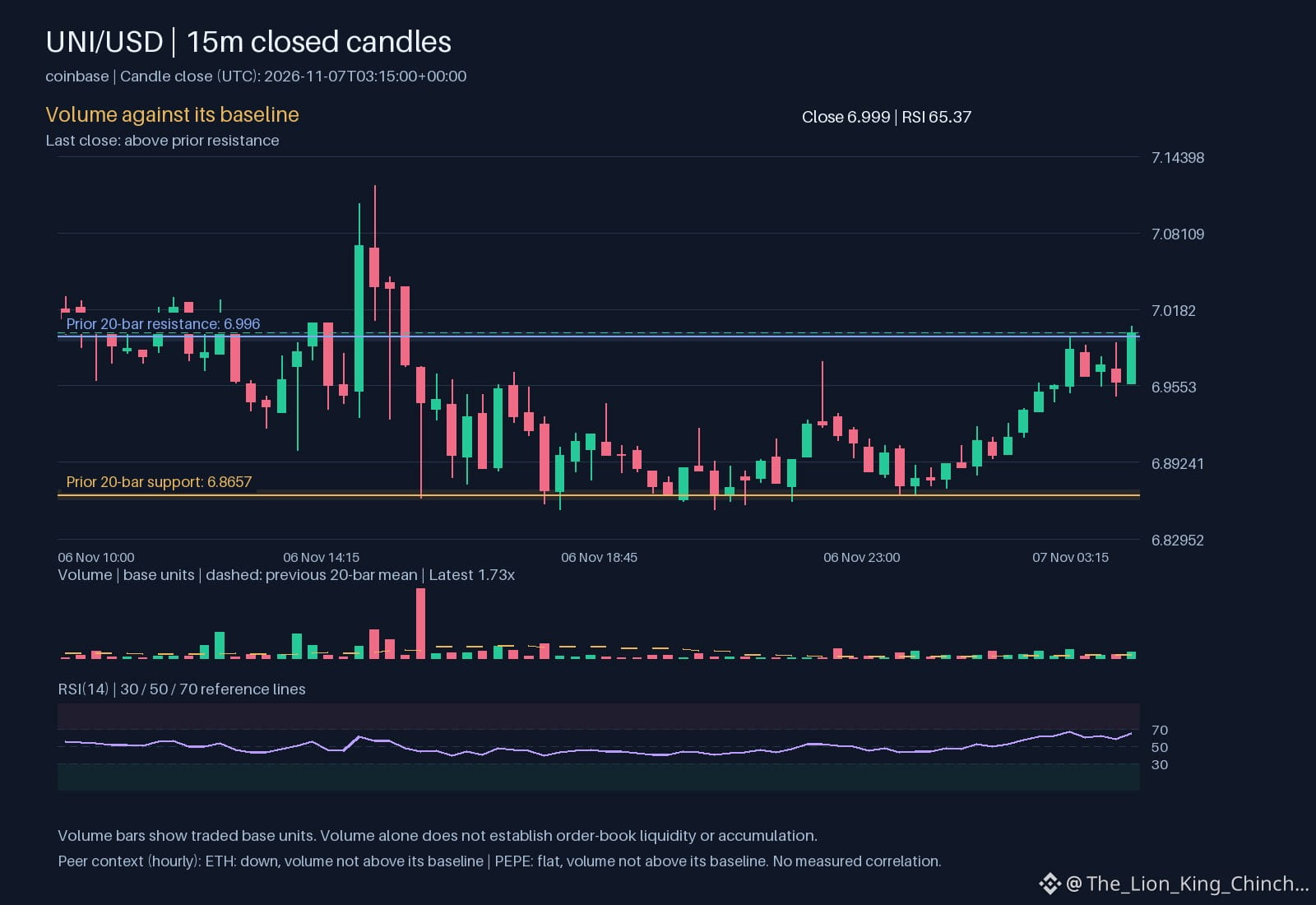
The current observation for $UNI shows price above resistance and moving up hourly. Volume is above baseline. This combination suggests a potential structural shift. However, we must distinguish this local move from the broader market context. The primary question is whether this move holds or fades.
Peer observations provide necessary context. $ETH is moving down hourly. Its volume is not above baseline. $PEPE is flat. Its volume is not above baseline. A shared direction is not measured correlation. It is not proof of capital rotation or a common cause. These are separate assets with different structures.
We can use 65.3657 to check momentum. We can use 6.93663 as a dynamic support line. If price holds above 6.93663 after the move, the structure remains intact. If it falls back below 6.93663 and closes below 6.996, the initial move may have failed. This is a concrete way to reassess the interpretation.
This comparison has limits. It does not explain why $UNI moved differently than the peers. It does not establish a causal link. It only shows current state. The risk is assuming that one venue's hourly move predicts another's. That is a false inference. We should focus on how the move holds relative to $UNI 's own structure. Direction matters, but persistence matters more. Do not chase the first impulse. Wait for confirmation via price action and volume persistence. This approach avoids the trap of pattern matching without substance.
Probabilistic market research, not a recommendation or guaranteed return.
The comparison to keep in mind: $ETH has hourly direction down and volume not above its baseline; $PEPE has hourly direction flat and volume not above its baseline. This alone does not establish correlation.
Which matters more in this comparison: direction or how the move holds?
#UNI #ETH #PEPE