


The upward trend that began at the start of the year is becoming firmly established. Oil transactions are driving the strongest figures in more than a decade.
Trade between Venezuela and the United States grew 739% in the third quarter of the year compared with the same period in 2025, reaching a total of $6.802 billion, according to data from the U.S. Department of Commerce.
The amount is the highest for a third quarter since 2014, driven by recovering oil sales following the easing of sanctions in January of this year, amid high crude oil prices due to the conflict in the Middle East, as well as increased momentum in Venezuela’s food purchases.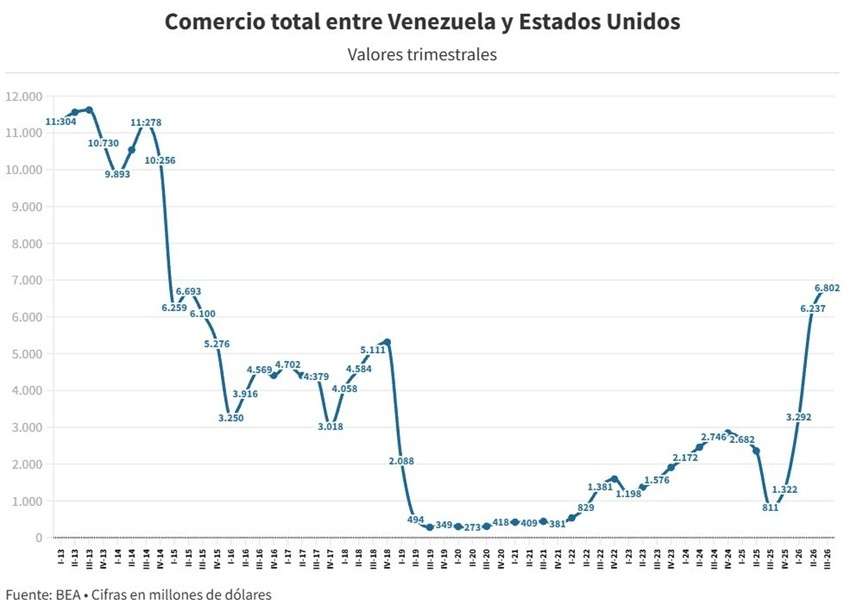
Over the period, total trade between the two countries comprised $5.101 billion in exports (the highest since 2014), up 1,775% from last year, and $1.701 billion in imports (the highest amount since 2015), a 216% increase over the period.
Trade expansion between the two countries accelerated between July and September, driven by new economic and political ties. These have mainly involved a broad easing of the sanctions imposed by Donald Trump, as well as agreements between various companies and the government of interim president Delcy Rodríguez, who succeeded Nicolás Maduro after his capture by the United States in January.
Oil consolidates its leading position
Crude oil exports topped the list of Venezuelan sales to the United States in the third quarter, at $4.461 billion (up 2,121.5% from the same period in 2025), while petroleum products contributed $480 million (there were none during that period last year). Unwrought aluminum also reappeared, worth $47.37 million.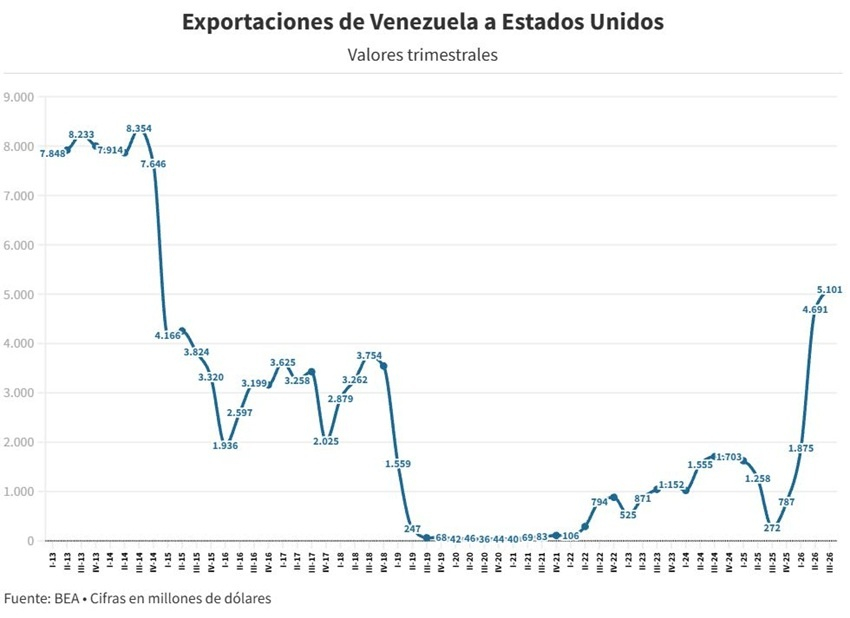
Another product that stood out in the quarter was methanol, which totaled $18.27 million, up 81.6% from the same period in 2025. Nitrogenous fertilizers also stood out, bringing in $13.42 million after being absent from trade last year.
Among nontraditional exports, cocoa beans continued their upward trend, totaling $10.36 million between July and September, an increase of 296.1% from the $2.61 million recorded in the same period last year. Coffee sales also rebounded, reaching $3.02 million in the third quarter, up 55.6%.
One of the biggest increases came from precious-metal waste and scrap for recycling, which brought in $3.31 million during the quarter, up 9,283.9% from the same period in 2025.
Imports of diluents and machinery
The breakdown of third-quarter imports also shows the consolidation of the new oil relationship between Venezuela and the United States. Purchases of diluents totaled $909.34 million, up 6,696.9% from the same period in 2025.
On the other hand, the quarter saw a strong flow of machinery, likely reflecting both oil-sector activity and the recovery work following the double earthquake that struck the country in June, causing thousands of deaths and extensive infrastructure destruction.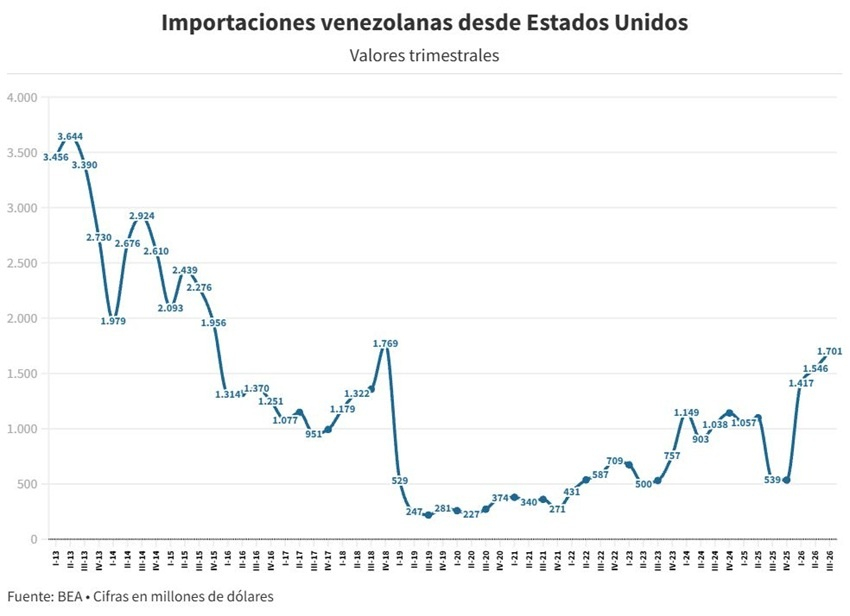
Purchases of mechanical machinery reached $126.78 million between July and September, up 141.2% from the same period in 2025. Meanwhile, purchases of vehicles and transport equipment totaled $88.87 million, an increase of 63.6%.
Telecommunications electrical equipment imports, meanwhile, reached $179.02 million, an increase of 167.3% from the third quarter of 2025.
Among food products, corn led the list, rising 65.1% in the third quarter, from $57.2 million between July and September 2025 to $94.45 million over the same period this year. Wheat and rice moved in the opposite direction, plunging 97.7% and 97.2%, respectively.
The picture for the first nine months of the year
Commerce Department data also show that trade between Venezuela and the United States grew 210% in the first nine months of the year compared with the same period in 2025, totaling $16.33 billion—the highest amount for that period since 2015.
The total comprised $11.666 billion in exports, up 315% from last year, and $4.664 billion in imports, an increase of 89% over the period.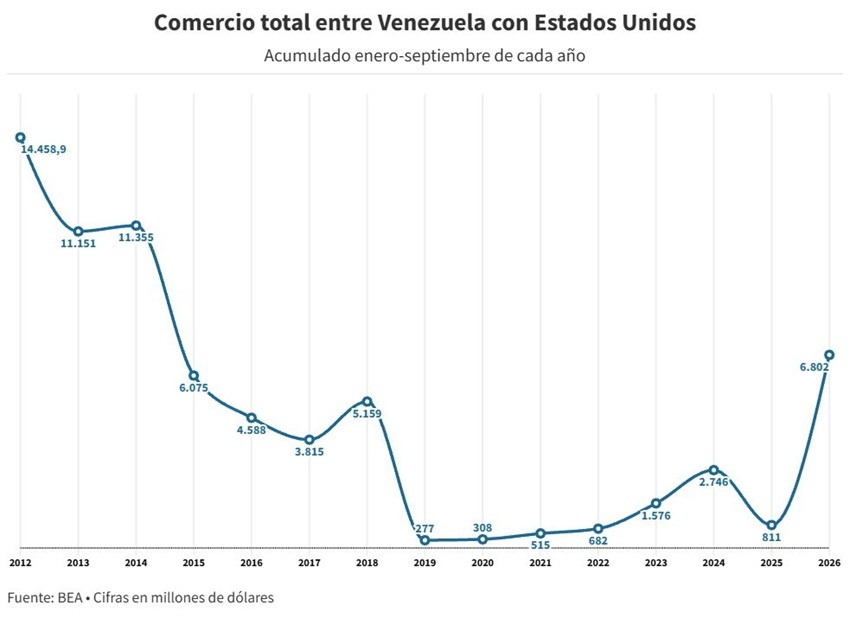
Oil (crude and refined products) accounted for 97% of Venezuelan exports to the United States in the first nine months, totaling $11.288 billion. This was a 368% jump from the same period in 2025.
Alongside a notable increase in shipment volumes, Venezuela benefited from rising crude prices, which surged in late February due to the conflict in Iran. The conflict has also led to the closure of the Strait of Hormuz, the region’s main trade route.
A reference estimate based on Commerce Department data indicates that the price per barrel exported to the United States rose from $69 between January and September 2025 to $81 over the same period in 2026, an increase of 17%.
However, the country’s use of this revenue is restricted: the United States has stipulated that it must be deposited in an account in that country before being authorized for use by the administration of interim president Delcy Rodríguez. It is not known how this mechanism works or how much money has actually reached Venezuelan coffers.
The energy basket also saw the return of some products, including liquefied petroleum gas, with shipments worth $28.81 million. The country had not sold this hydrocarbon to the United States since 2012.
By contrast, sales of petroleum coke contracted by 44.6%, falling from $166.82 million in the first nine months of last year to $92.48 million in the same period of 2026.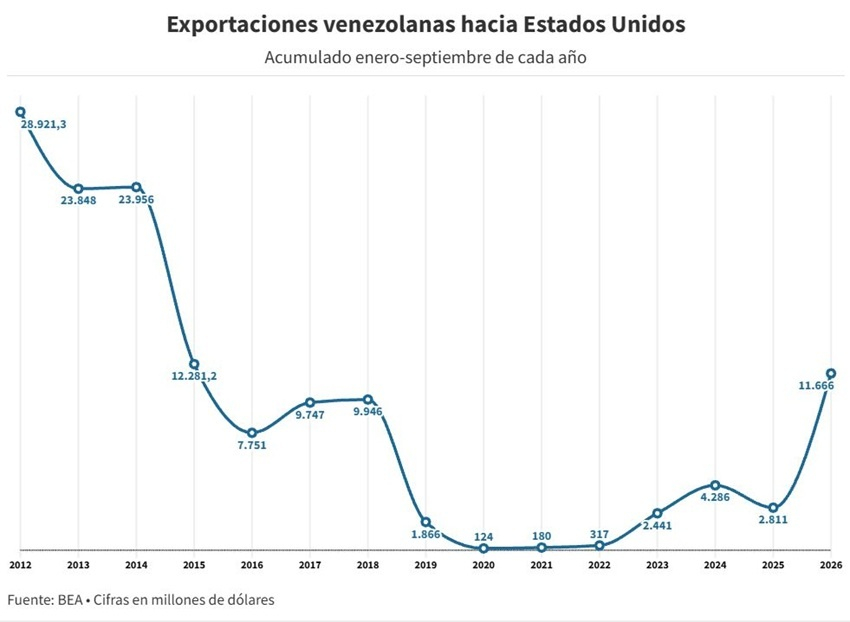
The rest of Venezuela’s exports to U.S. customers consisted mainly of methanol, worth $52 million (up 76%); coffee, which brought in $28.1 million (22% more than in the first nine months of last year); cocoa, totaling $21.9 million (up 15%); unwrought gold, which brought in $8.1 million (its highest amount for the period since 2019); and nitrogenous fertilizers, worth $13.42 million (up from zero in 2025), marking their first shipments since 2018.
The Commerce Department data also show strong growth in exports of unwrought aluminum to the United States, which totaled $47.37 million—a major rebound, given that exports had been halted since 2018.
Likewise, precious-metal waste and scrap for recycling jumped from $90,000 last year to $11.37 million this year (their highest amount for the period since 2017).
On the other hand, one striking case among non-oil sales is the dramatic reversal suffered by the traditional fishing sector. Exports of prepared crab fell to $985,470 between January and September this year, after reaching $41.27 million during the same period in 2025.
Similarly, fresh fish, which had brought in $16.66 million, fell to zero in 2026, while sales of frozen fish and fish fillets also nearly disappeared from the trade balance.
Sharp increase in purchases of diluents and food
As for imports from the United States, they too reflected the reshaping of the oil relationship, as Venezuela began buying larger quantities of key diluents for domestic refining.
As a result, spending on these products reached $2,527.5 million in the first nine months, up 165% from the same period in 2025 and accounting for 54% of total imports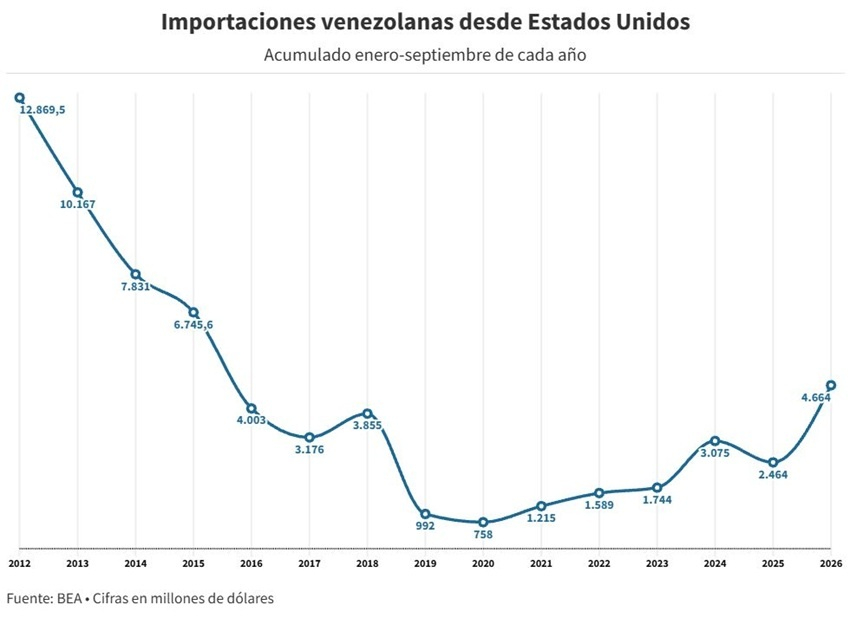
On the other hand, purchases of food and agricultural products rose sharply, increasing 35% from the first nine months of last year to total $673.3 million. The leading product in this category was corn, totaling $398.5 million, a jump of 409% and its highest level since at least 2009, the earliest year covered by U.S. Commerce Department statistics.
Other food products, by contrast, declined, including wheat, whose import bill fell from $115.6 million to $90.6 million (down 22%).
Rice followed a similar path, with imports plunging 97% to total $553,400, their lowest level for the first nine months of a year since 2022. Soybean oil purchases also fell, from $132.76 million to just $63.22 million in 2026 (down 52%).
Outside the oil and agricultural sectors, the leading import category was cellphones and other communications equipment, whose import bill soared to $250.45 million, an 83% increase from $136.86 million in 2025. This is the highest figure in the category since 2013, when it reached $377 million over the same period.
The expansion also included vehicles and auto parts, with total imports of $173.5 million, up 41% from the same period in 2025. Within this category, demand for freight vehicles stood out: purchases rose from just $464,700 in the first nine months of 2025 to $18.11 million over the same period in 2026 (the highest level since 2012).
Trade surplus strengthens
Venezuela has historically run a trade surplus with the United States, recording deficits only in 2020, 2021 and 2022. The balance reversed starting in 2023 and has continued to improve, with the first nine months of 2026 marking the strongest result since 2018.
The figures show that the surplus between January and September this year stood at $7,002.3 million, a 1,918% increase from the $347 million recorded in the same period of 2025.
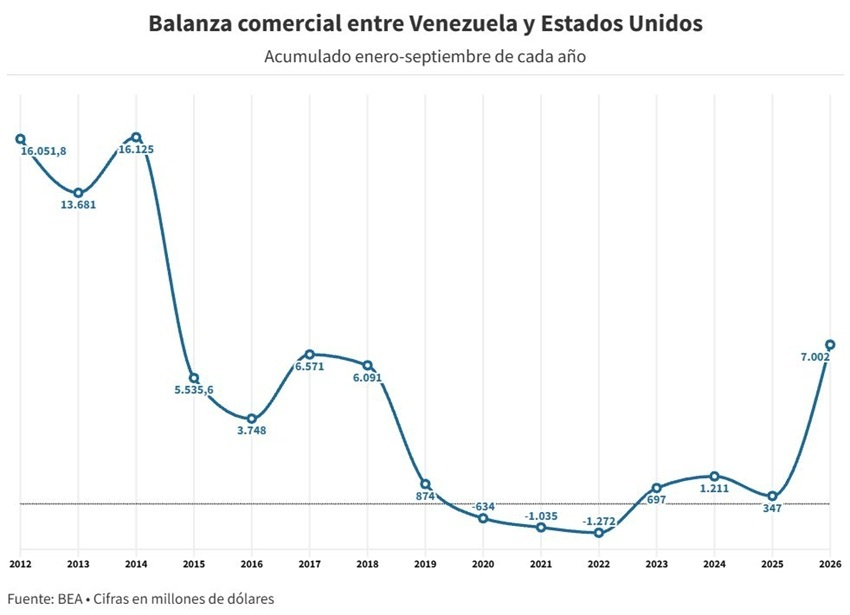
This trend is driven by a sharp rise in oil exports, compared with much more moderate growth in domestic imports. Nevertheless, it remains well below the all-time high of $12,869.53 million recorded in 2012 (cumulative total for January to September).