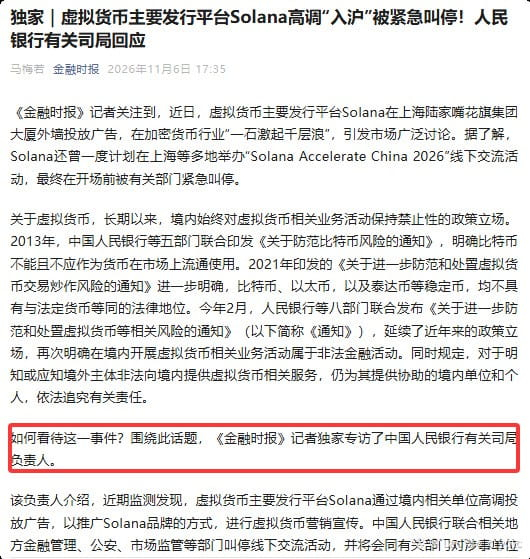
🚨 Solana named by the People’s Bank of China-affiliated Financial News—overinterpreted by the crypto community!
On November 6, Financial News, which is affiliated with the People’s Bank of China, published a report saying that recent monitoring had found Solana ( $SOL ) placing high-profile ads through relevant domestic entities to promote its brand and market virtual currencies. The central bank, together with local financial regulators, public security authorities, market regulators, and other departments, halted offline events and will investigate the entities and individuals involved.
The news quickly gained traction in the crypto community, with many interpreting it as “Chinese government agencies officially launching an investigation into Solana.”
The report also cited a relevant official as saying:
SOL, issued by Solana, is essentially a virtual currency. Solana also provides technical services for the issuance and trading of major virtual currencies such as USDT. These activities are all illegal financial activities explicitly identified in the Notice, and promoting them violates the regulations. Going forward, efforts to crack down on related activities will continue, focusing on domestic virtual currency traders and domestic affiliates of overseas platforms.
📌LaoYao ( #币圈心学 ) thinks this is clearly an overinterpretation.
1. The information is limited and the source is vague.
The article is only a few hundred words long, with large sections cobbled together from previously published online material. The statement attributed to $ comes from “a relevant bureau official”—a “no specifics” source, with no specific department, title, or individual!
In financial media, this kind of article is patchwork filler.
2. A search of articles by Ma Meiruo, who wrote the piece, turned up no in-depth reporting. She is probably not a veteran journalist who writes in-depth internal reports.
Of course, it cannot be ruled out that mainland regulators may investigate Solana rigorously. But judging from this article alone, the interpretations circulating across various crypto platforms seem to be a case of rumor being repeated as fact.
The cancellation of Solana’s planned “Solana Accelerate China 2026” roadshow, scheduled for October 16–22 in Shanghai, Hangzhou, Shenzhen, and Beijing, does not necessarily reflect the position of the central bank or mainland decision-makers. It may instead be the result of implementers thinking, “Better to stop something that might be permissible than do something wrong and be held responsible.”
Mainland China strictly controls crypto speculation, but it has never issued a document restricting the development of blockchain. If policy on the development of the blockchain industry were really being adjusted, that would not be a decision that could be made by a bureau-level official at the central bank.