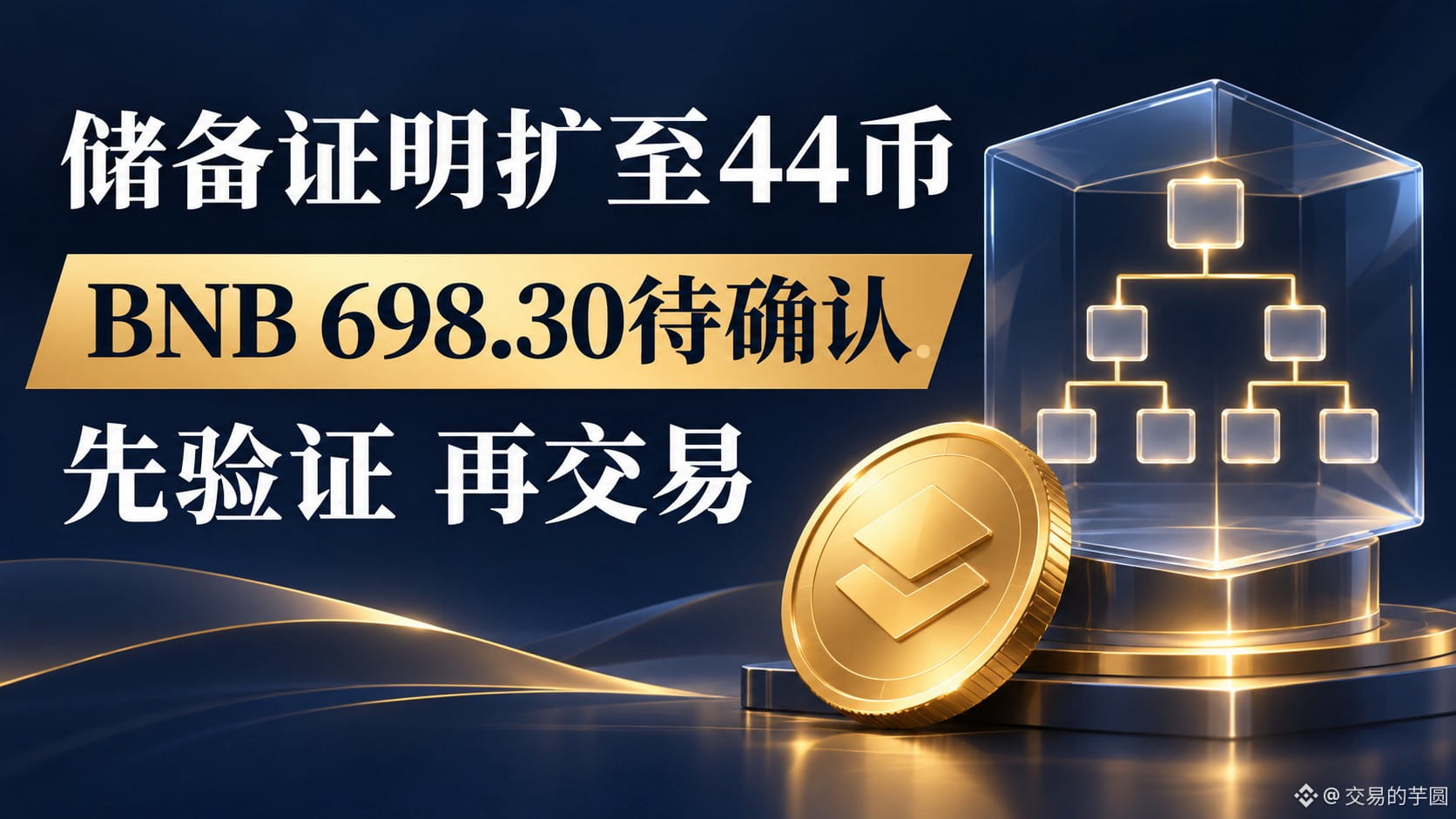
BNB search interest rises | Binance Proof of Reserves expands to 44 assets | I verify first, then discuss risk recovery
My stance is to watch cautiously, not to buy just because something is trending. Among the most-searched topics on Binance Square over the past six hours, BNB is marked “Trending up,” while the hot topic is still #Binance to restore withdrawals for more assets. Rather than repeat that “withdrawals are gradually being restored,” I’m more interested in what users can actually verify: Binance’s November 4 restoration announcement said the new Proof of Reserves snapshot covers 44 tokens, up from 10 previously, and was taken at 00:00 UTC on November 4. The company also said that around 98% of affected assets had been replenished, while procurement of the remaining low-liquidity tokens continues. These are platform-reported updates on the restoration process; they do not mean that every network and asset can be freely withdrawn right now.
The Proof of Reserves page offers a more concrete verification process: after logging in, select the snapshot date from the verification option in your wallet to obtain your record ID and Merkle leaf, then check whether your account balance is included in the total liabilities for that period. The platform also provides information on address ownership, balance snapshots, and zero-knowledge proofs. Expanding the range of covered tokens brings assets held by more accounts within the verifiable scope, but a snapshot reflects only one point in time. It cannot replace checking the status of each subsequent withdrawal, an independent security review, or prove that procurement of the remaining roughly 2% is complete. For BNB holders, whether the BNB in their account is included in the snapshot and whether the withdrawal button is available on the BSC network they use are two checks more relevant to risk than any slogan.
Why does this matter to the market? An exchange risk event first affects whether funds can be moved out, market-maker quotes, and user confidence, then transmits to token prices through liquidity. BNB is both an on-chain fee asset and a platform ecosystem asset, making the correlation stronger. But “increased reserve coverage” is not evidence that the platform is directly buying BNB. If restoration continues and users can independently verify it, tail risk may ease. If new suspensions occur, verification results do not match, or later reports overturn the current claims, the risk premium should be raised again. Major conclusions should wait for a formal postmortem and an independent review.
As for price, at the time of writing, BNB/USD was around $693.91 on Kraken, with an opening price of $688.89 and a 24-hour low and high of $683 and $698.30. It remains between the high and low; rising interest has not yet turned into a confirmed breakout. Quotes may vary slightly across exchanges. $698.30 is the immediate confirmation level, while $688.89 is the daily reference open. A break below $683 that cannot be reclaimed would invalidate the short-term bullish view.
If I were trading this myself, I would stay out for now. My only planned direction would be a leveraged-free spot long, with a position size of 0%. I would only test the waters with at most 0.5% of total capital if I confirmed that withdrawals were available on the network I use and the price moved above $698.30 and held on a retest; otherwise, I would keep waiting. The first target is $710, where I would sell half the position, with a target of $720 for the remainder. After entry, I would stop out if the price fell back below $688.89. If new withdrawal restrictions appear, reserve verification produces anomalies, or the price fails to hold the breakout level within two days, I would close the entire remaining position. Verification comes before chasing momentum.
Sources: Binance’s seventh restoration announcement update, Binance Proof of Reserves information, Binance Square trending topics and search pages; price is a Kraken snapshot taken at the time of writing. #币安将恢复更多资产提现 #BNB
This is only my personal market observation and does not constitute investment advice.