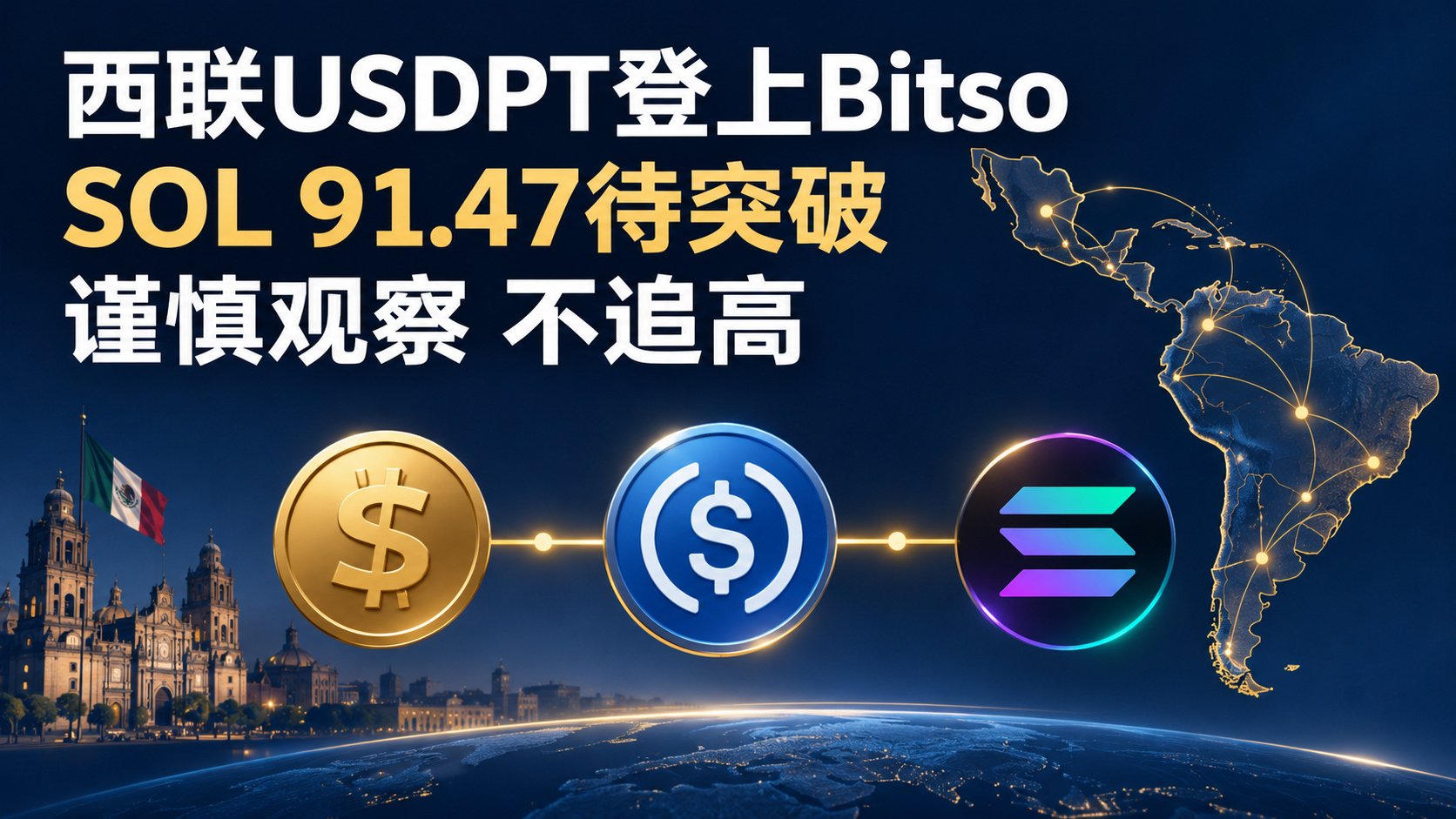
The SOL payments narrative gains a new Mexican on-ramp | USDPT is now available for peso conversions on Bitso | I’m still waiting for confirmation from increased volume
I’m cautiously bullish, but I’m not chasing the price right now. The Solana Foundation’s October ecosystem roundup, published on November 6, noted that Western Union’s USD stablecoin, USDPT, has launched on Mexico’s Bitso, where eligible retail customers can buy and sell it using Mexican pesos. Bitso’s USDPT price page now shows MXN quotes and a buy option, and its help center lists Solana as the network for USDPT deposits and withdrawals. Issuer Anchorage Digital has also confirmed that USDPT is built on Solana. What we can confirm here is that an on-ramp between fiat currency and a stablecoin is now available. That does not mean all Western Union remittances in Mexico are now being processed on-chain, nor does it prove that SOL has seen significant incremental buying.
Why is this worth watching? The real challenges in cross-border payments are often local fiat on- and off-ramps, compliant identity checks, and liquidity—not the speed of an individual on-chain transfer. If Bitso’s peso on-ramp, Anchorage’s issuance and redemption services, and Western Union’s existing network gradually connect, on-chain settlement could move beyond a showcase use case and into repeat, real-world use. But stablecoin circulation, actual cross-border transaction volume, exchange spreads, and user retention are the metrics to watch. Even if transactions take place on Solana, base fees are very low, so growth in stablecoin adoption will not translate proportionally into demand for SOL. The key is to watch for actual usage in official disclosures, rather than pricing in the brand names alone.
The price has not confirmed a one-way move. At the time of writing, SOL/USD was around $90.18 on Kraken, with an opening price of $89.22 and a 24-hour range of approximately $88.10 to $91.47; quotes may vary slightly from Binance’s market data. The news is now part of the public roundup, but the price remains within its range, suggesting the market has not made a meaningful breakout based on this news alone. $91.47 is the immediate upper boundary, $89.22 is the daily reference open, and $88.10 is the 24-hour low. If the price breaks above the range but quickly falls back into it, I would scale back my bullish view. A break below $88.10 without a recovery would invalidate the short-term structure, and the payments narrative is no substitute for a stop-loss.
If I were trading this myself, I’d sit this one out for now. I’d only consider a long position in unleveraged spot, and my current position is 0%. I’d only use up to 0.6% of my total capital to test an entry if the price moves decisively above $91.47, holds that level on a retest, and volume follows through. If it fails to hold on the retest, I won’t enter. I’d initially target $94, sell half there, and aim for $96 with the remaining position while raising my protective stop as the price moves. After entering, I’d stop out if the price falls back below $89.22. If subsequent official data fails to support real-world adoption, or the price cannot hold above $91.47 again within two days, I’d close the rest of the position. Managing risk on each trade takes priority over waiting for a compelling story to play out.
Sources: Solana Foundation October ecosystem roundup; Bitso USDPT pricing and network help pages; Anchorage Digital USDPT announcement. Price is a Kraken snapshot taken at the time of writing. #SOL
This is solely my personal market observation and does not constitute investment advice.