Two thousand one hundred and forty-seven whales couldn’t hold the 1.20 line
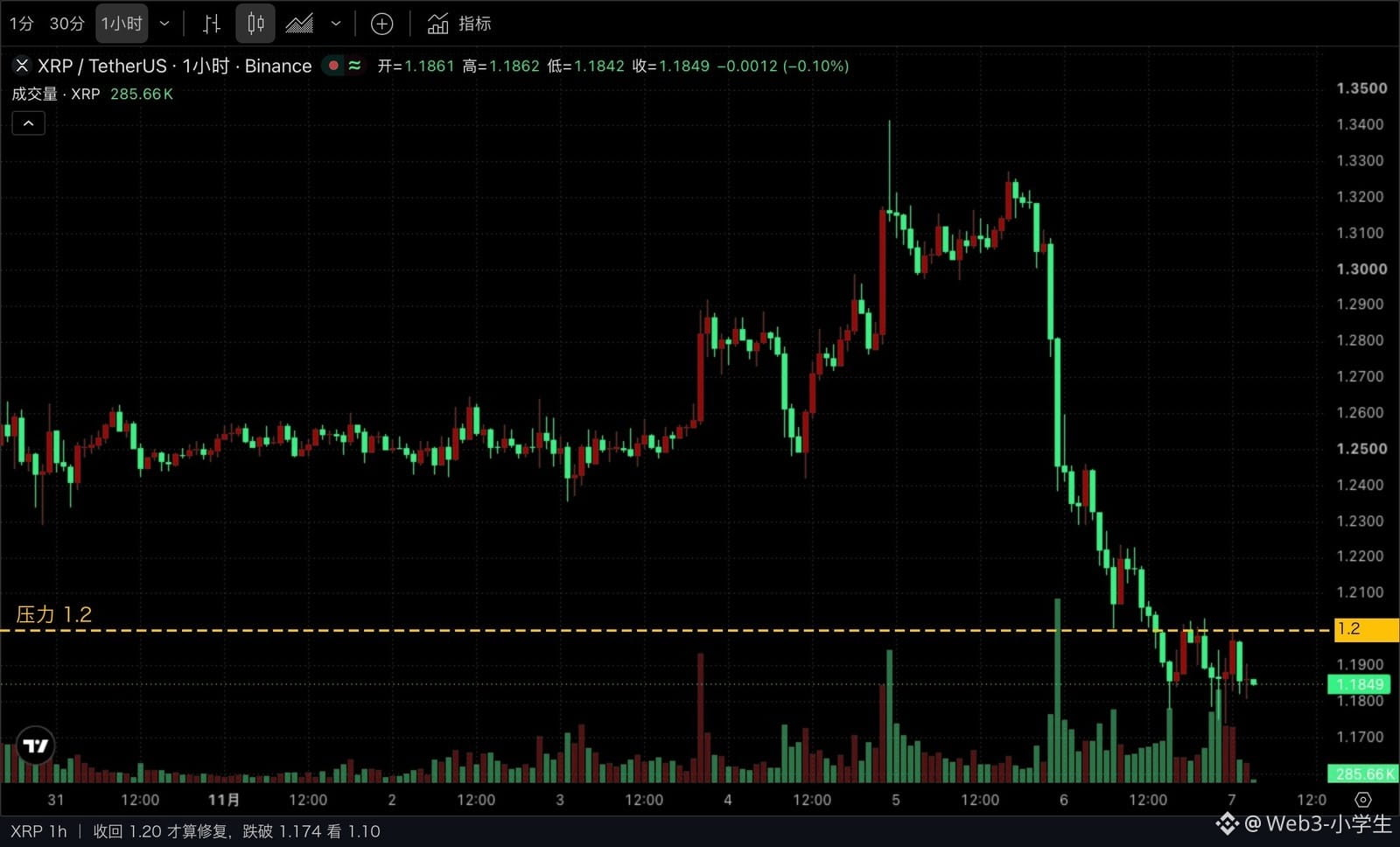
$XRP 1.1849. Two thousand one hundred and forty-seven wallets, each holding at least a million coins—the most ever this year.
The 1.20 level, defended since late August, was lost three days ago. Only ETF flows tell us who’s buying.
On November 3, Santiment counted 2,147 of these addresses, 28 more than ten days earlier, with 18 added in the final three days. That same day, the price touched 1.35.
Then, just 36 hours later, it fell to 1.174.
The selling pressure wasn’t really coming from on-chain activity. In spot ETF flows tracked by SoSoValue, Monday saw a small outflow, followed by three consecutive trading days—from Tuesday to Thursday—with zero net inflows.
Not a single buyer showed up. Not one.
Those two bullish on-chain signals were real: 13 million coins left exchanges, and whales added 60 million in a week. But they both track holdings—the people who have already bought.
The ETF flows over those three days track new money coming in. When that stops, it doesn’t matter how many coins anyone is holding.
I’ve thought about this. Falling exchange balances are always considered bullish, on the grounds that coins are being locked up. But moving coins from an exchange into a cold wallet is just changing their address. Not a single coin has disappeared, and it’s still the same people holding them. What’s so bullish about that?
For it to actually become bullish, someone has to be buying on the other side.
No one stepped in this time. It’s now the worst performer among the top 30, with a market cap of $75 billion, putting it even further behind $BNB at $90 billion.
U.S. stocks are looking pretty straightforward.
The Nasdaq had its worst day since 2020 on Thursday, then rebounded across the board on Friday. $BTC didn’t follow, still hovering around 75,790.
Risk appetite is back, but the money hasn’t returned to altcoins. It’s all elsewhere.
The key level is 1.20. It’s not an arbitrary line: every pullback since late August had found support above it. It broke on November 5, and yesterday’s bounce to 1.2029 was promptly knocked back down.
There’s no way to know whether those 2,000-plus addresses are dozens of wallets belonging to one person or genuinely 2,000 different people. Santiment itself says that address counts can’t prove new money is coming in.
So right now, just watch two price levels. Two.
Reclaim 1.20 and hold above it, and the first resistance above is the 7-day moving average at 1.2467, the midpoint of this move. Break below 1.174—the low of yesterday’s candle—and the next level down is 1.10.
The structure here is what’s really worth remembering. Wallet counts reflect decisions other people made in the past; ETF flows reflect decisions being made today.
Any asset whose valuation is propped up by whales adding to their positions will be brought back down to earth by the silence of new money.
Because holding is past tense. Buying is present tense.
XRP is currently at 1.1849, down 3.78% in a day, with $140 million in trading volume. Are you planning to wait above 1.20 with what you’re holding, or wait and see if it breaks below 1.174?