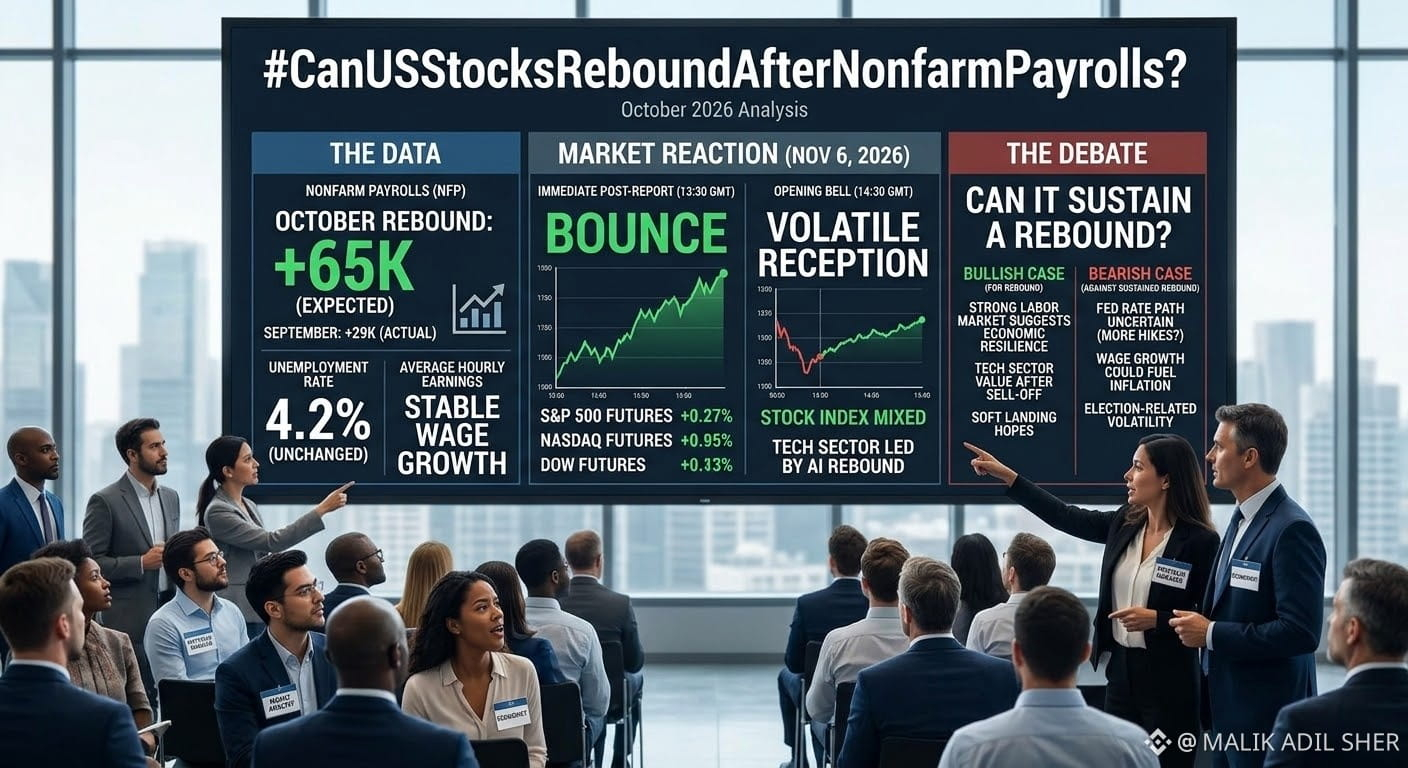
Whether U.S. stocks can sustain a rebound following the nonfarm payrolls (NFP) release depends on how the market balances strong labor data against interest rate policy expectations.
The latest jobs report delivered a strong surprise, complicating the trajectory for risk assets following recent tech market volatility.
Key Data Highlights
Nonfarm Payrolls: October nonfarm payrolls surged by 165,000, easily outperforming the market consensus expectation of 65,000. Additionally, prior months (August and September) saw upward revisions totaling 84,000 jobs.
Unemployment Rate: Ticked down to 4.1% from 4.2% in the previous month.
Immediate Stock Market & Macro Dynamics
1. Rate Hike / "Higher for Longer" Risk
While a strong labor market mitigates recession fears, it acts as a double-edged sword for equities. The upside beat signals economic resilience, giving the Federal Reserve room to maintain a hawkish stance or consider further rate hikes if inflation remains sticky.
Treasury yields spiked following the release, leading index futures (like the S&P 500) to pare back pre-market gains.
2. Tech Sector & Broader Divergence
Prior to the NFP release, equity futures—specifically the Nasdaq 100—were attempting a technical bounce, supported by a relief rally in AI and semiconductor names (e.g., Micron, AMD, NVIDIA) following prior sell-offs.
Growth vs. Value Split: Higher yields tend to disproportionately pressure high-valuation tech and interest-rate-sensitive stocks. While mega-cap tech earnings power can temporarily decouple from yield pressures, prolonged rate uncertainty limits upside momentum.
Dow & Small-Cap Hesitation: Blue-chip and small-cap indices (Russell 2000) show caution as higher borrowing costs directly impact cyclical industries and smaller-capitalization balances.
#CanUSStocksReboundAfterNonfarmPayrolls?
The latest jobs report delivered a strong surprise, complicating the trajectory for risk assets following recent tech market volatility.
Key Data Highlights
Nonfarm Payrolls: October nonfarm payrolls surged by 165,000, easily outperforming the market consensus expectation of 65,000. Additionally, prior months (August and September) saw upward revisions totaling 84,000 jobs.
Unemployment Rate: Ticked down to 4.1% from 4.2% in the previous month.
Immediate Stock Market & Macro Dynamics
1. Rate Hike / "Higher for Longer" Risk
While a strong labor market mitigates recession fears, it acts as a double-edged sword for equities. The upside beat signals economic resilience, giving the Federal Reserve room to maintain a hawkish stance or consider further rate hikes if inflation remains sticky.
Treasury yields spiked following the release, leading index futures (like the S&P 500) to pare back pre-market gains.
2. Tech Sector & Broader Divergence
Prior to the NFP release, equity futures—specifically the Nasdaq 100—were attempting a technical bounce, supported by a relief rally in AI and semiconductor names (e.g., Micron, AMD, NVIDIA) following prior sell-offs.
Growth vs. Value Split: Higher yields tend to disproportionately pressure high-valuation tech and interest-rate-sensitive stocks. While mega-cap tech earnings power can temporarily decouple from yield pressures, prolonged rate uncertainty limits upside momentum.
Dow & Small-Cap Hesitation: Blue-chip and small-cap indices (Russell 2000) show caution as higher borrowing costs directly impact cyclical industries and smaller-capitalization balances.
#CanUSStocksReboundAfterNonfarmPayrolls?