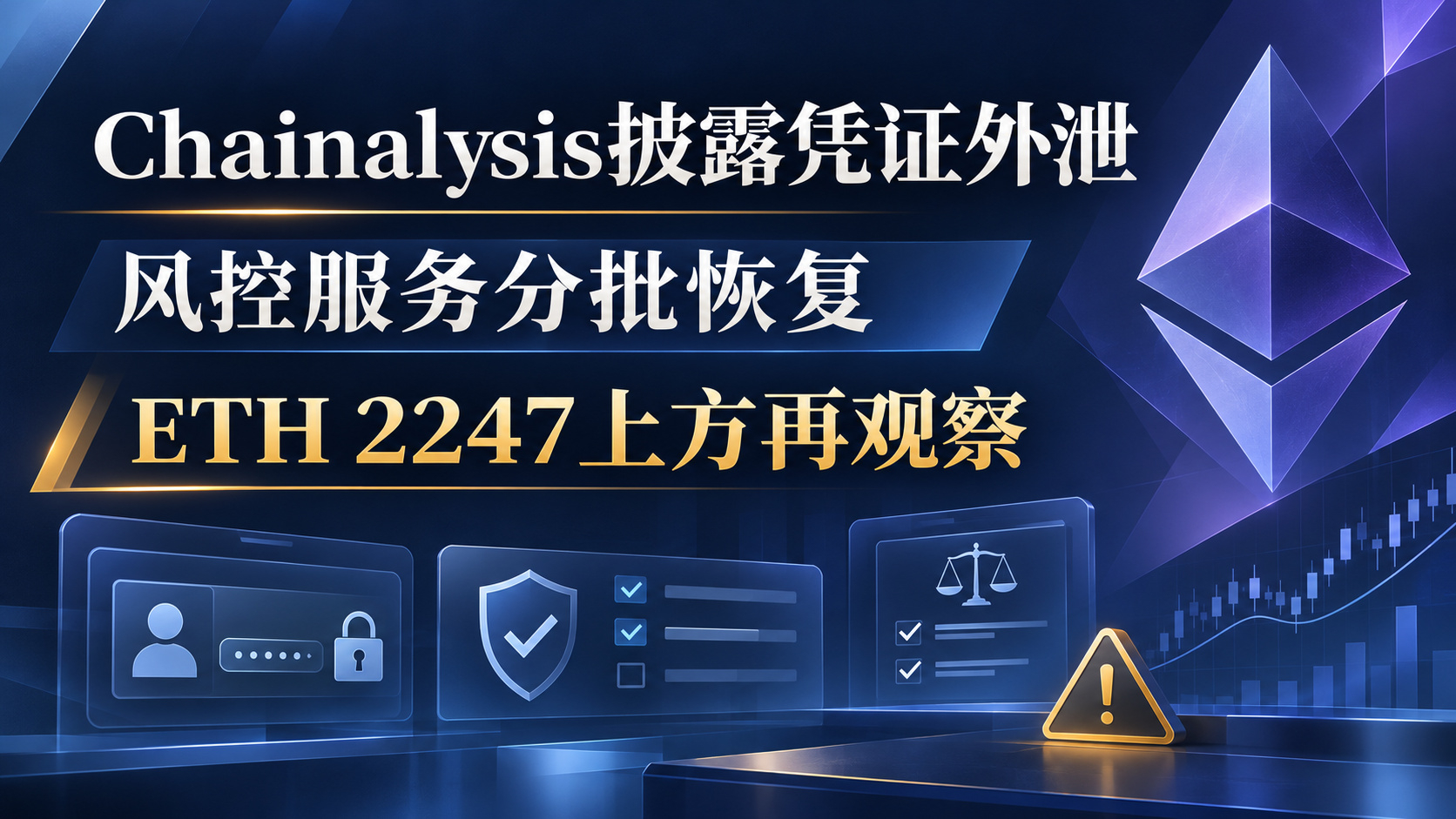
Chainalysis discloses credential leak|Risk-control services gradually resume|Don’t trade ETH prices as if this were an on-chain outage
My view is to classify this as an infrastructure risk and not to short ETH on this basis for now. A trending topic on Binance Square reads, “Chainalysis hacked, password hashes and tokens leaked.” I checked the company’s official updates: on the evening of November 4, the company disclosed that attackers obtained the names, usernames, password hashes, and “live tokens” of all users. The KYT interface and API, address screening, and login page were taken offline due to unusual activity, and KYT customers who appeared to have been accessed without authorization were notified. At 03:30 ET on November 6, the company said KYT and address screening had begun to resume in stages. Authorized users must reset their passwords and, where applicable, rotate their API keys. Reactor and Data Solutions are still being restored. This is an incident involving the company’s services, not a breach of Ethereum’s consensus layer, and the word “token” alone does not imply that ETH private keys have been leaked.
Why might this affect the market? Exchanges, custodians, and compliance teams may rely on third-party on-chain screening services to assess transaction risk. A service outage or credential rotation can increase manual verification and operating costs, affecting infrastructure efficiency and trust; it does not automatically change ETH supply. Chainalysis says there is currently no evidence that investigative data was accessed or its address attribution data tampered with; this still needs to be monitored. The Record also cross-checked the subsequent disclosures and phased restoration plans. It is essential to distinguish between “confirmed exposure of hashes and tokens,” “the company has so far found no issues with other data,” and “the type of tokens and the extent of any actual misuse remain unclear.”
The market reaction does not show ETH crashing solely because of this news. Kraken ETH/USD was around $2,241.58 when I wrote this; the daily open was $2,235.09, with an intraday low of $2,210.99 and high of $2,247.28. The rolling 24-hour low was $2,202.12 and high was $2,395.73. The price is only slightly above the daily open and still below the intraday high. This rebound cannot be attributed to the service restoration, and yesterday’s ETF outflows should not be mechanically treated as selling pressure right now. Watch whether $2,247.28 holds, followed by $2,260. To the downside, watch $2,235 and $2,211; only a break below $2,202 would indicate that the basis for the short-term recovery has been significantly damaged. The U.S. employment report, due at 21:30 Beijing time tonight, has not yet been released, and macro volatility could far exceed the direct price impact of this service news.
If I were trading this myself, I would stay out for now, with a 0% spot position, and only consider a conditional long without leverage, capped at 0.8% of total capital. The entry trigger would be for ETH to close an hourly candle above $2,247 at least 15 minutes after the employment report is released, then hold that level on a retest, with no new Chainalysis announcement expanding the scope of the impact. If the risk-control services go down again or the price move is just a brief spike, I would remain flat. The first target is $2,260, where I would sell half; the second target is $2,290, where I would sell most of the remainder and use a trailing stop for the rest. The initial stop is below $2,225; after entry, I would exit immediately if the price falls below $2,211, without averaging down. If the price still cannot hold above $2,247 after two hours, I would exit proactively. Both the incident and the price need verifiable developments before the position is worth opening.
Sources: Chainalysis official security updates, cross-check by The Record, Kraken ETH/USD, Binance Square trending topics. #Chainalysis遭攻击致密码哈希及令牌泄露 #ETH
The above is solely my personal market observation and does not constitute investment advice.