$ZRO appearing on 6 networks doesn’t mean 6x the bullish impact: tonight, check just three things
$ZRO appears on the 6 networks in Binance’s latest recovery announcement, but its price is still falling. This contradiction is more worth traders’ attention than “withdrawals resuming = bullish,” because the scope of an announcement, actual availability, changes in fund flows, and price confirmation are four distinct steps.
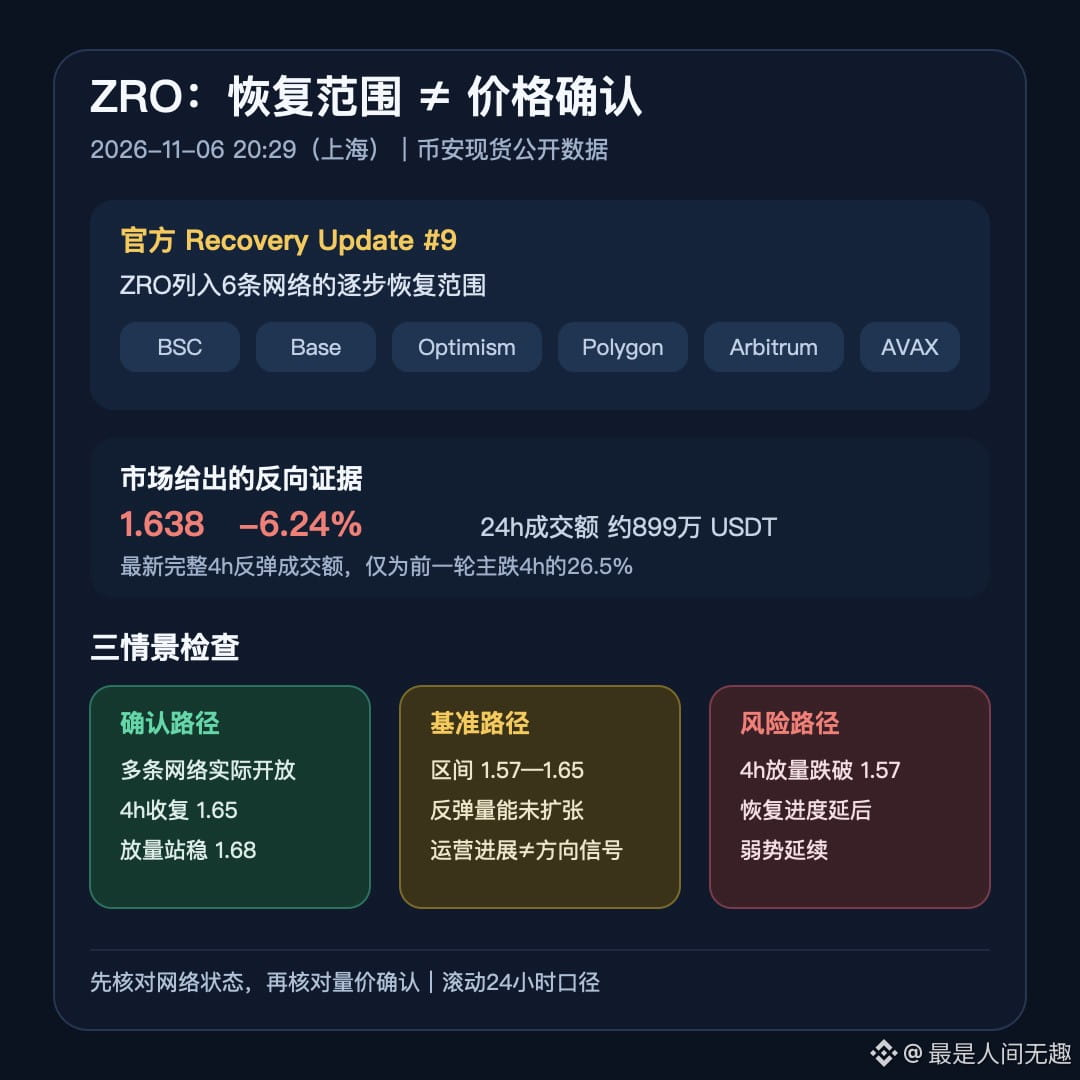
First, the verified facts. At 11:06 on November 6 (Shanghai time), Binance published Recovery Update #9, planning to gradually resume more “network–asset” combinations from 12:00 onward. ZRO was included on BSC, Base, Optimism, Polygon, Arbitrum, and Avalanche C-Chain. Binance also stressed that recovery would happen in batches and would require security and readiness checks. This confirms that the scope has expanded, but it doesn’t mean all 6 routes are available right now, much less that net inflows have occurred.
So far, the market hasn’t traded this as a strong catalyst. Public Binance spot data through 20:29 shows ZRO/USDT at 1.638, down 6.24% over the rolling 24 hours, with approximately 8.99 million USDT in trading volume; BTC was down about 4.73% over the same period, so ZRO has shown no relative strength. The latest complete 4-hour candle rebounded from around 1.573 and closed at 1.627, but trading volume was about 727,000 USDT—only 26.5% of the approximately 2.742 million USDT recorded in the previous 4-hour candle during the main sell-off. A rebound is underway, but volume confirmation has yet to appear.
Tonight, consider three scenarios:
First, the market confirms the recovery. Check that multiple ZRO networks are actually available on Binance’s withdrawal page, then watch for a 4-hour close back above 1.65. If price subsequently breaks above 1.68 on rising volume and holds that level on a retest, that would show the chain from “operational recovery → improved liquidity → price acceptance” beginning to form.
Second, there’s operational progress only. If price continues to trade between 1.57 and 1.65 without expanding rebound volume, then even if more networks show as available, this looks more like a restoration of convenience than a directional trading signal. The easiest mistake here is to treat the number of times an asset appears in an announcement as a measure of how bullish it is.
Third, weakness continues. If a 4-hour candle breaks below 1.57 on rising volume, or the recovery is delayed, the market will prioritize selling pressure and risk appetite over the announcement headline. That makes 1.57 both this round’s low and the risk level in this framework.
My base case remains “the event is confirmed, but the price isn’t.” This cautious view would be invalidated if multiple networks actually become available and price closes above 1.68 on rising 4-hour volume, then holds on a retest. Conversely, a break below 1.57 would invalidate the rebound scenario. Key risks also include further weakness across the broader market, network statuses changing at any time, and slippage or false breakouts caused by 24-hour trading volume of less than 10 million USDT.
Tap $ZRO to check real-time trading volume and how it closes around 1.65/1.68, then visit the withdrawal page to confirm the status of each network. Only when status and price-volume action both align is it worth upgrading this recovery from an “announcement” to a “trading signal”.