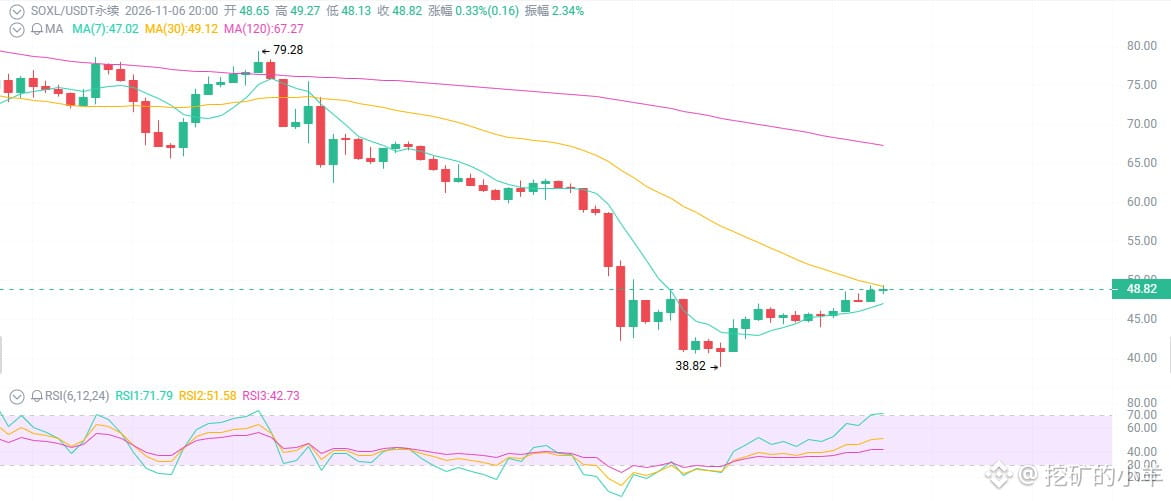
SOXL at $49—would you catch the falling knife?
Down 38.7% in a single day, plunging from 56.95 to 40.59. Panic selling of 500 million shares, as Korean retail investors’ dip-buying bets were punished by leverage—and just now, it rebounded 17% premarket to $49. Is this a dead-cat bounce or a golden buying opportunity?
First, the headlines: The semiconductor sector suffered its worst single-day drop since the 2020 pandemic. The Philadelphia Semiconductor Index fell more than 10%, with every component stock down. But premarket trading has already bounced back to 48–49, with perpetual futures volume surging over the past 24 hours. The chart tells you this: After daily RSI hit deeply oversold levels, it started to recover—a selling climax may be over. The question is, would you pick up shares from the wreckage of a leveraged ETF?
First point: The 38.7% crash doesn’t mean AI is dead—it means leverage got the better of you.
On November 5, SOXL opened at 56.95, closed at 40.87, and hit an intraday low of 40.59. A 38.7% drop in a single day.
There were plenty of triggers: Democrats took the lead in the midterm elections, stoking concerns about tighter regulation of AI data centers; UBS estimated that 30% of new capacity planned for 2028 was at risk; Qualcomm’s results missed expectations; and mechanical selling from leveraged ETF rebalancing amplified the decline.
It’s not that semiconductor companies are suddenly failing—the three-times leverage got trampled in the panic.
Second point: AI demand isn’t dead; your position is.
ASML’s EUV equipment customers have already booked through 2029–2030.
TSMC and ASE are expanding advanced packaging (CoWoS), making it the new bottleneck.
Microsoft and Google hyperscalers are still spending heavily on AI capex.
After the crash, sector P/E ratios are approaching the lower-to-middle end of their historical range.
The AI infrastructure story hasn’t changed one bit. What changed is your leverage and cost basis.
Korean retail investors had previously bought SOXL heavily to catch the dip, only to be punished by leveraged rebalancing—they got the direction right but died by the tool they used.
Third point: The technicals suggest a bounce after extreme oversold conditions, not a confirmed reversal.
Daily chart: A huge bearish candle, with volume exceeding 500 million shares—a classic panic sell-off combined with a leveraged ETF rout. RSI is recovering after hitting deeply oversold levels; MACD remains bearish but shows signs of a bullish divergence near the lows.
Support: 40–42 (previous low + psychological level) → 35–38 (if it falls further)
Resistance: 52–55 (previous intraday high) → 60 (heavy trading zone) → 70–75 (previous consolidation range)
$49 is a bounce zone, not a safe zone. A high-volume move above 55 is needed before you can talk about a short-term reversal; below 47, the falling knife keeps dropping.
Down 38.7% in a single day, plunging from 56.95 to 40.59. Panic selling of 500 million shares, as Korean retail investors’ dip-buying bets were punished by leverage—and just now, it rebounded 17% premarket to $49. Is this a dead-cat bounce or a golden buying opportunity?
First, the headlines: The semiconductor sector suffered its worst single-day drop since the 2020 pandemic. The Philadelphia Semiconductor Index fell more than 10%, with every component stock down. But premarket trading has already bounced back to 48–49, with perpetual futures volume surging over the past 24 hours. The chart tells you this: After daily RSI hit deeply oversold levels, it started to recover—a selling climax may be over. The question is, would you pick up shares from the wreckage of a leveraged ETF?
First point: The 38.7% crash doesn’t mean AI is dead—it means leverage got the better of you.
On November 5, SOXL opened at 56.95, closed at 40.87, and hit an intraday low of 40.59. A 38.7% drop in a single day.
There were plenty of triggers: Democrats took the lead in the midterm elections, stoking concerns about tighter regulation of AI data centers; UBS estimated that 30% of new capacity planned for 2028 was at risk; Qualcomm’s results missed expectations; and mechanical selling from leveraged ETF rebalancing amplified the decline.
It’s not that semiconductor companies are suddenly failing—the three-times leverage got trampled in the panic.
Second point: AI demand isn’t dead; your position is.
ASML’s EUV equipment customers have already booked through 2029–2030.
TSMC and ASE are expanding advanced packaging (CoWoS), making it the new bottleneck.
Microsoft and Google hyperscalers are still spending heavily on AI capex.
After the crash, sector P/E ratios are approaching the lower-to-middle end of their historical range.
The AI infrastructure story hasn’t changed one bit. What changed is your leverage and cost basis.
Korean retail investors had previously bought SOXL heavily to catch the dip, only to be punished by leveraged rebalancing—they got the direction right but died by the tool they used.
Third point: The technicals suggest a bounce after extreme oversold conditions, not a confirmed reversal.
Daily chart: A huge bearish candle, with volume exceeding 500 million shares—a classic panic sell-off combined with a leveraged ETF rout. RSI is recovering after hitting deeply oversold levels; MACD remains bearish but shows signs of a bullish divergence near the lows.
Support: 40–42 (previous low + psychological level) → 35–38 (if it falls further)
Resistance: 52–55 (previous intraday high) → 60 (heavy trading zone) → 70–75 (previous consolidation range)
$49 is a bounce zone, not a safe zone. A high-volume move above 55 is needed before you can talk about a short-term reversal; below 47, the falling knife keeps dropping.