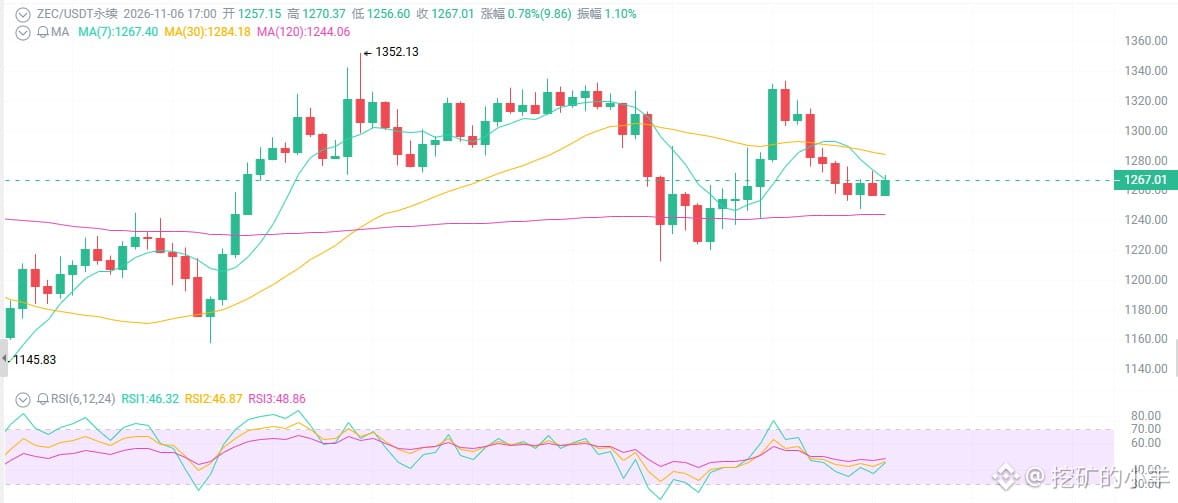
ZEC at $1,268—still waiting for $1,500?
The NU7 upgrade just went live, and ZEC has plunged from $1,650 to $1,268, down another 5% in 24 hours. ETFs have attracted $1 billion and whales are buying, yet the price is stuck below the 50-day moving average—is this a shakeout or distribution?
First, the big picture: Why is the leading privacy coin, up 190% for the year, falling right after its upgrade went live?
It’s down 3%–5% over 24 hours. Its yearly gain is still over 190%, with a market cap of around $21.5–22 billion, ranking it in the top 10. But after pulling back from September’s $1,650–1,700 high, it found support at October’s $1,120–1,130 low and rebounded. Now it’s fluctuating within a high-level range of $1,200–1,350.
The 200-day moving average is at $740–765, well below the price, indicating long-term strength. The 50-day moving average is at $1,310–1,315, with the price below it, indicating a medium-term pullback.
First question: The NU7 upgrade went live—why did the price fall instead of rise?
NU7 activated on November 5: block times were cut from 75 seconds to 25 seconds, making confirmations 3x faster; 60% of transaction fees now go into a sustainable network reserve; and around 12,224 ZEC in the old Sprout privacy pool became unspendable.
Over the long term, this is a major upgrade to the privacy payment experience and network security. In the short term, it’s a classic “sell the news” move—those who bought in anticipation of the upgrade are selling now that it’s live.
Second question: ETFs and whales are buying, but the broader market is selling off.
The Grayscale ZEC ETF attracted funds rapidly, at one point reaching the $1 billion mark. There have also been recent reports of whales buying and adding to their positions. These are genuine institutional signals backed by real money.
BTC is around $75,600–76,000, down about 6% over 24 hours and near its lowest close since mid-September. The Nasdaq plunged around 5.5%, with AI and chip stocks being sold off. Total crypto market cap is around $2.66 trillion, and risk appetite is fading.
ZEC’s correlation with BTC is around 0.5. It has held up relatively well recently, but holding up better doesn’t mean it’s decoupled.
When BTC is shaky, even a compelling privacy story can’t stop ZEC from moving with the market.
Third question: The technical picture shows a high-level range, with $1,268 in the lower half of the range.
Immediate support: $1,230–1,240
Strong support: $1,150–1,190 (previous support/low zone)
Deeper support: $1,100–1,125
Immediate resistance: $1,310–1,320 (around the 50-day moving average)
Secondary resistance: $1,370–1,400
Higher resistance: $1,500–1,650 (previous high zone)
The chart looks like a high-level range or flag consolidation. A daily close holding above $1,320 with rising volume would open up room toward $1,400–1,500+. A daily close below $1,190/$1,150 would open the door to a deeper pullback, toward $1,100 or even lower.
The real opportunities are a hold at $1,230–1,240 or a deeper shakeout to $1,150–1,190.