
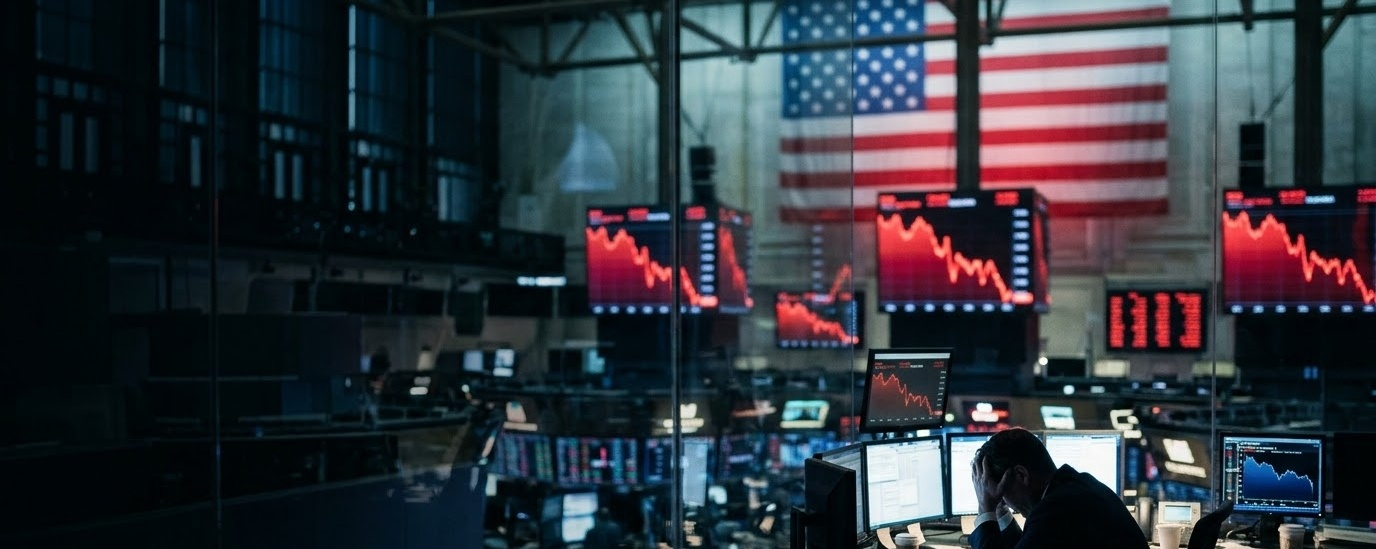

When U.S. stocks fall sharply, the damage is rarely limited to portfolios.
Red candles on a chart can trigger something more personal: panic, denial, anger, regret, and the desperate urge to “fix” a losing position immediately. A market sell-off may begin with earnings, interest rates, economic data, or geopolitical shocks—but it often becomes more severe when traders’ emotions take control.
Markets Fall Faster When Confidence Breaks
Stock markets are built on expectations. Investors price in future growth, corporate profits, consumer demand, and monetary policy. When those expectations weaken, selling begins.
At first, the decline may look manageable. A major index drops a few percent. Technology stocks retreat. Traders tell themselves it is a normal correction.
But sentiment can change quickly.
As losses increase, confidence starts to disappear. Traders who entered near recent highs may feel trapped. Those who missed earlier gains may hesitate to buy the dip. Others begin closing positions simply because they cannot tolerate watching their account value decline further.
This is where a stock-market decline can turn into a psychological crisis.
The Mind Under Pressure
A trader facing a falling market is not only processing numbers. They are fighting instinct.
Humans are naturally loss-averse: losing money often feels more painful than gaining the same amount feels rewarding. That can create predictable mistakes during a market collapse:
Panic selling: Closing a position after a large drop simply to stop the emotional discomfort.
Revenge trading: Taking oversized new trades to recover losses quickly.
Freezing: Refusing to act at all because every choice feels dangerous.
Confirmation bias: Searching only for opinions that support an existing position.
Overtrading: Entering and exiting repeatedly in response to every headline or intraday move.
The market may be volatile, but the trader’s emotional reaction can create even more damage than volatility itself.
Why Leverage Makes Fear Worse
Leverage can magnify market exposure—and psychological pressure.
When prices move against a leveraged trader, the focus often shifts away from the original thesis. Instead of asking, “Has my analysis changed?” the trader starts asking, “How do I avoid being forced out?”
That mental shift is dangerous. Decisions become driven by urgency rather than discipline. A trader may add to a losing position without a clear plan, close at the worst possible moment, or take another high-risk trade in an attempt to recover.
During broad market declines, survival matters more than proving a point.
The Difference Between Volatility and Collapse
Not every sharp decline is a full market collapse. Markets regularly experience corrections, temporary fear, and rapid reversals. A decline can reflect changing expectations without meaning that the entire financial system is failing.
Still, traders often interpret every major drop as the beginning of something much worse. Social media, nonstop market commentary, and alarming headlines can intensify that feeling.
A disciplined approach separates facts from fear:
What actually changed in the economy or company fundamentals?
Is the move broad across sectors, or concentrated in a few names?
Is liquidity stable, or are markets showing signs of severe stress?
Is the position size appropriate for the trader’s risk tolerance?
Can the trader explain the reason for holding or exiting without relying on emotion?
These questions do not eliminate uncertainty, but they can reduce impulsive decisions.
The Real Battle Is Often Internal
The collapse of traders’ minds does not always look dramatic. Sometimes it appears as checking prices every few minutes. Sometimes it is sleeplessness, constant second-guessing, or the inability to follow a previously defined plan.
The strongest traders are not necessarily the ones who predict every move correctly. They are often the ones who recognize that uncertainty is unavoidable and build systems to manage it.
That may include using smaller position sizes, avoiding excessive leverage, setting clear risk limits before entering a trade, and stepping away from the screen when emotions become overwhelming.
A market downturn tests capital. It also tests patience, discipline, and self-awareness.
Conclusion
The collapse of U.S. stocks can be visible on a chart. The collapse of a trader’s mindset is less visible—but often more consequential.
Markets can recover. Prices can stabilize. New opportunities can emerge. But decisions made in panic may have lasting effects.
In volatile periods, the goal is not to predict every bottom or catch every rebound. It is to protect decision-making from fear, greed, and urgency. Because when markets fall, the most important position to defend may be your own state of mind.