

OKX Regular Spot already lists a lower maker fee than Binance Regular User. That is the honest starting point. For most beginners who market-buy majors, pay Futures takers, and want a day-one fee cut without climbing a VIP ladder, Binance is still the better pick once you add liquidity on the pairs new traders actually use, a flat 20% Spot and Futures cut from account creation, and a BNB fee-payment path that OKX Regular does not mirror.
Figures below use Binance Regular User / USDⓈ-M rows and OKX Regular (global) rows stamped to early November 2026. OKX also runs separate EEA and United States schedules with higher Spot bases for some accounts. Rates move. Open each fee page before you size a live order. Educational only, not financial advice.
👉 Sign up on Binance with 20LESSFEES
Eligible new users can also work through the welcome bonus of up to 19,800 USDT on the same task list that ships with every sign-up code. The fee cut and the bonus are separate offers: one trims trading fees from the first fill, the other pays when you finish the listed tasks.
Why does OKX look cheaper on the Spot maker line?
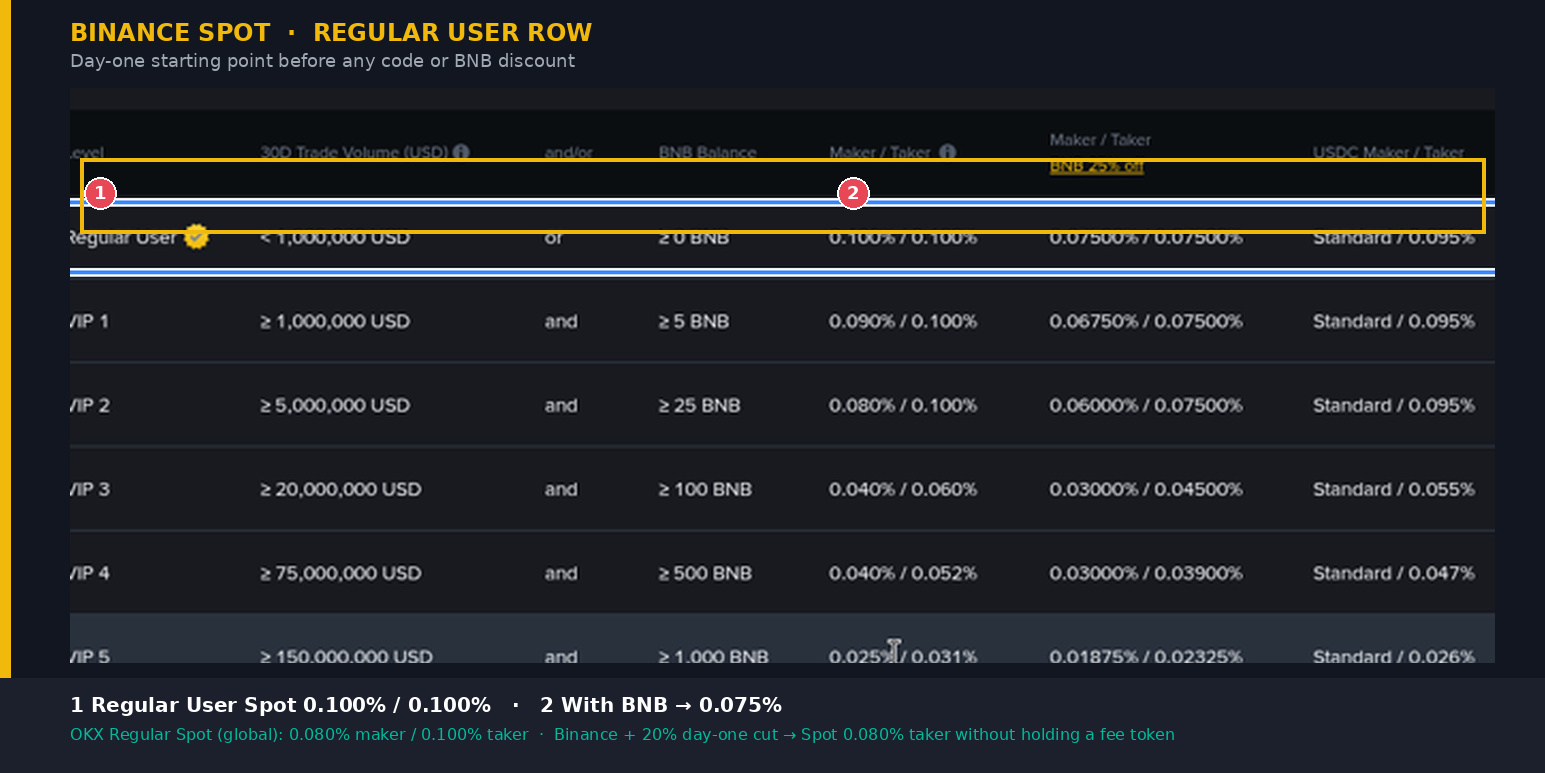
Open the OKX global Spot table and Regular shows 0.0800% maker and 0.1000% taker on standard pairs. Open Binance Spot and Regular User shows 0.100% maker and 0.100% taker. On maker-only Spot limit flow, OKX wins that single cell by 0.0200 percentage points. That is a real published gap, not a blog invention.
Most beginners do not live on maker-only Spot. A market buy is a taker. Both venues list 0.100% Spot taker at the Regular / Regular User row, so the headline that "OKX is cheaper for beginners" often collapses the moment the first market order fills. The rest of this piece separates maker cells, taker cells, Futures notional math, fee-token options, VIP distance, and day-one code timing so the table stops lying by omission.
How do Spot fees compare on a 2,500 USDT buy?
Work one Spot market buy of 2,500 USDT of a major pair. Ignore spread for a second and use only the listed taker fee.
Binance Regular User Spot taker: 0.100% × 2,500 USDT = 2.50 USDT.
OKX Regular Spot taker (global): 0.1000% × 2,500 USDT = 2.50 USDT.
Binance with 20LESSFEES: Spot falls to 0.080%, so the same buy costs 2.00 USDT.
Binance paying the fee in BNB: 0.075% × 2,500 USDT = 1.875 USDT.
OKX Regular Spot maker on a resting limit: 0.0800% × 2,500 USDT = 2.00 USDT if the order actually rests and fills as maker.
On a single lot the dollar gap looks small. On a month of 60,000 USDT Spot volume the base taker fee is 60 USDT either way; with the day-one 20% cut Binance lands at 48 USDT; with BNB fee payment Binance lands near 45 USDT. OKX Regular stays on 0.100% taker unless you qualify into VIP or you manage to fill as maker. There is no Binance-style BNB toggle that knocks Regular Spot down another step for a brand-new OKX account.
Liquidity is the second Spot axis. BTC/USDT and ETH/USDT books on Binance usually absorb a beginner-sized market order with less slippage than thinner books. A matched 0.100% taker on a deep book can still beat a matched 0.100% taker on a thin book once the fill price walks. Fee math that stops at the schedule ignores that cost.
What about OKX's three fee schedules?
OKX does not publish one beginner row for every account type. Global Regular Spot sits at 0.080% / 0.100%. Some EEA accounts without a derivatives path and United States accounts have been published at much higher Spot bases (around 0.20% / 0.35% on those schedules). A screenshot from a friend on a different entity, or a blog that mixes schedules, can make OKX look either cheaper or far more expensive than the row your own login actually shows.
Binance Regular User is the realistic day-one row for the global binance.com path this article covers. Compare like with like: your logged-in OKX fee page against Binance Regular User, not a VIP 5 cell against a Regular User cell, and not a US schedule against a global schedule.
How do Futures fees compare on a 5x round trip?
Futures fees charge on notional value, not on the margin you post. That detail trips beginners more often than the percentage itself. Put up 2,000 USDT margin at 5x and the position is 10,000 USDT notional. Open and close with taker orders and you pay the taker rate twice on that 10,000 USDT.
Binance USDⓈ-M Regular User taker: 0.0500% × 10,000 × 2 = 10.00 USDT.
OKX Regular Futures taker: 0.0500% × 10,000 × 2 = 10.00 USDT.
Binance with the 20% day-one cut: Futures taker becomes 0.0400%, so the same round trip costs 8.00 USDT.
Binance maker round trip at base: 0.0200% × 10,000 × 2 = 4.00 USDT if both legs rest on the book.
OKX Regular maker round trip: 0.0200% × 10,000 × 2 = 4.00 USDT on the same maker path.
Base Futures maker and taker match between Binance Regular User and OKX Regular. The gap opens when Binance applies the day-one 20% cut, or when Binance pays Futures fees in BNB (published Regular path 0.0180% maker / 0.0450% taker). OKX Regular Futures does not ship an equivalent flat registration cut for new accounts in the same form, and its fee FAQ describes fees coming out of the trade itself rather than a separate fee-token balance you toggle.
What do beginners miss when they crown OKX on one Spot maker cell?
Five traps show up when people pick an exchange from a single fee screenshot.
Maker screenshot, taker behaviour: OKX Regular Spot maker at 0.080% looks better than Binance 0.100%. Market buys still pay 0.100% taker on both.
Wrong OKX schedule: Global, EEA, and US rows are not interchangeable. Always read the fee page while logged into the account you will trade.
VIP distance: OKX VIP 1 on the global Spot table asks for roughly 100,000 USD in assets or about 1,000,000 USD of 30-day volume. That is not a beginner plan. Compare Regular to Regular User.
Notional vs margin: A 5x Futures trade with 2,000 USDT margin is a 10,000 USDT fee base. Spot with the same 2,000 USDT is a 2,000 USDT fee base. Percentage tables that look "cheap" on Futures can still cost more dollars on the cash you deposited.
Day-one cut timing: The flat 20% Spot and Futures reduction tied to a Binance sign-up code is entered at registration. After the account exists, that particular cut cannot be bolted on. Timing the code field is part of the fee plan, not a footnote.
Our earlier comparison of Binance vs Bybit fees for beginners uses the same Regular / VIP 0 discipline on a different venue if you want another worked pair beside this OKX read. For the map of maker vs taker, Spot vs Convert, and withdrawal networks inside Binance alone, see Binance fees compared side by side.
Binance day-one fees Pros and Cons against OKX Regular
Spot taker parity, then a cut: Base Spot taker matches OKX Regular at 0.100%. With 20LESSFEES, Spot moves to 0.080% without needing a resting maker fill.
Futures base parity, then a cut: Base Futures 0.0200% / 0.0500% matches OKX Regular. With the day-one cut, Futures taker becomes 0.0400%.
BNB fee path: Optional BNB payment lists Spot at 0.075% and Futures at 0.0180% / 0.0450% on the Regular path. That is a separate lever from the sign-up cut.
Spot liquidity on majors: Deeper books on the pairs beginners actually trade reduce the hidden cost that never appears on a fee schedule.
Spot maker cell trails OKX: Binance Regular User Spot maker at 0.100% sits above OKX Regular 0.0800% before discounts. Limit-only Spot flow that truly rests can favour OKX on that one cell.
BNB balance is a separate decision: The BNB path needs BNB sitting in the account. Price moves in BNB can eat part of the fee you just saved.
OKX Regular fees Pros and Cons for new traders
Stronger Spot maker headline: 0.0800% maker beats Binance Regular User 0.100% on resting Spot limits.
Matched Spot taker and Futures bases: 0.1000% Spot taker and 0.0200% / 0.0500% Futures sit level with Binance Regular User before Binance discounts.
No flat Binance-style day-one Spot+Futures registration cut: New OKX Regular accounts stay on published Regular rows unless they qualify upward or fill as maker.
Schedule confusion risk: Global vs EEA vs US rows make casual screenshots unreliable. Your logged-in page is the only row that counts.
VIP 1 is far from day one: Asset or volume bars near the 100k / 1M marks push better Spot rows out of beginner range for a long time.
Where does the sign-up code sit on the Binance form?
On Binance the code field is part of the create-account flow. Enter it before you submit. After the account exists, that particular fee cut cannot be added later. The cropped registration screen below marks the code area so you see where the line sits relative to password and submit.
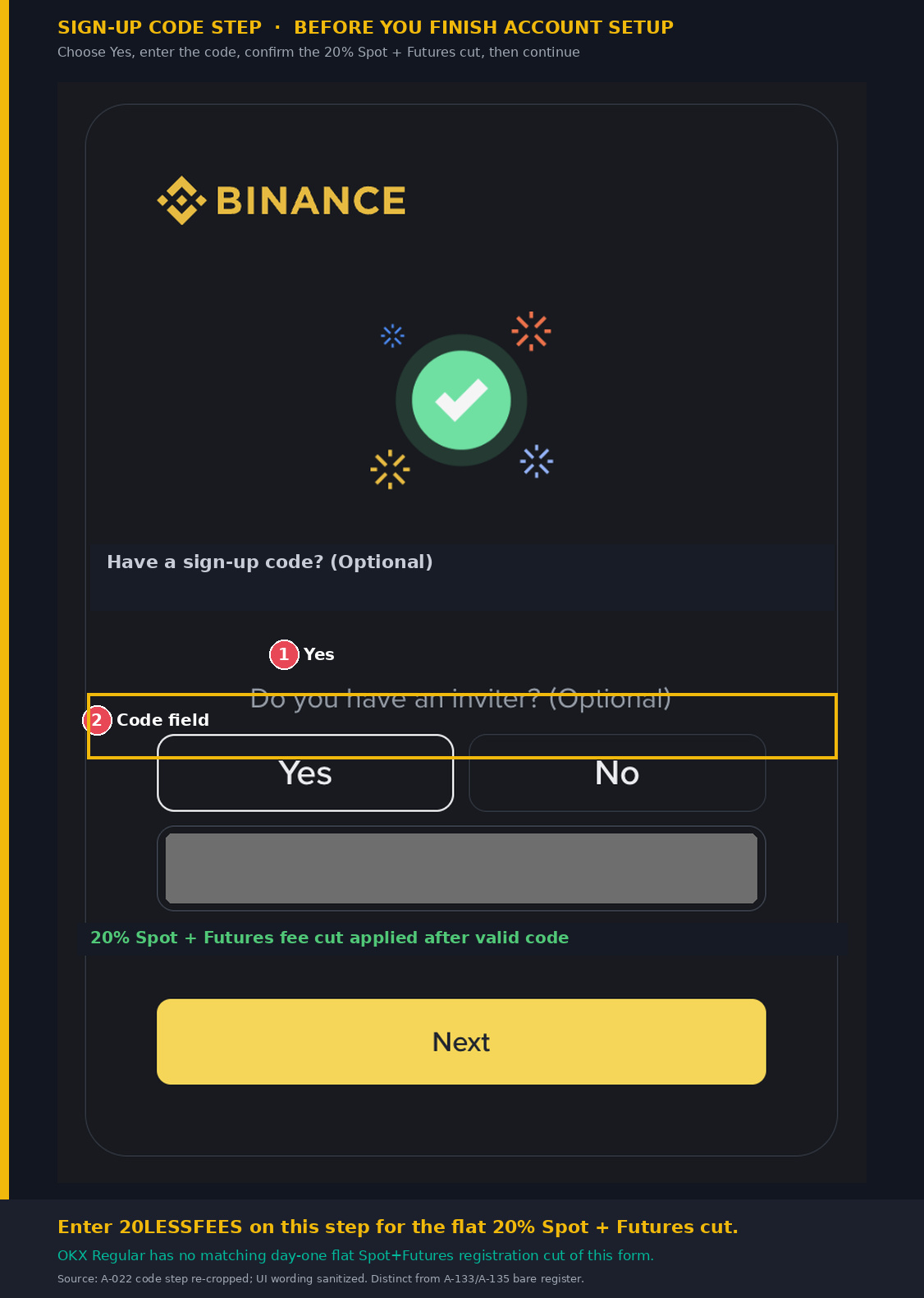
A second reminder without a fresh link: enter the sign-up code on the form before you submit if that discount is part of your plan. 20LESSFEES is the code used throughout this article for the flat 20% Spot and Futures fee reduction.
Which exchange wins for a beginner who only cares about fees?
On Spot maker base alone, OKX Regular leads 0.0800% to 0.100%. On Spot taker base, call it a draw at 0.100%. On Spot with a day-one sign-up cut on Binance, Binance leads at 0.080% taker without needing a maker fill. On Spot with BNB fee payment, Binance lists 0.075%. On Futures base maker and taker, call it a draw at 0.0200% / 0.0500%. On Futures with the day-one cut, Binance leads at 0.0400% taker. On VIP access, both Regular rows are the realistic beginner comparison; VIP 1 on either venue is a capital plan, not a fee tip.
Liquidity and product breadth sit outside the percentage table, but they still change what you pay. A matched taker fee on a deep BTC/USDT book can beat the same percentage on a thin book once slippage is counted. That is why this comparison pairs every fee line with a liquidity note instead of stopping at the schedule.
For the current task list tied to new accounts, check the Binance welcome bonus event page. Rewards and eligibility change, and that page is the source of truth for what currently counts toward the welcome tasks.
Do OKX maker wins stack against Binance after a sign-up cut?
Only on Spot maker flow that truly rests. Once you include Spot takers, Futures takers, and the Binance day-one 20% cut, the beginner path that market-buys and occasionally uses Futures favours Binance on published November 2026 rows. Read the fee on a filled order in your own history after you change settings. Do not assume a stacked percentage from a blog table until your fill confirms it.
FAQ
Is Binance cheaper than OKX for Spot beginners?
On raw Spot maker, no: OKX Regular lists 0.0800% against Binance 0.100%. On Spot taker, they match at 0.100%. With a day-one 20% sign-up cut on Binance, yes for Spot taker fee alone at 0.080% without needing a maker fill.
Why do the Futures base numbers match?
Binance USDⓈ-M Regular User and OKX Regular Futures both publish 0.0200% maker and 0.0500% taker on the schedules cited here. The gap appears after Binance applies the day-one cut or BNB fee payment.
Why use 2,500 USDT and 5x in the examples?
Different cash and leverage from a 1,000 USDT / 10x template keeps the arithmetic fresh and still lands on a clean 10,000 USDT Futures notional so you can compare round-trip dollars without a calculator.
Does paying fees in BNB replace a sign-up code?
No. BNB payment is an account setting that needs you to hold BNB. A sign-up code is entered once at registration. They solve different problems and are available on different timelines.
Can a beginner reach OKX VIP 1 just to beat Binance Spot?
VIP 1 on the global Spot table needs about 100,000 USD in assets or heavy 30-day volume. For most first accounts that is not a fee plan, it is a capital plan. Compare Regular to Regular User instead.
Are these rates guaranteed next month?
No. Both exchanges update fee pages, and OKX schedule group can depend on entity. Treat early November 2026 figures as a snapshot, open each logged-in fee schedule before you trade size, and remember this article is not financial advice.