It wasn’t until my 10th year of dollar-cost averaging that I realized the “buy more as it falls to lower your average cost” strategy had basically stopped working.
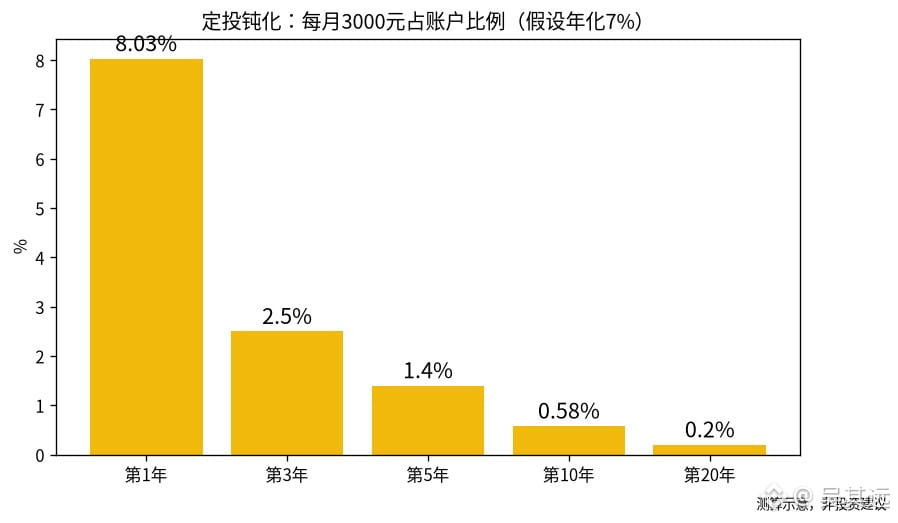
I ran the numbers assuming a monthly investment of 3,000 yuan and an annualized return of 7%, and looked at what share of the account each new monthly contribution represented:
· Year 1: one month’s contribution was about 8% of the account;
· Year 3: about 2.5%;
· Year 5: about 1.4%;
· Year 10: about 0.58%;
· Year 20: just about 0.2%.
By year 10, the account would be worth about 520,000 yuan. A 20% drawdown would mean a loss of just over 100,000 yuan—and at 3,000 yuan a month, it would take 34 months of contributions to offset that. By year 20, the account would be worth about 1.53 million yuan. The same 20% drop would take 100 months to offset.
This is what people often call “dollar-cost averaging losing its impact.” In the early years, each new contribution can noticeably lower your average cost. But over time, the account starts to resemble a lump-sum holding, with its ups and downs driven mostly by the money already invested.
So these days, I think what really matters in the later years of dollar-cost averaging is your stock-bond allocation, whether to rebalance, and when you’ll need the money—not adding a few hundred yuan more this month.
Bro, what do you think—should you keep investing the same amount on autopilot in the later years, or start adjusting your holdings? Let’s talk in the comments.
(This is an illustrative calculation based on assumptions. It does not represent the actual returns of any fund and is not investment advice.)
#定投 #基金 #LongTermism
I ran the numbers assuming a monthly investment of 3,000 yuan and an annualized return of 7%, and looked at what share of the account each new monthly contribution represented:
· Year 1: one month’s contribution was about 8% of the account;
· Year 3: about 2.5%;
· Year 5: about 1.4%;
· Year 10: about 0.58%;
· Year 20: just about 0.2%.
By year 10, the account would be worth about 520,000 yuan. A 20% drawdown would mean a loss of just over 100,000 yuan—and at 3,000 yuan a month, it would take 34 months of contributions to offset that. By year 20, the account would be worth about 1.53 million yuan. The same 20% drop would take 100 months to offset.
This is what people often call “dollar-cost averaging losing its impact.” In the early years, each new contribution can noticeably lower your average cost. But over time, the account starts to resemble a lump-sum holding, with its ups and downs driven mostly by the money already invested.
So these days, I think what really matters in the later years of dollar-cost averaging is your stock-bond allocation, whether to rebalance, and when you’ll need the money—not adding a few hundred yuan more this month.
Bro, what do you think—should you keep investing the same amount on autopilot in the later years, or start adjusting your holdings? Let’s talk in the comments.
(This is an illustrative calculation based on assumptions. It does not represent the actual returns of any fund and is not investment advice.)
#定投 #基金 #LongTermism