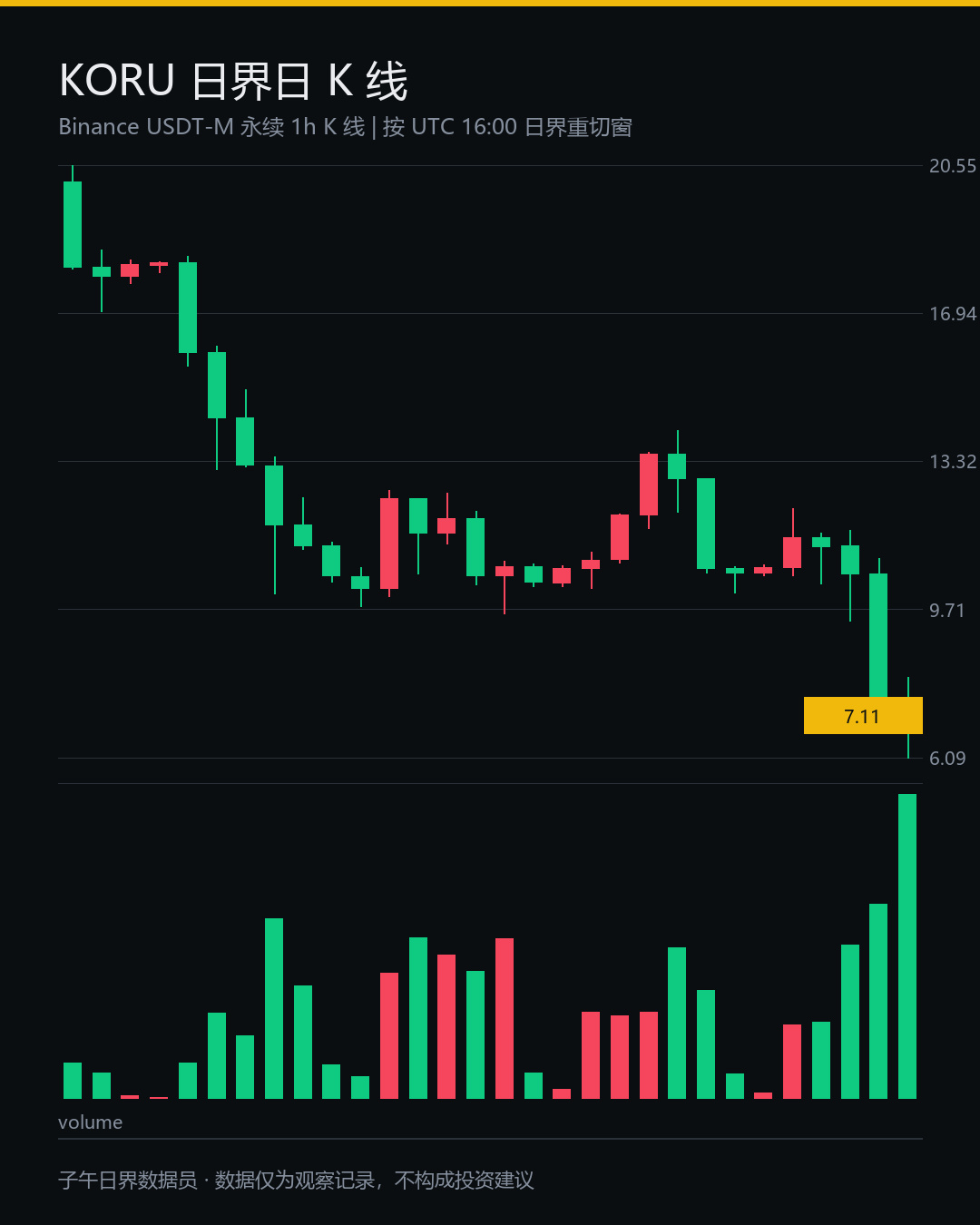
Over 24 hours, $KORU fell 26.966%. Yesterday's daily candle had a high of 10.39 and a low of 6.09.
I'm looking at the positioning.
The 20-day range runs from an upper bound of 14.08 to a lower bound of 6.09. At 7.15, it's now sitting at just the 13.27th percentile—which means that over the past month, only a little over one in ten assets have done worse.
There was one number I had to check twice before I believed it.
Open interest rose from 10.05 million contracts to 15.55 million in 23 hours, up 54.649%,
but notional value only climbed from 96.2 million to 112.9 million. The price collapsed by a quarter,
while positions moved in the opposite direction, growing by half.
Who's taking the other side?
Long accounts make up 88.29%, while shorts account for just 11.71%, putting the long-to-short account ratio at 7.5397. The funding rate is still positive at 0.061882%;
yesterday at 8 a.m. it settled once at 0.106702%. Even after a drop like this, longs are still paying to hold their positions.
No one is willing to take profits first.
It's like a group of people all scrambling for the same table. There are only so many plates of food. Whoever gets closest to the kitchen gets served first; when there's no room to sit, they keep adding chairs, until there are more chairs than food.
Positioning matters more than the story.
The move down from 14.08 looks like a reservoir being drained: the water level falls step by step, eventually bottoming at 6.09. Even the rebound to 7.15 only makes up half a step.
The broader market is dragging too. Over the same period, $BTC fell 5.576%, and $ETH fell 7.887%.
It fell 26.966%—roughly four times as much as either of them. When liquidity tightens, peripheral assets are the first to be sold.
My take: increase attention, but don't chase. Wait for the funding rate to turn negative and open interest to come down, then see whether this wave of buying support is real or not.
What do you all think?
#KORU #比特币 #Crypto
The above is a record of my personal trading system and observations of market data. It does not constitute investment advice.