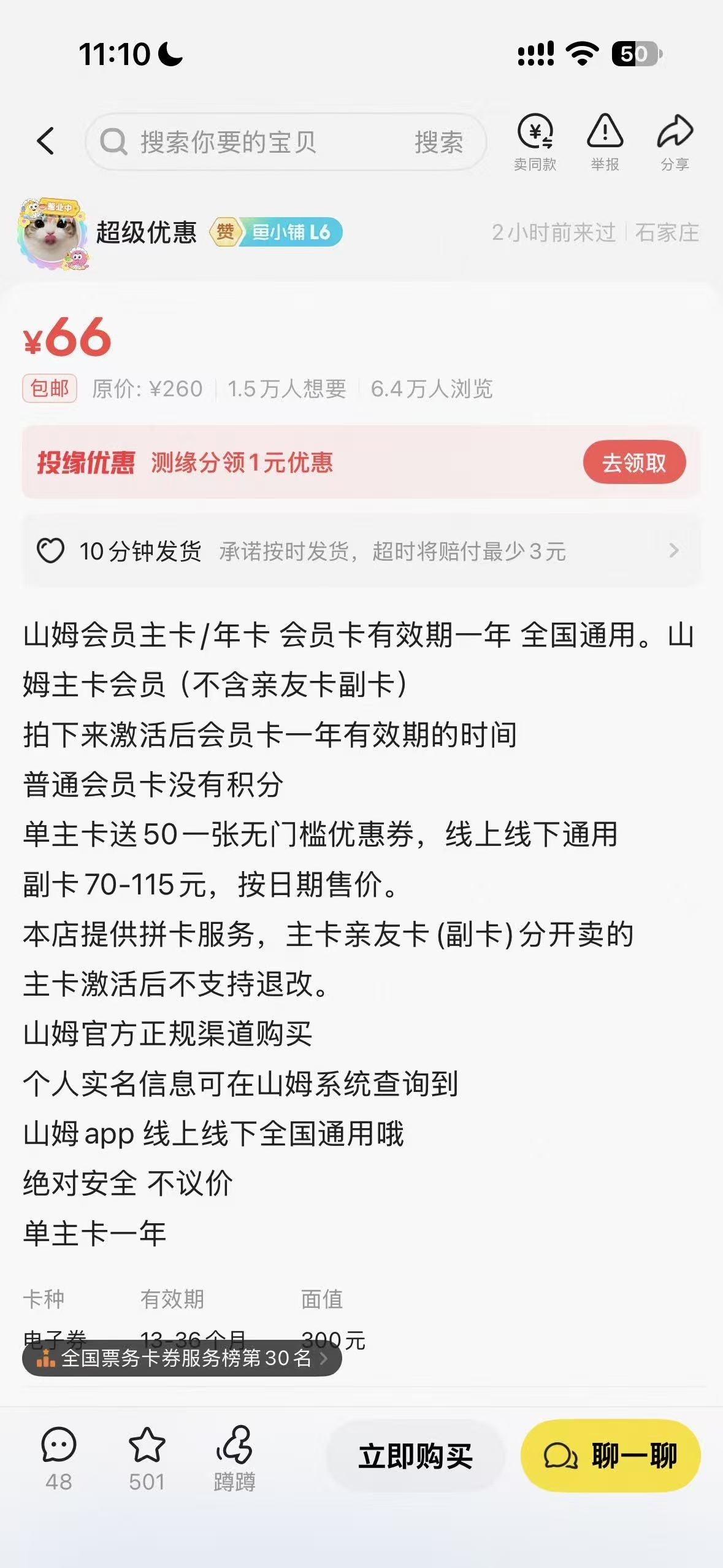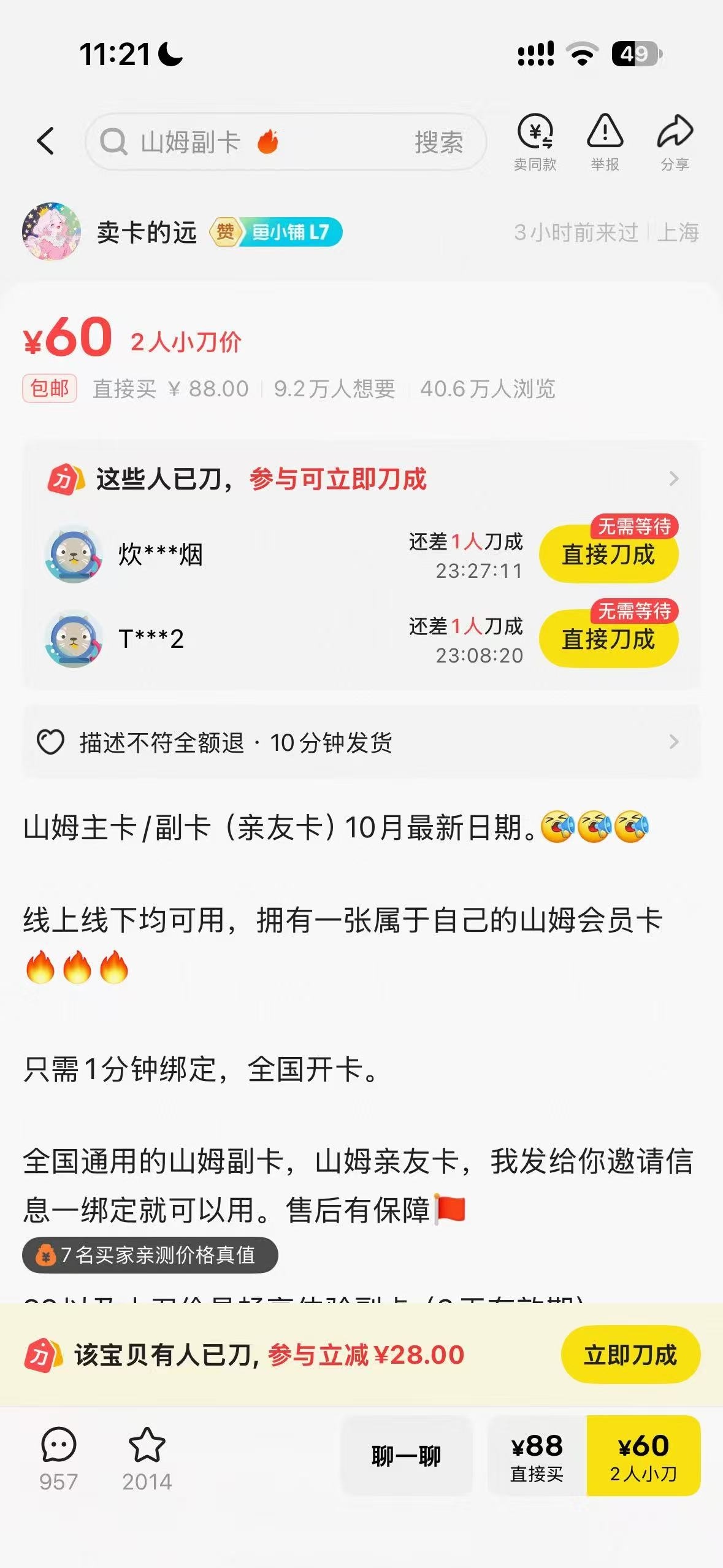

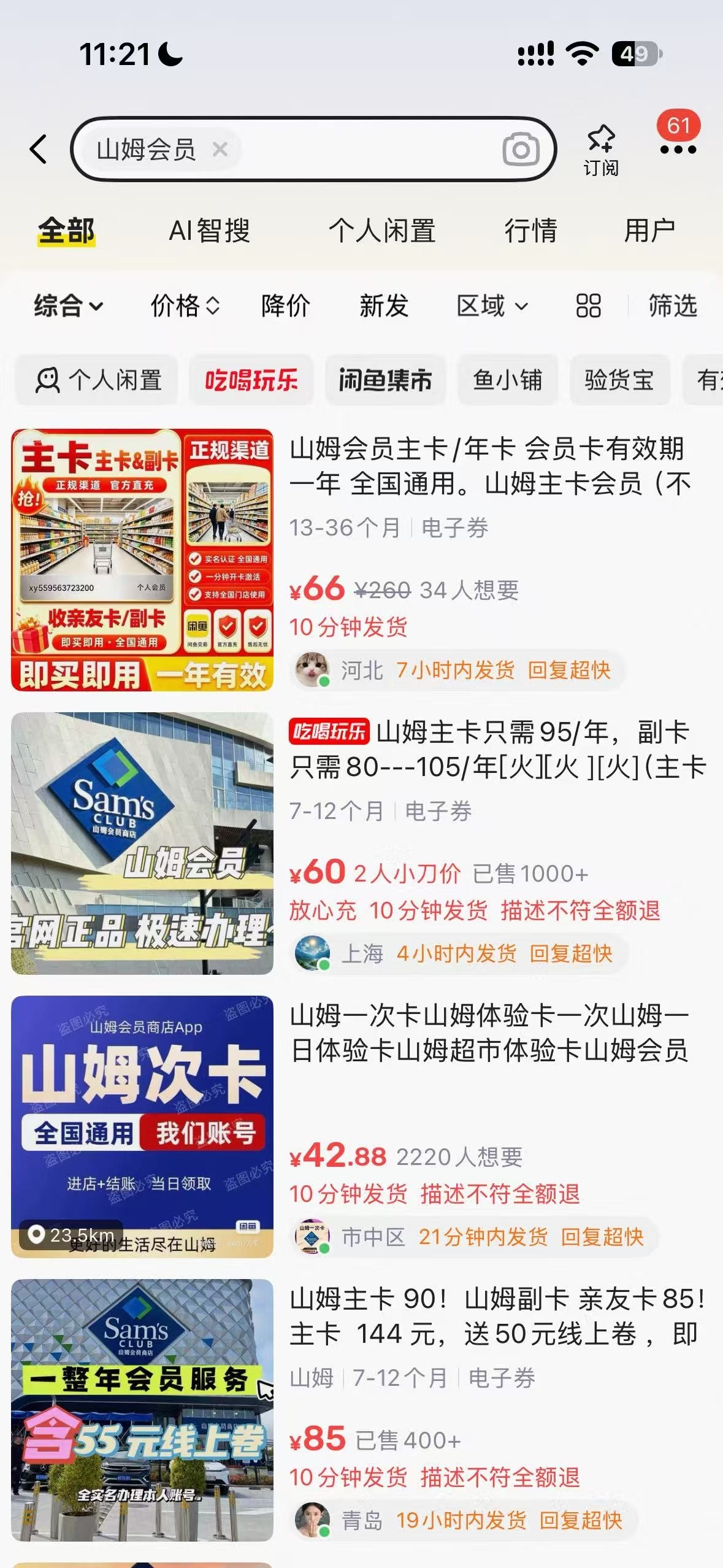
Today I bought a Sam's Club membership card on Xianyu.
Normally, activating a membership costs 260 yuan, but on Xianyu it only costs around 150 yuan.
I was curious: how exactly does the seller make money?
So I found a shop with the highest sales, contacted the seller, and placed an order for 5 yuan.
They told me to go directly to the official Sam's Club app and pay 260 yuan to activate a membership.
After activating it, they asked me to list an item for 110 yuan on Xianyu and send them the link.
Someone bought it shortly afterward.
So, subtracting 110 yuan from the 260 yuan and adding the initial 5 yuan payment, my actual expense was 155 yuan.
Also, Sam's Club gave me a 50-yuan coupon with no minimum purchase requirement.
Including the coupon, the actual cost of activating the card came to 105 yuan.
I thought the transaction was over at that point.
But unexpectedly, the other person told me that in a few days, the supplementary card would need to be removed and shared again.
I was confused. Why remove the card?
Later, I learned that the person who added me the first time had actually bought a 3-day trial card for 46 yuan.
Meanwhile, this seller's shop listed long-term supplementary cards for 98 yuan.
At that point, I understood how it worked.
He split the benefits of using a Sam's Club supplementary card into two separate sales.
First, he sells it to a short-term user for 46 yuan.
After the 3-day period ends, he has the primary cardholder remove the linked card, then shares it with a buyer looking for a long-term supplementary card, charging 98 yuan.
Let's calculate the profit.
The two sales bring in a total of 144 yuan.
He pays 110 yuan to the primary cardholder, plus the 5 yuan he collected at the start.
That gives him a theoretical gross profit of 39 yuan per transaction.
It doesn't seem like much, right?
But I took a look at this seller's Xianyu shop.
The product listing has around 15,000 people who marked it as wanted, and the shop has over 7,000 reviews.
That suggests the shop handles a substantial volume of transactions.
Let's make a conservative estimate.
If he has completed 10,000 transactions in total, at 39 yuan per transaction, his theoretical gross profit would be 390,000 yuan.
I find this business quite interesting.
The key is that the seller doesn't need to buy a Sam's Club membership himself.
He just needs to do three things well: attract customers, match buyers and sellers, and coordinate the linking of primary and supplementary cards.
The cost of activating the card is covered by the person buying the primary membership card; the seller makes money from the price difference between the two parties.
The business model behind this kind of venture is not complicated.
Some people want to get a Sam's Club primary membership card at a low price;
some just want to shop there once;
and others want to use a supplementary card long-term.
These three needs originally belonged to different people, but the seller brought them together.
I think the biggest risks with this business model are restrictions on membership rules and disputes between buyers and sellers.
For example, I saw someone mention in a negative review that the primary cardholder had removed their supplementary card, though this seems to be a very rare case.
However, if Sam's Club tightens its rules for changing supplementary cardholders later on, the whole business model could stop working.
I think the most worthwhile thing to study about this business isn't making 39 yuan on a single transaction.
It's the business logic and information gap behind it.
Often, making money doesn't necessarily require creating a new product.
We just need to identify the gap between how an existing product is priced and what users actually need.
All we have to do is find that information gap.