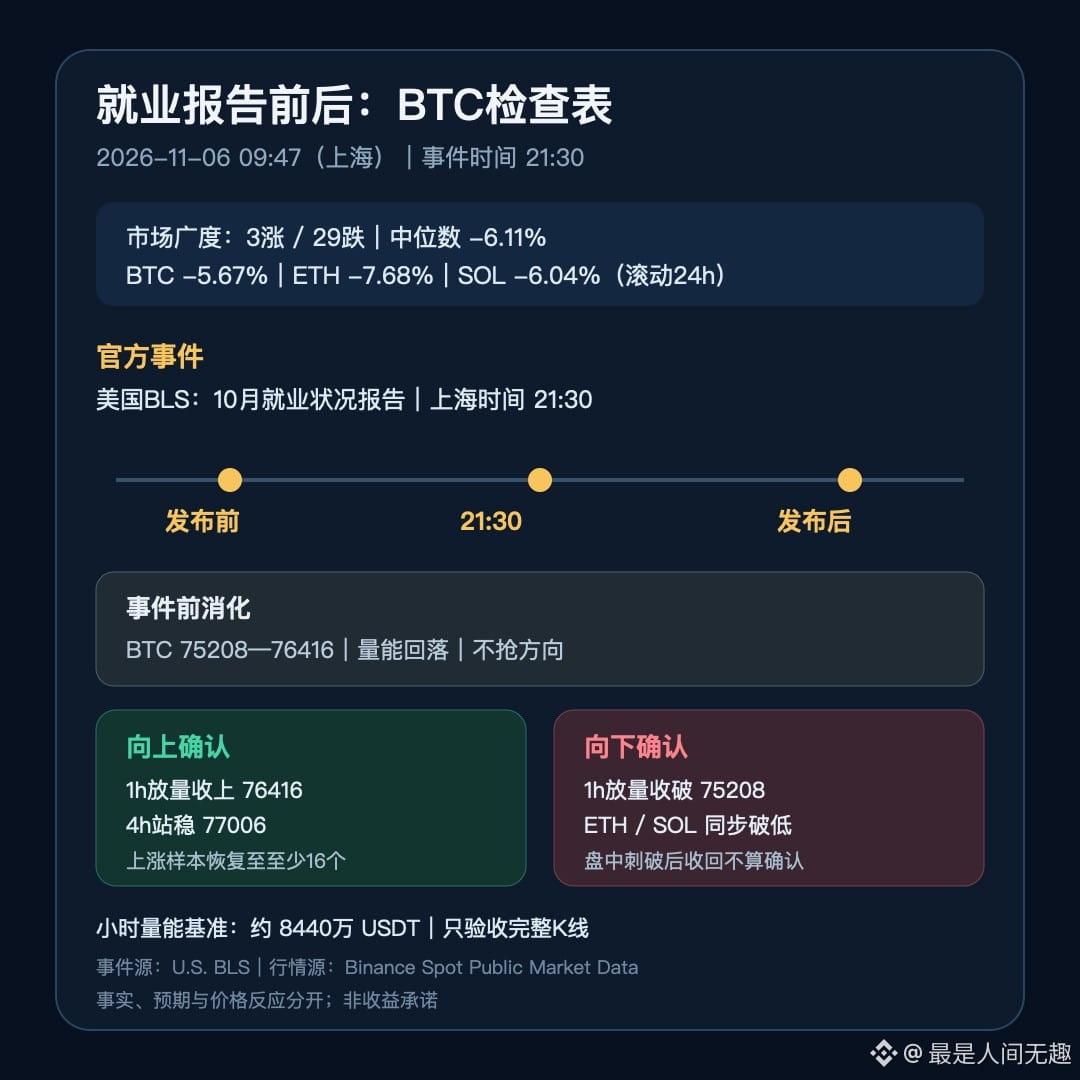
Before tonight’s 21:30 jobs report, $BTC has already fallen into a two-sided checkpoint zone
In the 09:47 Binance spot snapshot, only 3 of 32 highly liquid USDT pairs were up, while 29 were down; the median was -6.11%. BTC was down 5.67% over the rolling 24 hours, ETH fell 7.68%, and SOL fell 6.04%. This is a broad contraction in risk appetite, but the overnight drop cannot be attributed directly to a result that has not yet been released simply because a jobs report is due tonight.
First, let’s establish the facts: the US Bureau of Labor Statistics’ official calendar confirms that the October Employment Situation report will be released at 08:30 ET on November 6, corresponding to 21:30 Shanghai time. The calendar confirms only the release time; it does not tell us whether the report will be “bullish or bearish for crypto.” The data, market expectations, and price reaction are three different things.
Why is it worth setting up a checklist now? BTC’s most recent completed 4-hour candle hit a low of 75208.42 and closed at 76088.01, with about 291 million USDT in turnover—1.27 times the average of the previous 24 candles—indicating genuine turnover at the lows. The next completed 1-hour candle then rebounded from 76088.01 to 76332.56, but turnover was only about 65.2 million USDT, just 0.77 times the average for the previous 24 completed hours. Buying absorbed the selling pressure, but the recovery has yet to be confirmed by volume.
Before the release, track only the two boundaries: 75208 is the tested low, and 76416 is the high of the latest completed hourly rebound. If price stays within the range and volume continues to fade, treat it as pre-event consolidation; don’t rush to pick a direction.
After the release, don’t draw conclusions from the first sharp move up or down. Wait for a full hourly candle to confirm:
Upside path: Hourly turnover rises back above the recent average of about 84.4 million USDT and the candle closes above 76416; then BTC holds above 77006 on the 4-hour timeframe, with the number of advancing assets recovering to at least 16. Only then can we say that a recovery in risk appetite is broadening.
Downside path: An hourly candle closes below 75208 on rising volume, while ETH and SOL also break their lows. That would show selling pressure confirmed across assets. An intraday dip below the level followed by a close back above it does not count as a decisive breakdown.
The current view—“broad contraction in risk appetite, rebound unconfirmed”—is invalidated if a completed BTC 4-hour candle reclaims 77006 on rising volume while market breadth recovers to more than half. The counter-risk is that volatility expands after the jobs data is released, order-book slippage increases, and the initial price reaction is later reversed. Tap $BTC to first check real-time hourly turnover and whether the close is above or below 75208 / 76416, then decide which post-event path the market has actually accepted.