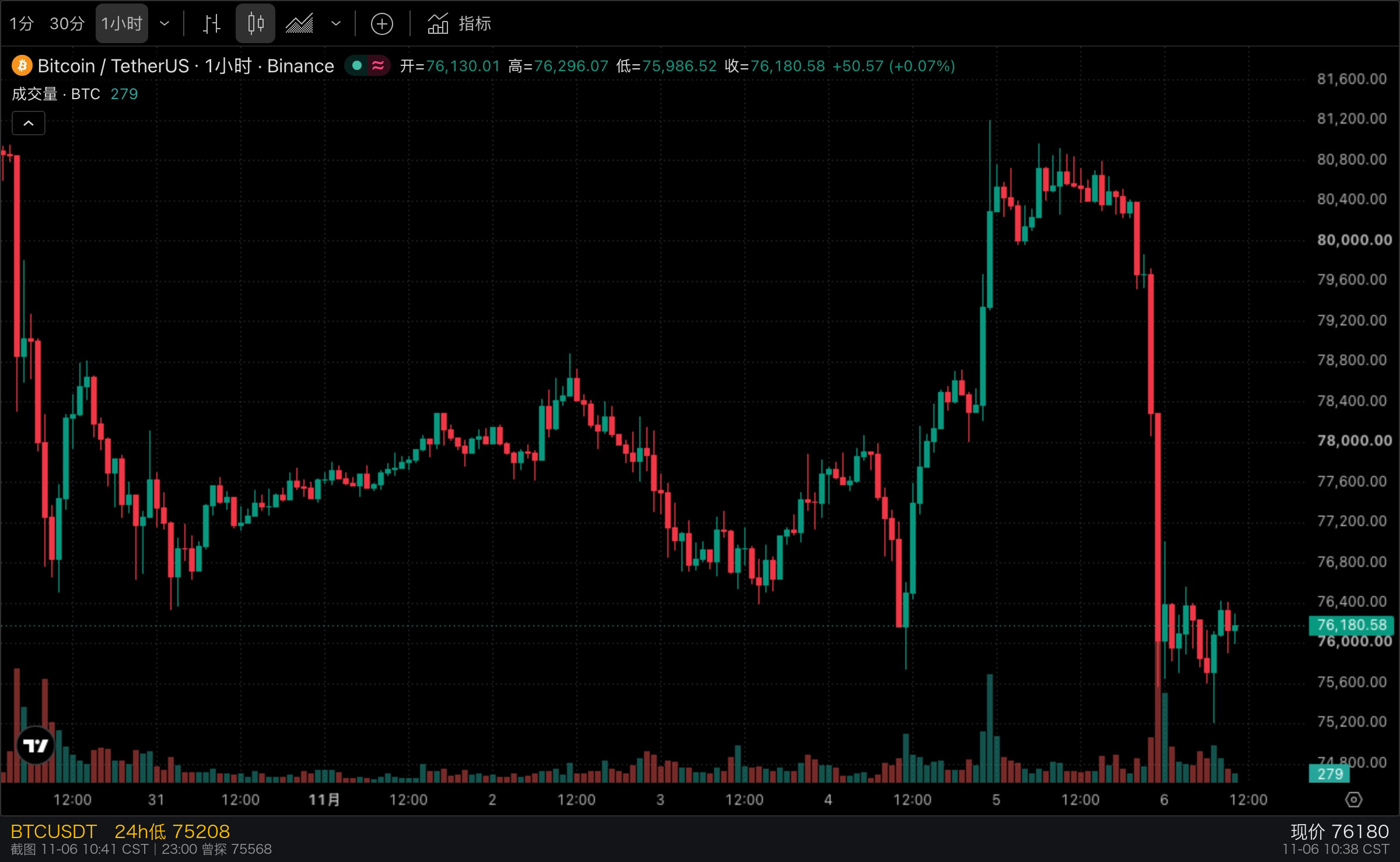
Korean stocks fell 5.28% on 11-05. Over those six and a half hours, $BTC went from 80547 to 80359, down 0.23%.
U.S. stocks opened at 22:30. By 2 a.m., 79662 had become 75850, down 4.79%.
Crypto’s pricing clock isn’t set to Asia; it’s set to the moment U.S. markets open. That’s no coincidence.
Those seven hourly candles in Asia totaled $263 million in volume. The four after the U.S. open totaled $986 million—3.7 times as much.
$ETH was even more extreme: $93 million across seven Asian candles, versus $389 million across four U.S. sessions, or 4.2 times as much.
Prices are set in the hours when the money is there.
There was no ambiguity on the memory-stock front. SK Hynix closed at 1,262,000 won, down 9.60%.
Samsung Electronics fell 7.57%, and the KOSPI fell 5.28%. That was already settled by 14:30.
That 9.60% drop in Korean stocks was a bet against memory earnings expectations. DRAM prices, long-term HBM contracts, shipments for next year’s first quarter—these can all be assessed during the daytime in Seoul.
BTC is about positioning. When positions are marked to market isn’t decided in Seoul.
So the big drop during Asian hours looks more like something still pending than a price that’s already settled.
The real action came in three candles that evening. At eight, it broke 79520; at ten, it went from 79662 to 78288; at eleven, it plunged to 75568 before recovering to 76029.
The 11 p.m. candle saw $513 million in volume, four times the previous hour.
The counterevidence is in my own data: the 8 p.m. candle broke below 79520 two and a half hours before the U.S. market opened, and over the next seven hours it fell 0.87%.
So it’s not that the Asian decline failed to carry over. It’s that by the time it did, the people taking the other side had already clocked off. The Asian session was over, Europe was watching, and the accounts actually placing orders based on their positions were in New York.
Asia sets expectations; the U.S. session sets positions.
That holds true every trading day. It’s just hard to see when volatility is low.
What I’m not sure about is whether this time difference can be used as a trading signal. This was the sequence on 11-05; one day doesn’t make a pattern.
But here’s one thing worth remembering: how much BTC falls during the Asian daytime has little bearing on how it closes that day. What really matters is whether those two candles after 22:30 hold.
Next time you see a sharp drop during the Asian daytime, treat it as news that hasn’t been settled yet—not as a price that’s already settled.
At 10:40 a.m. on 11-06, BTC was at 76170, down 5.49% for the day; ETH was at 2243 at the same time, down 7.58%.
How do you plan to use today’s sequence: reduce your position when Asia falls, or wait until the U.S. session opens to decide?
Data from Binance spot 1-hour candles and Naver Korean stock-market closing prices.
Korean stock figures are closing values for 11-05; crypto prices are readings from 10:41 CST on 11-06. The U.S. Dollar Index and other indices are not cited. This is not investment advice.