
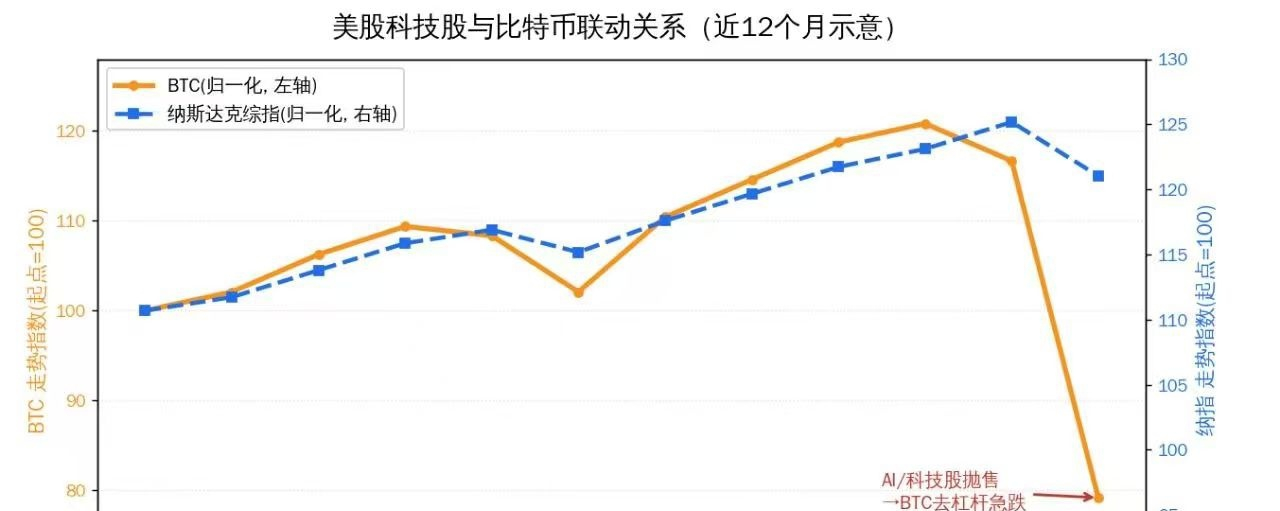

A lot of people are wondering: why did the market take another nosedive while we were asleep?
Here’s the key point: this sell-off wasn’t caused by a single negative catalyst. It was driven by the convergence of four major risks. This was no simple pullback—it was a deep shakeout fueled by broad weakness in sentiment, capital flows, leverage, and macro conditions.
A quick recap of the market action:
BTC rapidly fell back from above $80,000, dipping as low as $75,600; ETH dropped to around $2,220. More than $1 billion in liquidations hit the market over 24 hours, with 90% of them being long positions. The bulls were completely crushed.
I. The four key reasons behind this crash
1. U.S. tech stocks crashed, dragging down the entire market
After the Democratic Party took control of Congress, the market grew concerned that the AI and chip industries would face stricter regulation. The Nasdaq and semiconductor sector plunged across the board. BTC, ETH, and U.S. tech stocks are closely correlated, and as broad market sentiment collapsed, crypto naturally weakened too.
2. The fallout from Binance’s security incident continues to grow
Even though the platform promised full reimbursement after the earlier theft of a large amount of assets, the damage to market trust has already been done. Users are anxious about withdrawals, institutions are fleeing to safer assets, and market confidence cannot recover quickly—continuing to weigh on any rebound.
3. Market liquidity has shrunk significantly
There is clearly less capital available in the market now: the total supply of stablecoins continues to fall, while BTC and ETH spot ETFs have seen consecutive net outflows.
Simply put: outside capital isn’t coming in, while capital already in the market is still leaving. Combined with the Fed’s high-interest-rate environment, the market has no real momentum for a sustained rally.
4. A cascade of leveraged liquidations
After the price fell below the key support level of 77,000, a large number of leveraged long positions were liquidated. The cascading liquidations drove prices lower and lower, creating a vicious cycle that directly amplified the decline.
II. Key signals to watch closely going forward
1. Key support: BTC’s 73,000–76,000 range, where many long positions are concentrated. Holding this range could open the door to a recovery; a break below it could lead to a deeper correction.
2. Capital flows: Will ETF outflows end? Will the total supply of stablecoins stop falling and start to recover?
3. Broad market sentiment: Can the Nasdaq and AI tech stocks stabilize and rebound?
4. Regulatory developments: Updates on new U.S. congressional regulations for the crypto industry
III. Practical advice for everyday investors
1. Futures traders: Reduce leverage immediately
The market is extremely unstable right now, and using high leverage is like throwing your money away! Keep leverage to 2–3x and positions small. Never hold on to losing positions or try to buy the dip against the trend.
2. Spot traders: Don’t panic-sell or make large additional purchases
Patiently hold your core positions in major coins, and don’t panic-sell at the market’s lowest point. But there are no signs of stabilization yet, so wait and watch—don’t go all in.
3. Optimize your portfolio: Prioritize major coins
When liquidity is shrinking, capital tends to concentrate in BTC and ETH. Altcoins are highly volatile and recover very slowly, so avoid them as much as possible.
To sum up:
This is a concentrated release of risk and a retreat in market sentiment, not the start of a bull trend. Until capital flows back in and the market stabilizes, any rebounds are just oversold bounces. Don’t blindly turn bullish!
Do you think the 73,000 support level will hold? Share your thoughts in the comments!
