
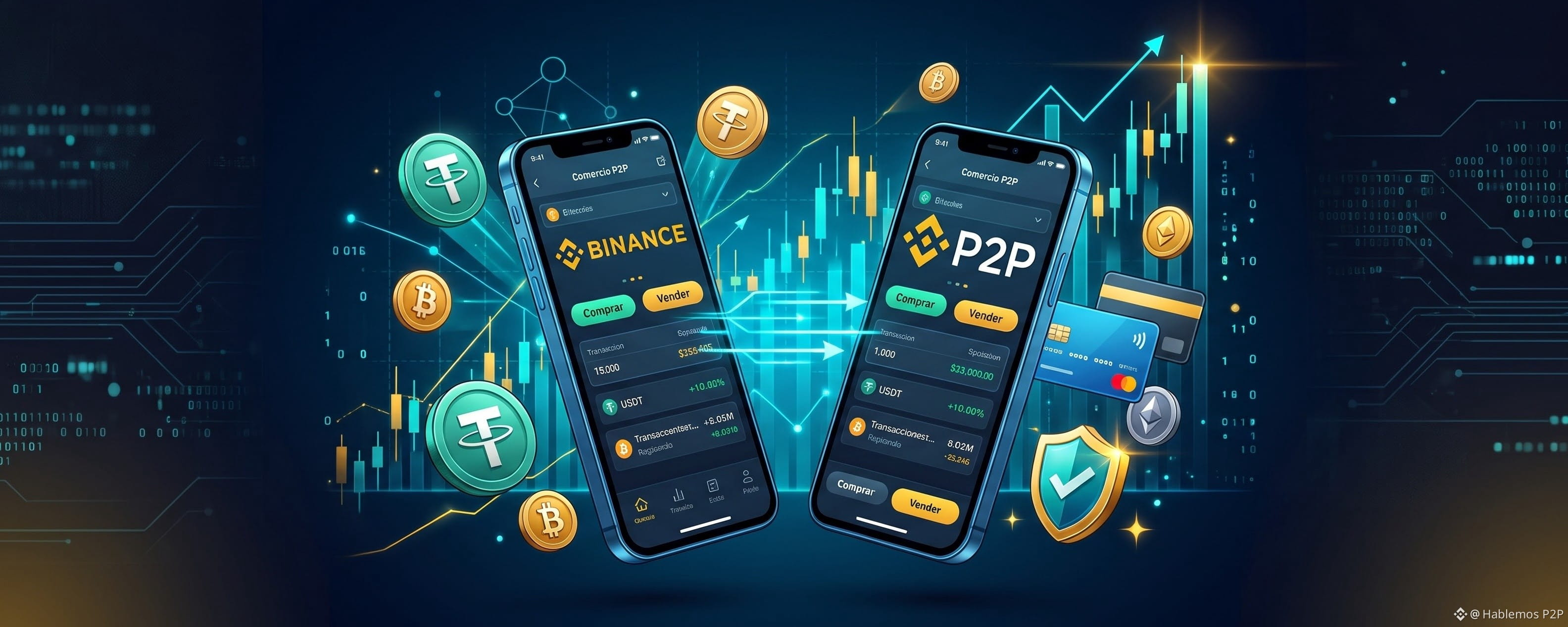
Peer-to-peer (P2P) trading has become the true driving force behind Venezuela’s digital economy. For many, it represents a path to financial independence; for others, a lifeline amid devaluation. However, behind the success stories lies a learning curve full of operational challenges, banking management, and risk control—things rarely discussed on social media.
Below, we’ve compiled the most valuable experiences, successes, and warnings shared directly by those who operate on the P2P front lines every day.
1. The myth of getting rich with 100 USDT: patience and volume
One of the most common mistakes when starting out is believing that 100 or 200 USDT will generate astronomical income right away. The mathematical reality of the market says otherwise:
Initial margin: As an unverified user, the spreads per cycle usually range from 0.5% to 1%. With 100 USDT, that amounts to generating between 0.50 and 1 USDT per cycle.
The true purpose of initial capital: It’s not to become a millionaire in the first month, but to learn how to trade, master the platform (Binance or Bybit), calibrate response times, and build a track record without risking amounts that could jeopardize your assets.
The real goal: Meet the volume requirements (trade consistently and safely) to qualify for verification as a merchant. With the verified badge, spreads and access to qualified buyers increase significantly.
2. Banking management: the trader’s Achilles’ heel
The exchange will rarely give you trouble if you follow the rules; the real challenge lies with traditional banking:
Bank accounts for regular use: Banks such as Banesco, Mercantil, and Provincial are the most commonly used and have the greatest liquidity for transfers between accounts held by the same person.
Caution with public banking (BDV): The community strongly advises against using Banco de Venezuela accounts for intensive arbitrage or to receive recurring P2P funds, due to preventive account freezes and operational delays.
Gradually increase transaction amounts: A classic mistake is opening an account and suddenly moving thousands of bolivars in dozens of daily transactions. The bank detects this unusual behavior immediately. Your transaction flow should be gradual.
Keep your documentation up to date: Keep your bank profile current, with an income certification prepared by a licensed accountant (stating your activity as a digital asset trader or digital services provider) and a letter explaining the source of funds. If the bank requests information, having a formal file makes all the difference.
3. Golden rules for protecting your capital
⛔ No transfers to/from third parties
Never accept transfers from bank accounts whose account holder name does not exactly match the name verified on Binance. Bridge accounts or third-party accounts are the main vehicle for triangulation schemes and claims involving compromised funds. If someone pays you from a third party’s account, return the funds to the original sender and cancel the order in accordance with the exchange’s rules.
⚡ The trap of “getting stuck holding bolivars”
In markets with high volatility or currency depreciation, keeping bolivars in your bank account for hours or days means a constant drain on your money. The P2P trader’s strategy is to buy and sell immediately (close the cycle). If you sell USDT to get bolivars, you should buy USDT again as soon as possible to protect your replacement capital.
🔎 Smart filters for your ads
When setting up your buy or sell ads, don’t compete solely to be in the top spot if it compromises your security. Use the platform’s filters:
Require your counterparties to have a minimum number of completed orders.
Set a high completion rate (above 95%).
Filter for counterparties with verified accounts and a certain account history.
Final thoughts for the new trader
P2P is a legitimate and profitable business, but it must be approached with business discipline. The key to lasting success is not speed, but consistency, risk management, and strict protection of your bank accounts. Take it one step at a time: first learn to walk the corridors; there will be time to run later.
Question for today’s discussion:
What has been your biggest lesson or scare while trading P2P, and which bank has provided you with the most stability so far? Share your experience in the comments!