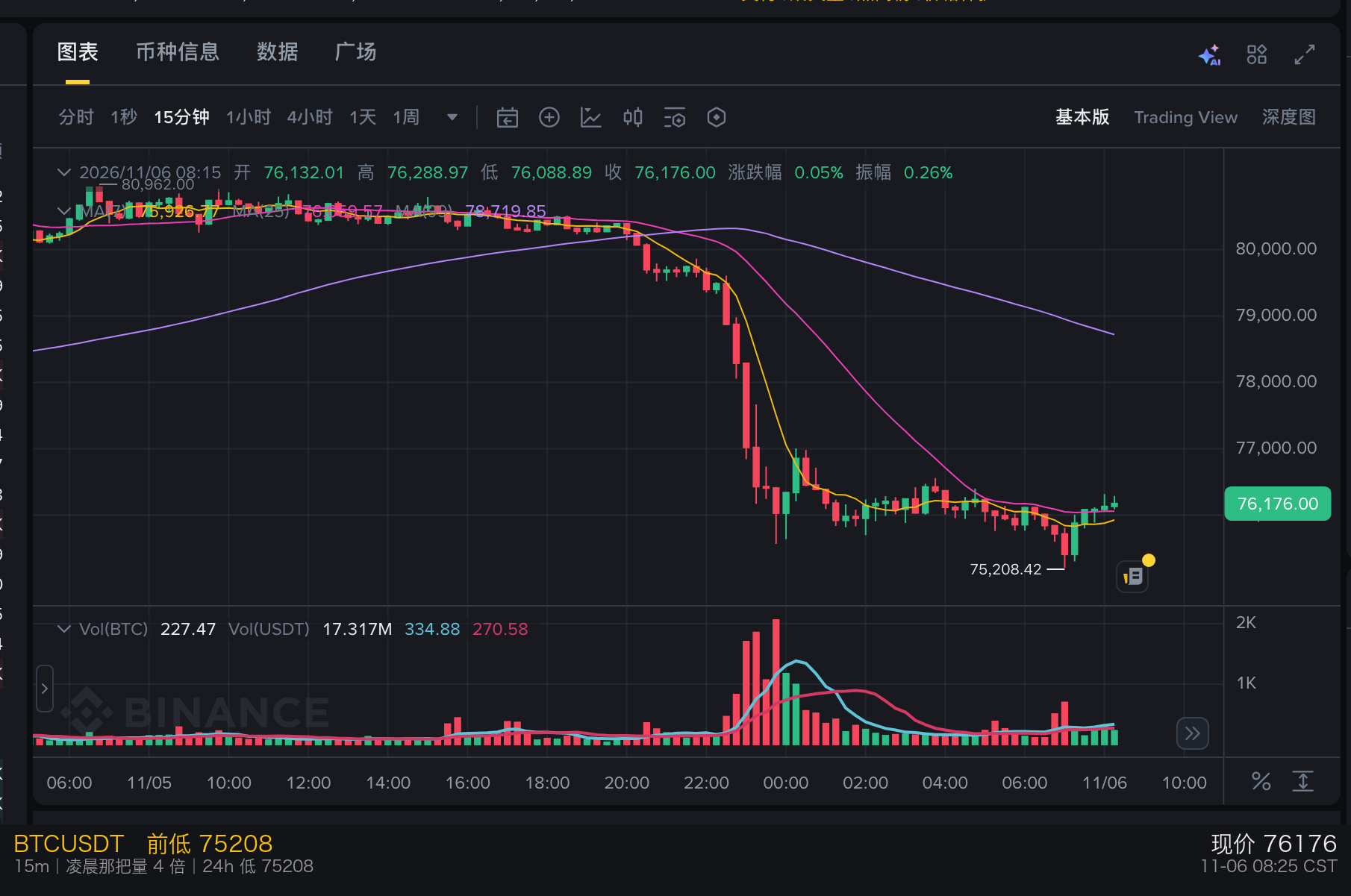
That Thursday 11 p.m. hourly candle: $BTC got slammed from 78288 to 75568, then closed at 76029. The hour saw $513 million in volume, four times the previous hour.
Those selling were being liquidated, not opening short positions.
The evidence is in the futures market. Binance perpetual open interest was still 96,610 coins at 8 p.m. By four hours later, it had fallen to 91,617 coins—a drop of 4,993 coins, or 5.17%.
During the same period, the funding rate settled at 0.0100% at 11-06 00:00, right on the zero-premium baseline. The 8 a.m. settlement was the same.
If shorts were really piling in, the funding rate would be falling. It didn’t budge.
Leverage was being cut on one side, while nobody was willing to pay to bet on a direction. Together, those two things only point to positions being liquidated—not the market repricing the asset.
But there’s something more important than the size of the drop, and it’s new.
Open interest has already recovered by half. At 2 a.m. it briefly climbed back to 94,694 coins—3,077 coins above the low, exactly 62% of what had been wiped out.
By 8 a.m., it was still at 94,179 coins. That half-recovery hadn’t been given back.
The price hasn’t returned to where it was before the sell-off, but leverage has come back first.
A 60% recovery in two hours doesn’t look like manual trading. It looks like conditional orders queued up at the same price.
The 50-week moving average is now at 75,774. That evening’s candle pierced it by $200, then closed back above it.
A break below followed by a recovery usually means there were stop-losses clustered there, not that it was a trendline.
At 7 a.m., it pierced the level again, reaching a low of 75,208—more than 500 below the moving average—then still closed back above it.
A wick can only clear orders sitting at that price. It can’t clear out people who want to leave.
There are two possible answers coming up, and both are in the playbook. If open interest gets back above 96,600 while the price doesn’t follow, that’s a second batch of leveraged positions lining up in the same trap. If open interest drops back below 91,600, then that’s real distribution.
Conversely, if this really were a cascade of long liquidations reaching its end, funding should turn negative. It’s holding at the baseline, which means shorts haven’t come in either.
Neither side is betting. That means both sides are waiting for the same thing.
$SOL 89.81 is down 6.22%, $ETH 2240.52 is down 7.81%—there isn’t a single asset across the whole market that’s down by less.
What I can’t tell is whether these 3,077 coins were bought as a dip or added as a hedge. Recovering 60% in two hours is too fast—fast enough to look automated—but there’s no way to prove it.
So what to watch next is open interest, not price.
At 8:25 a.m. on 11-06, BTC was at 76,176, down 5.62% over 24 hours.
If you’re holding a long position above 76,000, would you cut half now, or wait for open interest to get back to 96,600 before acting?
Data is from Binance spot 1-hour candles, USDⓈ-M perpetual open interest, and funding-rate endpoints.
Open interest and funding-rate figures are endpoint readings from around 8 a.m. on 11-06. This is not investment advice.