
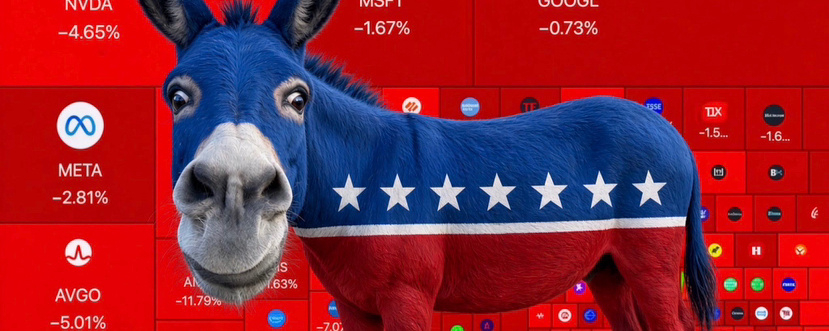

Today’s market crash looks like a massive overreaction when you consider what’s actually happening.
Investors are worried that the Democrats will use control of Congress to impose major restrictions on AI, especially data centers.
But a few important things are being overlooked.
1. AI is now a major part of the U.S. economy.
According to research from the Federal Reserve Bank of St. Louis, AI-related investment categories accounted for about 39% of U.S. economic growth in the first three quarters of 2025.
Now imagine what would happen if the government suddenly introduced restrictions that forced companies to cancel data centers, slash spending, and lay off thousands of workers.
It wouldn’t just hurt Nvidia, AMD, or other AI stocks. It could also slow down the entire U.S. economy.
And the Democrats know this.
They have another election coming up in November 2028.
If their policies lead to slower growth, fewer jobs, and a weaker stock market, voters could punish them in that election.
That’s why a complete shutdown of AI development seems very unlikely.
2. The Democrats can’t simply pass any laws they want.
The Republicans will still control Congress until January 3, 2027.
Even after the Democrats take over, Trump can veto bills, and overriding him requires a two-thirds majority in both chambers.
The Democrats don’t have enough votes to do that on their own.
They can block Republican bills, but passing major new federal AI restrictions would require Trump’s support or enough Republican votes.
Of course, state governments can still restrict data center development through permits, electricity regulations, and other rules.
But regulating an industry and completely stopping its growth are two very different things.
3. Some of this sell-off may simply be profit-taking.
Just yesterday, stocks surged as investors hoped the election results would bring more clarity and possibly improve the chances of ending the Iran war.
Now that optimism has almost vanished overnight.
With AI valuations still high and companies spending billions of dollars on infrastructure, some investors may be using these rallies to reduce their exposure.
That doesn’t necessarily mean the entire AI trade is collapsing.
4. Remember the April 2025 Liberation Day crash?
The S&P 500 fell about 11% in just two trading days as investors feared a recession and a prolonged trade war.
But then Trump paused many of the tariffs.
By April 24, the index had recovered more than 10% from its low.
And by May 21, it had risen about 19% from its April bottom.
The economic risks hadn’t disappeared. Investors simply realized that the worst-case scenario was becoming less likely.
A similar rebound could happen if the proposed AI restrictions turn out to be less severe than investors currently fear.
5. History also favors a rebound after midterm elections.
Since 1950, the S&P 500 has NEVER delivered a negative return in the 12 months following a U.S. midterm election.
That’s 19 consecutive midterm elections with positive 12-month returns, averaging around 15%.
Of course, the Iran war, inflation, and lofty AI valuations remain serious risks.
But nothing fundamentally changed overnight to suggest that AI development is about to stop or that the entire U.S. economy is headed for a collapse.
Markets could rebound much faster than people expect once there’s more clarity about what the Democrats actually plan to do.