
Jacob trade
8.9k Posts

Jacob trade
Report
Block User
Jacob Trade: Where trends are made, and profits never fade 💰💰
86 Following
423 Followers
3.0K+ Liked
Posts
All
Quotes
PINNED
·
--
#trumpmeetsonwideriranoffensive
The “Situation Room” meeting by Trump signals a new dangerous phase in Iran
war: “The objective now is to ...”
-
Trump mentioned a massive offensive against Iran
.
- The United States aims to damage
Iran
, and to open the Strait of Hormuz.
- Tensions are intensifying; an American blockade,
Iran strikes American bases.
#USUKTreasuriesRecommendStablecoinAlignment
#BinanceSquare #Trump #ChinaQ2GDPGrows4.3%MissingForecast
$BTC
{future}(BTCUSDT)
$ETH
{future}(ETHUSDT)
$BANK
{future}(BANKUSDT)
#trumpmeetsonwideriranoffensive
The “Situation Room” meeting by Trump signals a new dangerous phase in Iran
war: “The objective now is to ...”
-
Trump mentioned a massive offensive against Iran
.
- The United States aims to damage
Iran
, and to open the Strait of Hormuz.
- Tensions are intensifying; an American blockade,
Iran strikes American bases.
#USUKTreasuriesRecommendStablecoinAlignment
#BinanceSquare #Trump #ChinaQ2GDPGrows4.3%MissingForecast
$BTC
$ETH
$BANK

6
17
37.9k
PINNED
·
--
Verified
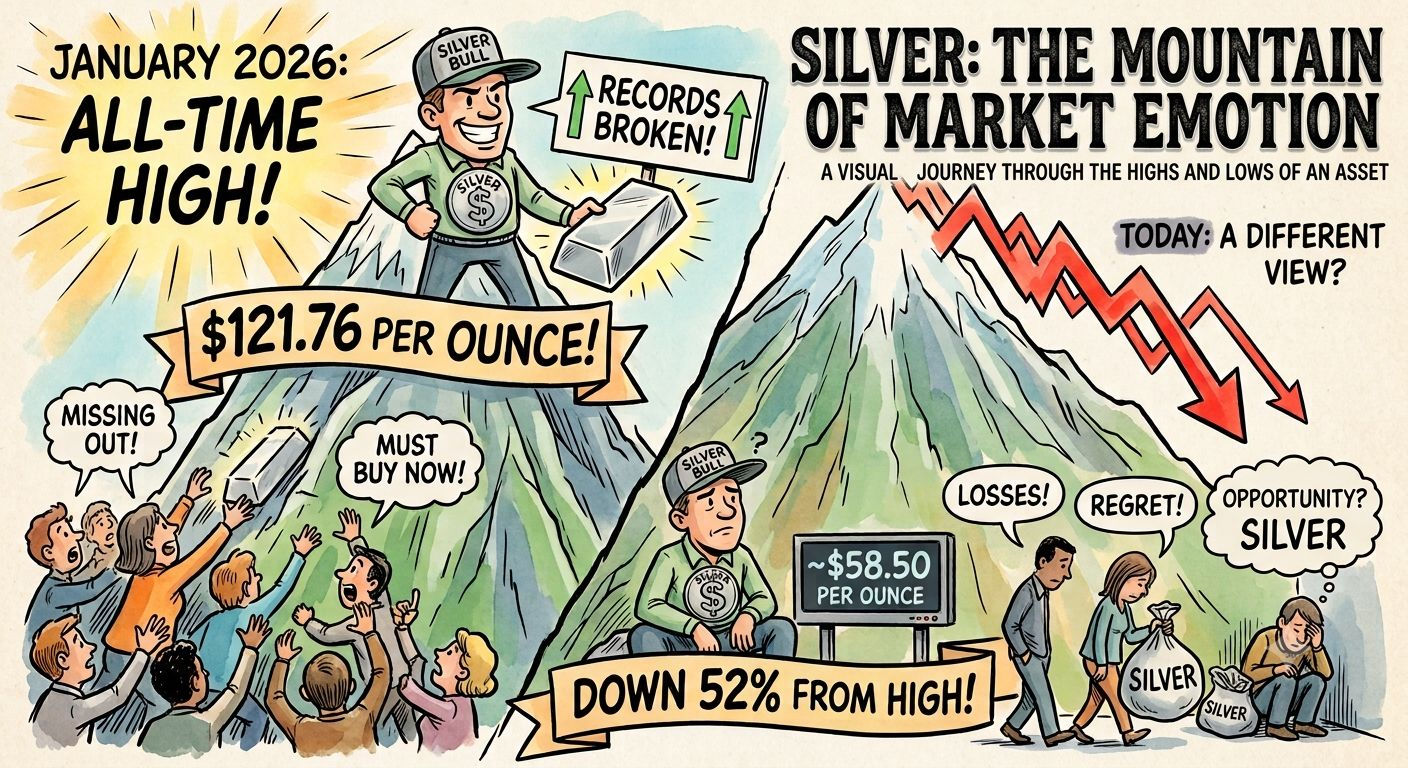
#silverdown52%fromjanuaryrecordhigh
Silver in free fall of 52%... Is this the opportunity everyone is missing?
💥 The price of silver hit its peak point in January 2026: it was worth $121.76. But today, it’s trading around $58.50. In other words, silver has lost more than half of its value. Many people who trade are wondering whether this is a major panic or if it’s the right time to buy silver for the long term.
#PreciousMetalsRally #silver #SilverDown52%FromJanuaryRecordHigh
#BinanceSquare
$XAG $XAUT $EVAA
12
25.3k
·
--
#USMidtermsCouldShakeUpUS-IranTies
US Midterms aren’t just a political show... This is the literal macro trigger that could ignite the oil markets, rewrite sanctions, and either crash crypto liquidity or send it flying! 📉📈
Whales are watching Washington like hawks while retail traders chase 5-minute candles. When oil spikes due to Iran tensions, rate cuts get delayed, and altcoins bleed instantly.
🛑 The big question: Do you think these political shocks will trigger a brutal market wipeout before the next leg up, or will the market completely ignore the macro noise as usual?
Drop your take in the comments below, and hit follow for real-time breakdowns! 👇
#USMidterms #CryptoMacro
$AKE
{future}(AKEUSDT)
$UAI
{future}(UAIUSDT)
$CYBER
{future}(CYBERUSDT)
#USMidtermsCouldShakeUpUS-IranTies
US Midterms aren’t just a political show... This is the literal macro trigger that could ignite the oil markets, rewrite sanctions, and either crash crypto liquidity or send it flying! 📉📈
Whales are watching Washington like hawks while retail traders chase 5-minute candles. When oil spikes due to Iran tensions, rate cuts get delayed, and altcoins bleed instantly.
🛑 The big question: Do you think these political shocks will trigger a brutal market wipeout before the next leg up, or will the market completely ignore the macro noise as usual?
Drop your take in the comments below, and hit follow for real-time breakdowns! 👇
#USMidterms #CryptoMacro
$AKE
$UAI
$CYBER

503
·
--
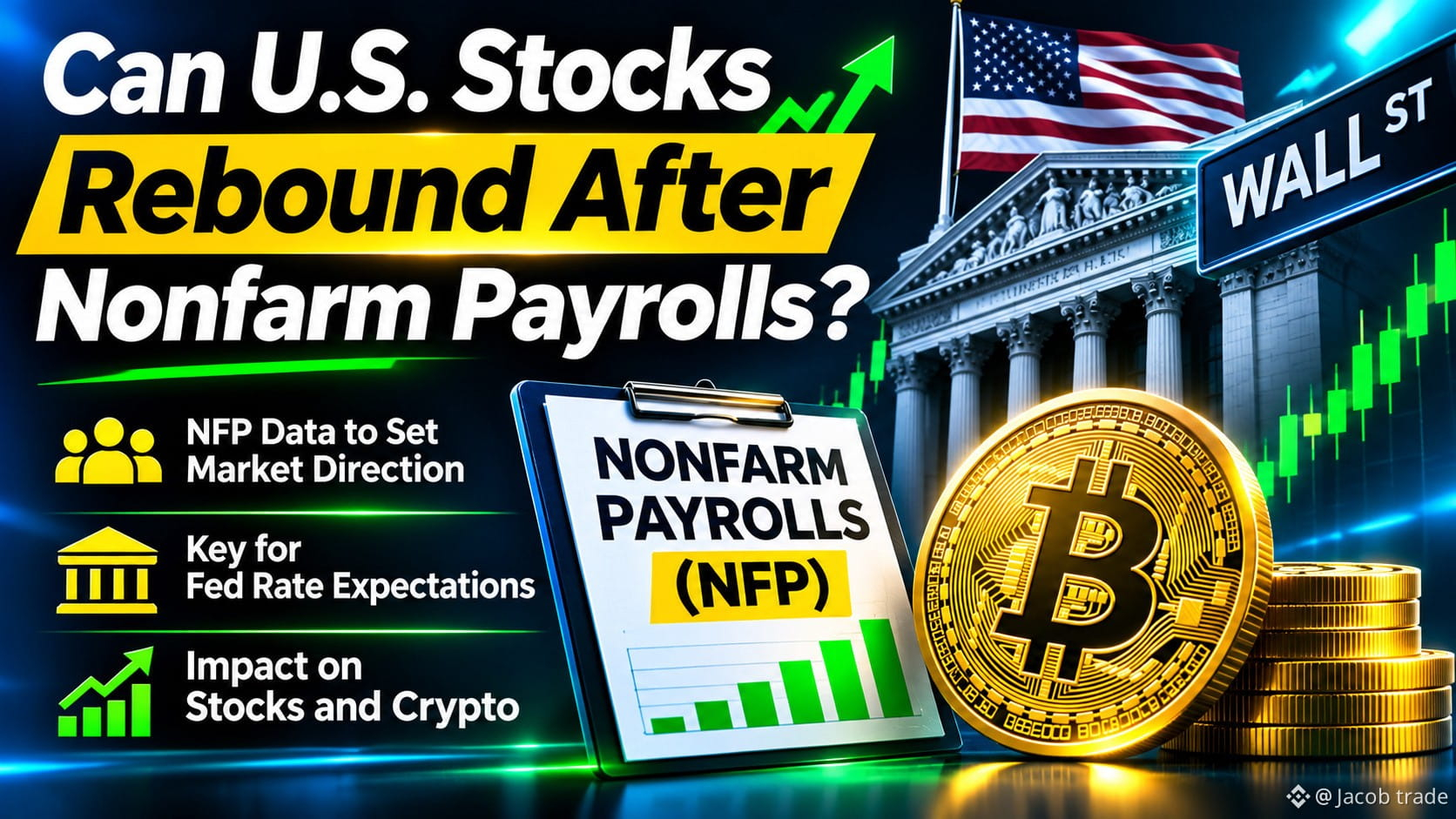
#canusstocksreboundafternonfarmpayrolls?
🇺🇸 Can U.S. stocks rebound after the nonfarm payrolls report?
After a strong session marked by a retreat from risk, U.S. markets are waiting for the latest nonfarm payrolls report to find direction. Disappointing employment data could strengthen expectations of a Federal Reserve policy easing, while stronger figures could continue to weigh on hopes for rate cuts.
📊 For cryptocurrencies, the key question is how markets will interpret this data through Treasury yields, the U.S. dollar, and expectations regarding the Fed. A weaker labor market could improve risk appetite, but that does not automatically mean Bitcoin will see a sustained rise.
₿ In summary: the nonfarm payrolls report could be an important short-term volatility catalyst for both stocks and cryptocurrencies. Traders will likely focus less on the headline figure than on what it implies for the Fed’s next monetary policy decisions.
$AKE
{future}(AKEUSDT)
$UAI
{future}(UAIUSDT)
$CYBER
{future}(CYBERUSDT)
#canusstocksreboundafternonfarmpayrolls?
🇺🇸 Can U.S. stocks rebound after the nonfarm payrolls report?
After a strong session marked by a retreat from risk, U.S. markets are waiting for the latest nonfarm payrolls report to find direction. Disappointing employment data could strengthen expectations of a Federal Reserve policy easing, while stronger figures could continue to weigh on hopes for rate cuts.
📊 For cryptocurrencies, the key question is how markets will interpret this data through Treasury yields, the U.S. dollar, and expectations regarding the Fed. A weaker labor market could improve risk appetite, but that does not automatically mean Bitcoin will see a sustained rise.
₿ In summary: the nonfarm payrolls report could be an important short-term volatility catalyst for both stocks and cryptocurrencies. Traders will likely focus less on the headline figure than on what it implies for the Fed’s next monetary policy decisions.
$AKE
$UAI
$CYBER
3
1.5k
·
--
#hongkongplanstaxincentivescoveringdigitalassets 🇭🇰 Hong Kong expands tax incentives to digital assets
Hong Kong is stepping up efforts to realize its ambition of becoming Asia’s leading hub for digital assets. New regulatory proposals aim to extend tax benefits to cryptoassets held by eligible funds and family offices.
📰 Top stories
• The Hong Kong government is expanding its preferential tax regimes to explicitly include digital assets and gold for family offices and private funds www.ifcreview.com.
• Announced in the 2026–2027 budget, this initiative aims to modernize the tax framework for funds and attract international asset managers www.sidley.com.
• To qualify for these benefits, funds must meet specific operational criteria, such as employing full-time local staff and incurring a minimum amount of local expenditure www.sidley.com.
📊 Market impact
• 🏢 Institutional inflows: By classifying digital assets as commodities eligible for tax benefits, Hong Kong stands out from competing jurisdictions, potentially accelerating institutional capital allocation www.alpadis.com.
• ⚖️ Regulatory maturity: This proactive and structured approach reflects a stable, compliant environment and encourages legitimate Web3 companies to establish their regional headquarters there.
• 🌐 Ecosystem growth: A greater presence of family offices and hedge funds could boost liquidity and foster innovation in the region’s tokenized assets and decentralized infrastructure.
💬 Let’s talk
What impact do you think these targeted tax incentives will have on global competition among crypto-friendly jurisdictions? Share your thoughts in the comments below
$AKE
{future}(AKEUSDT)
$UAI
{future}(UAIUSDT)
$CYBER
{future}(CYBERUSDT)
#hongkongplanstaxincentivescoveringdigitalassets 🇭🇰 Hong Kong expands tax incentives to digital assets
Hong Kong is stepping up efforts to realize its ambition of becoming Asia’s leading hub for digital assets. New regulatory proposals aim to extend tax benefits to cryptoassets held by eligible funds and family offices.
📰 Top stories
• The Hong Kong government is expanding its preferential tax regimes to explicitly include digital assets and gold for family offices and private funds www.ifcreview.com.
• Announced in the 2026–2027 budget, this initiative aims to modernize the tax framework for funds and attract international asset managers www.sidley.com.
• To qualify for these benefits, funds must meet specific operational criteria, such as employing full-time local staff and incurring a minimum amount of local expenditure www.sidley.com.
📊 Market impact
• 🏢 Institutional inflows: By classifying digital assets as commodities eligible for tax benefits, Hong Kong stands out from competing jurisdictions, potentially accelerating institutional capital allocation www.alpadis.com.
• ⚖️ Regulatory maturity: This proactive and structured approach reflects a stable, compliant environment and encourages legitimate Web3 companies to establish their regional headquarters there.
• 🌐 Ecosystem growth: A greater presence of family offices and hedge funds could boost liquidity and foster innovation in the region’s tokenized assets and decentralized infrastructure.
💬 Let’s talk
What impact do you think these targeted tax incentives will have on global competition among crypto-friendly jurisdictions? Share your thoughts in the comments below
$AKE
$UAI
$CYBER

2
3.3k
·
--
#usstocksslipandcryptomarketunderbroadpressure
The wave of AI-linked stock selling on Wall Street hit cryptocurrencies within hours. But not all coins fell in the same way. 📉
Why stocks fell
The Nasdaq 100 lost about 6.4%, while semiconductor stocks plunged (semiconductor index: about -12%), amid fears that a Democratic-majority Congress could tighten regulations on AI and data center development.
Crypto roundup (24h)
BTC -5.8%
Higher-beta altcoins fell more than BTC, a classic risk-off pattern.
Cross-check
Sources agree on about $1 billion in liquidations, but differ on the breakdown: about 88% long positions according to BeInCrypto, versus about 74% in another estimate. In any case, forced selling amplified the decline.
What to watch
1) BTC support is between $75,000 and $76,000; moving back above $80,000 would be a sign of recovery.
2) Today's U.S. jobs report (8:30 a.m. ET, consensus around 65,000; ADP reported +86,000). Analysts are divided between a Fed pause in December and a rate hike, so expect volatile reactions.
Bottom line: this looks like contagion from the tech sector, not a crypto-specific breakdown. Adjust your position sizes to account for volatility. This is not financial advice.
$AKE
{future}(AKEUSDT)
$UAI
{future}(UAIUSDT)
$BTC
{future}(BTCUSDT)
#usstocksslipandcryptomarketunderbroadpressure
The wave of AI-linked stock selling on Wall Street hit cryptocurrencies within hours. But not all coins fell in the same way. 📉
Why stocks fell
The Nasdaq 100 lost about 6.4%, while semiconductor stocks plunged (semiconductor index: about -12%), amid fears that a Democratic-majority Congress could tighten regulations on AI and data center development.
Crypto roundup (24h)
BTC -5.8%
Higher-beta altcoins fell more than BTC, a classic risk-off pattern.
Cross-check
Sources agree on about $1 billion in liquidations, but differ on the breakdown: about 88% long positions according to BeInCrypto, versus about 74% in another estimate. In any case, forced selling amplified the decline.
What to watch
1) BTC support is between $75,000 and $76,000; moving back above $80,000 would be a sign of recovery.
2) Today's U.S. jobs report (8:30 a.m. ET, consensus around 65,000; ADP reported +86,000). Analysts are divided between a Fed pause in December and a rate hike, so expect volatile reactions.
Bottom line: this looks like contagion from the tech sector, not a crypto-specific breakdown. Adjust your position sizes to account for volatility. This is not financial advice.
$AKE
$UAI
$BTC

2.4k
·
--
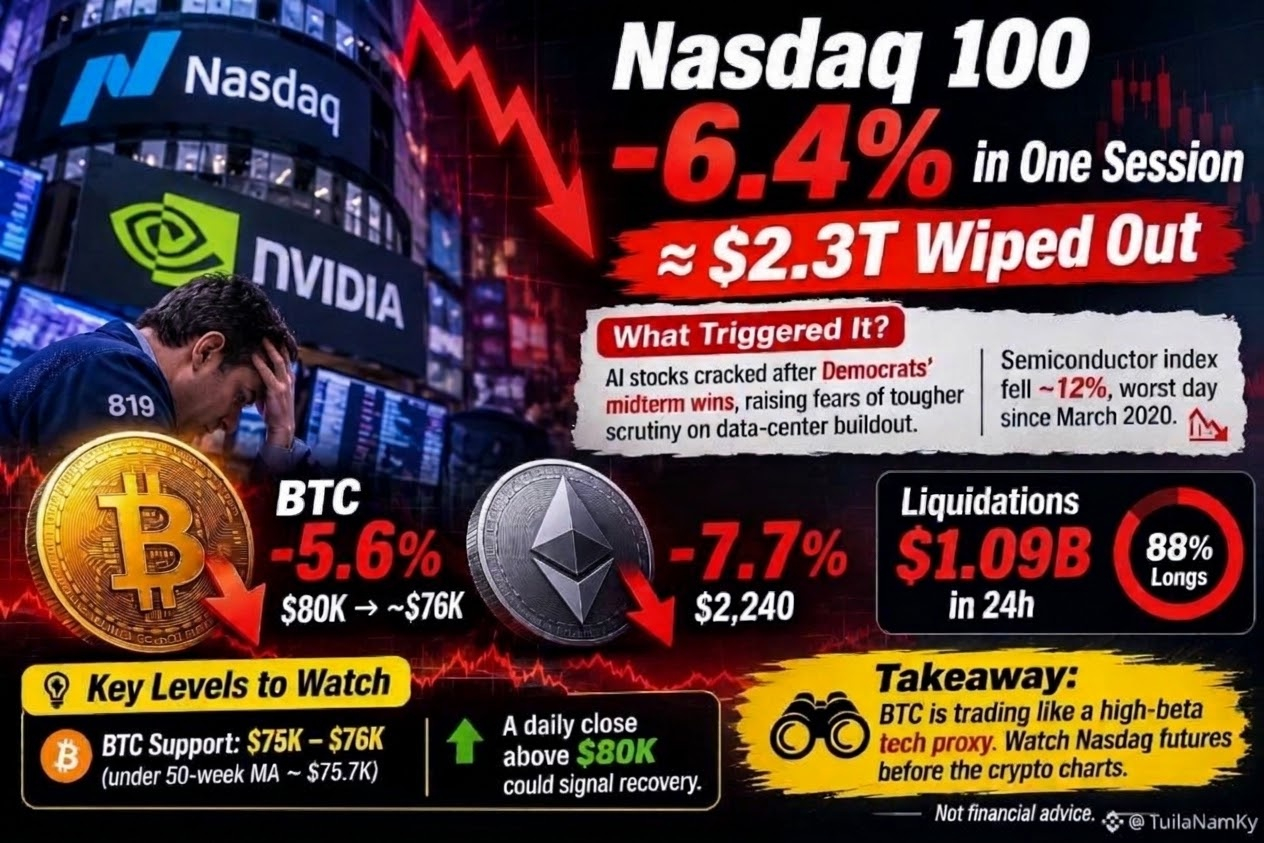
#nasdaq100tumbles6%
📉 The Nasdaq 100 fell 6.4% in a single session, wiping out about $2.3T. Cryptocurrencies felt the impact immediately.
What triggered the drop
AI-related stocks plunged after Democratic victories in the midterm elections reignited fears of stricter controls on data center development. The semiconductor index fell about 12%, its worst day since March 2020, with industry leaders driving the decline.
Impact on cryptocurrencies
bitcoin fell about 5.6%, from over $80K to around $76K. $
About $1.09B in positions were liquidated in 24 hours, nearly 88% of them long positions.
My analysis
Sources agree on the cause but differ on the scale ($2.3T versus $2.5T, Nasdaq 100 versus Nasdaq Composite). This looks like a leveraged-position unwind adding to a stock market shock. Inflows of $74.6M into spot Bitcoin ETFs on November 4 weren’t enough to absorb the shock.
Levels to watch
Bitcoin support: $75K–$76K (it fell below the 50-week moving average, near $75.7K). A daily close above $80K would signal a recovery.
Takeaway: bitcoin moves like a high-beta tech asset. Watch Nasdaq futures before cryptocurrency charts. This is not financial advice.
$AKE
{future}(AKEUSDT)
$BTC
{future}(BTCUSDT)
$UAI
{future}(UAIUSDT)
#nasdaq100tumbles6%
📉 The Nasdaq 100 fell 6.4% in a single session, wiping out about $2.3T. Cryptocurrencies felt the impact immediately.
What triggered the drop
AI-related stocks plunged after Democratic victories in the midterm elections reignited fears of stricter controls on data center development. The semiconductor index fell about 12%, its worst day since March 2020, with industry leaders driving the decline.
Impact on cryptocurrencies
bitcoin fell about 5.6%, from over $80K to around $76K. $
About $1.09B in positions were liquidated in 24 hours, nearly 88% of them long positions.
My analysis
Sources agree on the cause but differ on the scale ($2.3T versus $2.5T, Nasdaq 100 versus Nasdaq Composite). This looks like a leveraged-position unwind adding to a stock market shock. Inflows of $74.6M into spot Bitcoin ETFs on November 4 weren’t enough to absorb the shock.
Levels to watch
Bitcoin support: $75K–$76K (it fell below the 50-week moving average, near $75.7K). A daily close above $80K would signal a recovery.
Takeaway: bitcoin moves like a high-beta tech asset. Watch Nasdaq futures before cryptocurrency charts. This is not financial advice.
$AKE
$BTC
$UAI
5.5k
·
--
#usstocksslipandcryptomarketunderbroadpressure U.S. stocks fell on Thursday as a wave of selling in the semiconductor sector dragged the Nasdaq sharply lower. Investors fear the election results may be followed by new rules for the AI sector. Cryptocurrencies also declined. Bitcoin fell below $79,000, and crypto-related stocks such as Coinbase and Strategy lost around 4–5%. Bitcoin and ether funds also continued to see outflows this week. All eyes are now on Friday’s jobs report. 📉
$UAI
{future}(UAIUSDT)
$AKE
{future}(AKEUSDT)
$UVXY
{future}(UVXYUSDT)
#usstocksslipandcryptomarketunderbroadpressure U.S. stocks fell on Thursday as a wave of selling in the semiconductor sector dragged the Nasdaq sharply lower. Investors fear the election results may be followed by new rules for the AI sector. Cryptocurrencies also declined. Bitcoin fell below $79,000, and crypto-related stocks such as Coinbase and Strategy lost around 4–5%. Bitcoin and ether funds also continued to see outflows this week. All eyes are now on Friday’s jobs report. 📉
$UAI
$AKE
$UVXY
$UAI
$AKE
$UVXY

2.8k
·
--
Verified
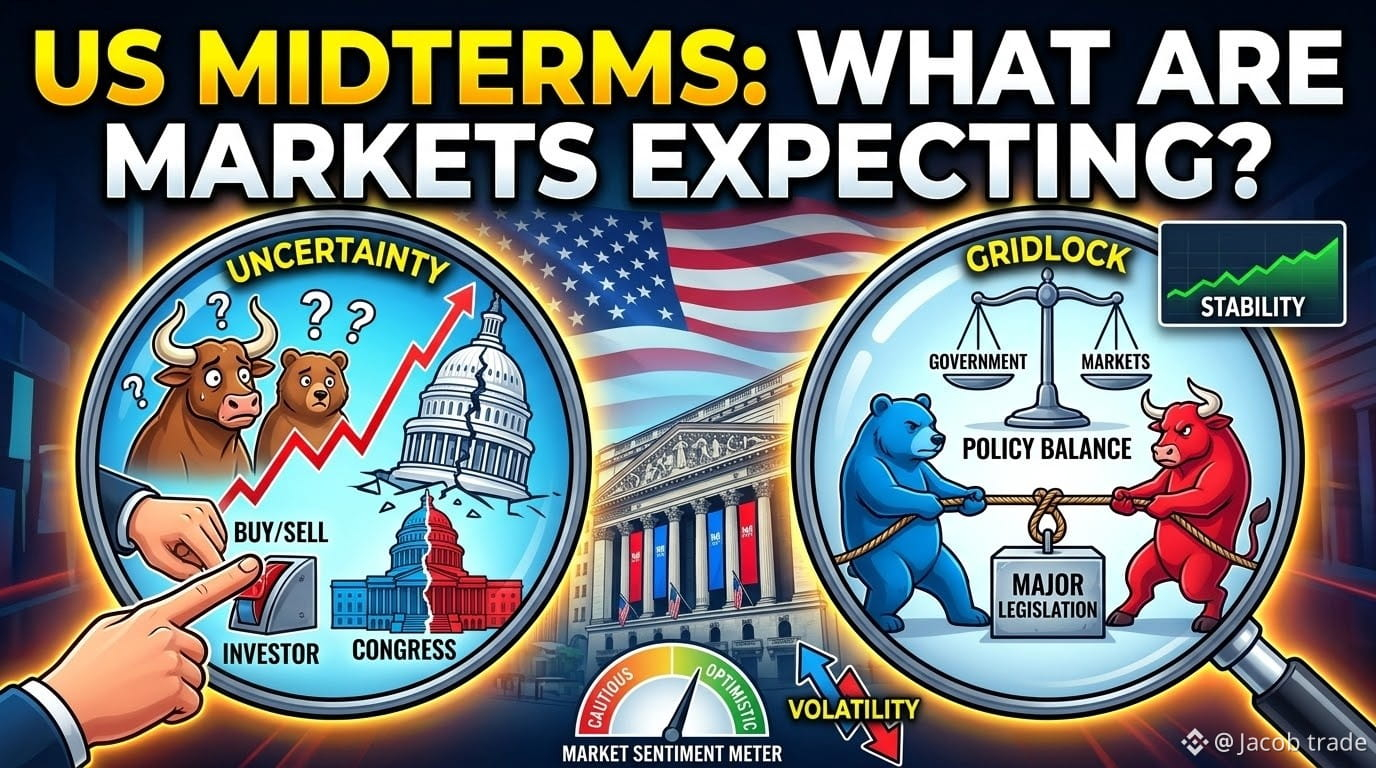
#usmidterms-whataremarketsexpecting?
Following the U.S. midterm elections, major stock market indices are surging as uncertainty surrounding the elections has dissipated.
Investors expect political gridlock, with a divided or Democrat-led Congress, which traditionally reassures markets by limiting major policy changes. Shares in the clean energy, healthcare, and retail sectors are advancing, buoyed by hopes for favorable environmental policies and increased spending. By contrast, technology and AI stocks are under pressure due to possible regulations, defense stocks are declining, and oil prices and bond yields have fallen.
$SOXS
{future}(SOXSUSDT)
$UVXY
{future}(UVXYUSDT)
$ARIA
{future}(ARIAUSDT)
#usmidterms-whataremarketsexpecting?
Following the U.S. midterm elections, major stock market indices are surging as uncertainty surrounding the elections has dissipated.
Investors expect political gridlock, with a divided or Democrat-led Congress, which traditionally reassures markets by limiting major policy changes. Shares in the clean energy, healthcare, and retail sectors are advancing, buoyed by hopes for favorable environmental policies and increased spending. By contrast, technology and AI stocks are under pressure due to possible regulations, defense stocks are declining, and oil prices and bond yields have fallen.
$SOXS
$UVXY
$ARIA
3
3.9k
·
--
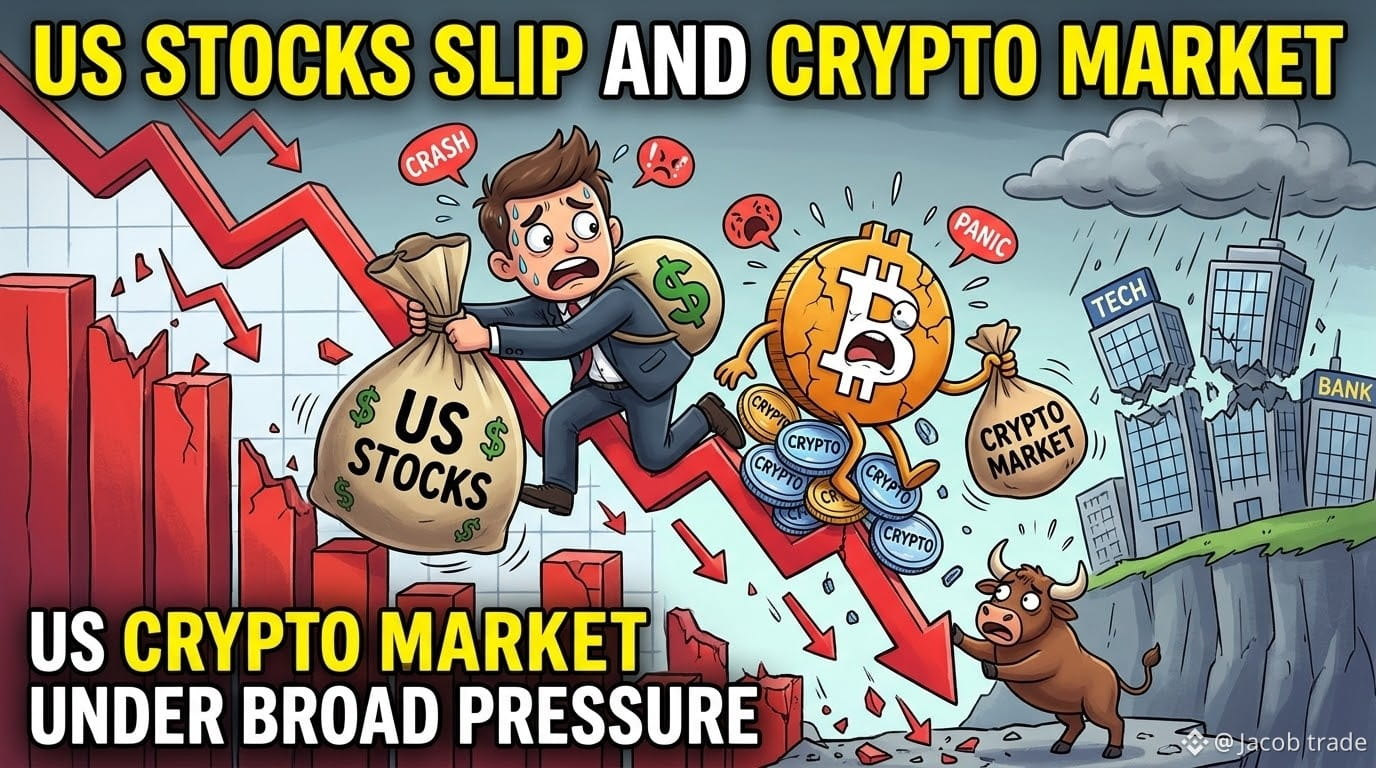
#usstocksslipandcryptomarketunderbroadpressure Both U.S. stocks and the cryptocurrency market are under heavy pressure right now. Investors are worried about high interest rates, the substantial costs associated with artificial intelligence, and weak economic growth. Major stock indexes, such as the S&P 500 and Nasdaq, have fallen sharply, with large technology companies losing value. At the same time, leading cryptocurrencies, such as Bitcoin and Ethereum, are plunging as traders sell their riskier investments. Investors remain cautious while waiting for market conditions to improve.
$UVXY
{future}(UVXYUSDT)
$SOXS
{future}(SOXSUSDT)
$LYN
{future}(LYNUSDT)
#usstocksslipandcryptomarketunderbroadpressure Both U.S. stocks and the cryptocurrency market are under heavy pressure right now. Investors are worried about high interest rates, the substantial costs associated with artificial intelligence, and weak economic growth. Major stock indexes, such as the S&P 500 and Nasdaq, have fallen sharply, with large technology companies losing value. At the same time, leading cryptocurrencies, such as Bitcoin and Ethereum, are plunging as traders sell their riskier investments. Investors remain cautious while waiting for market conditions to improve.
$UVXY
$SOXS
$LYN
$UVXY
$SOXS
$LYN
1
1.7k
·
--
#us10yeartreasuryyieldfallsto4.845%
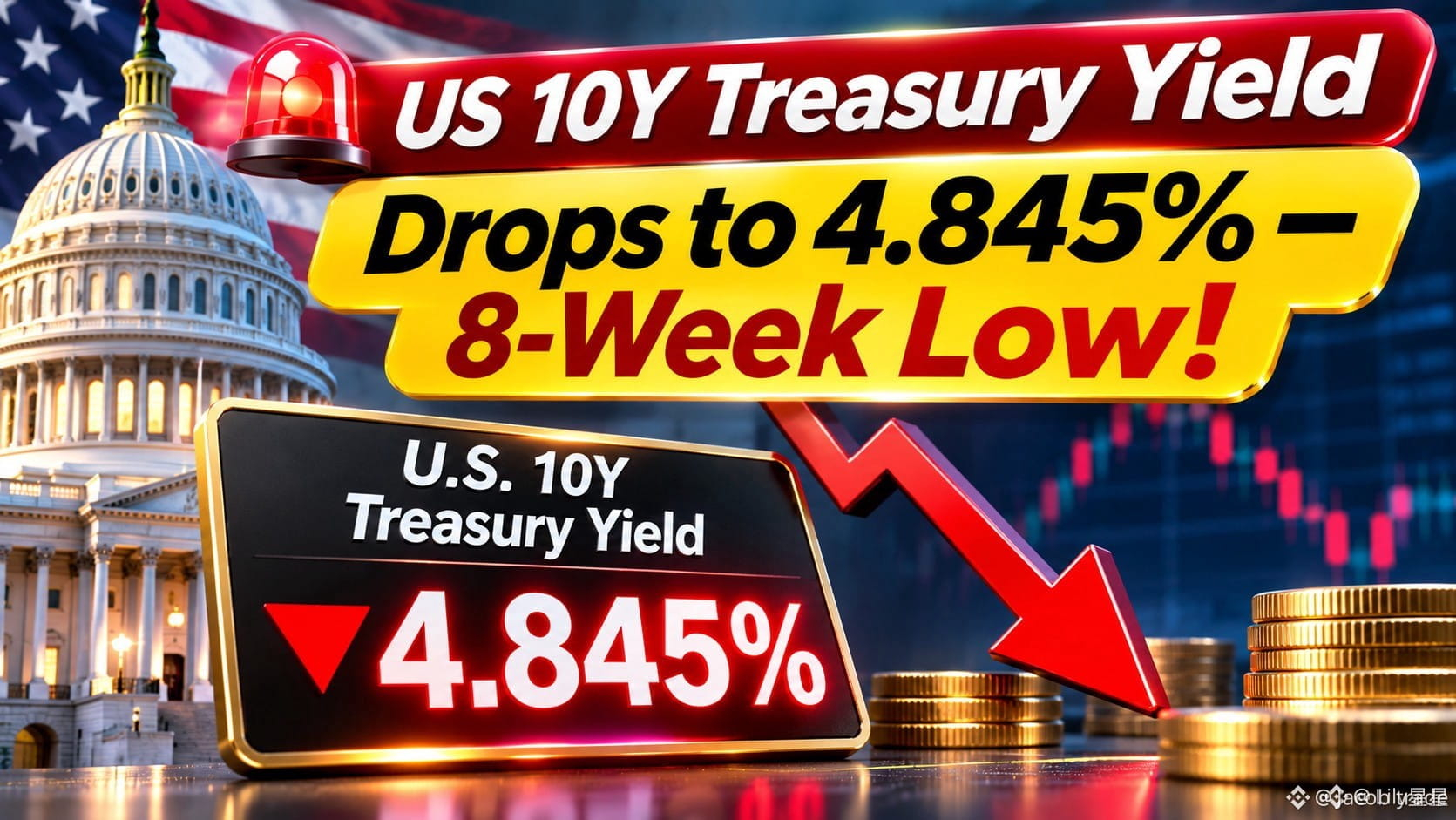
🚨 The 10-year US Treasury yield falls to 4.845% — its lowest in 8 weeks! 🇺🇸📉
⚡ Key points:
• 📉 Falling yields: The 10-year yield has dropped about 52 basis points from its October peak of 5.365%, reaching an 8-week low around 4.84%–4.85%.
• 🏛️ Midterm election impact: The Democratic victory in the midterm elections has raised expectations of political gridlock, signaling a future slowdown in fiscal expansion and deficit spending.
• 📊 Yield curve movements: The 2-year yield fell to 4.546%, while the 30-year yield dropped to 5.229%, as rate expectations adjusted. • 🎯 Key technical support: The 4.80% level is worth watching closely — a sustained break below it could target the 4.60% zone.
• 🪙 Impact on cryptocurrencies: Falling yields ease financial conditions and improve sentiment toward Bitcoin and risk assets! 🚀
$SOXS
{future}(SOXSUSDT)
$APP
{future}(APPUSDT)
$LYN
{future}(LYNUSDT)
#us10yeartreasuryyieldfallsto4.845%
🚨 The 10-year US Treasury yield falls to 4.845% — its lowest in 8 weeks! 🇺🇸📉
⚡ Key points:
• 📉 Falling yields: The 10-year yield has dropped about 52 basis points from its October peak of 5.365%, reaching an 8-week low around 4.84%–4.85%.
• 🏛️ Midterm election impact: The Democratic victory in the midterm elections has raised expectations of political gridlock, signaling a future slowdown in fiscal expansion and deficit spending.
• 📊 Yield curve movements: The 2-year yield fell to 4.546%, while the 30-year yield dropped to 5.229%, as rate expectations adjusted. • 🎯 Key technical support: The 4.80% level is worth watching closely — a sustained break below it could target the 4.60% zone.
• 🪙 Impact on cryptocurrencies: Falling yields ease financial conditions and improve sentiment toward Bitcoin and risk assets! 🚀
$SOXS
$APP
$LYN
2.7k
·
--
#adpusprivateemployersadd86000jobsinoctober
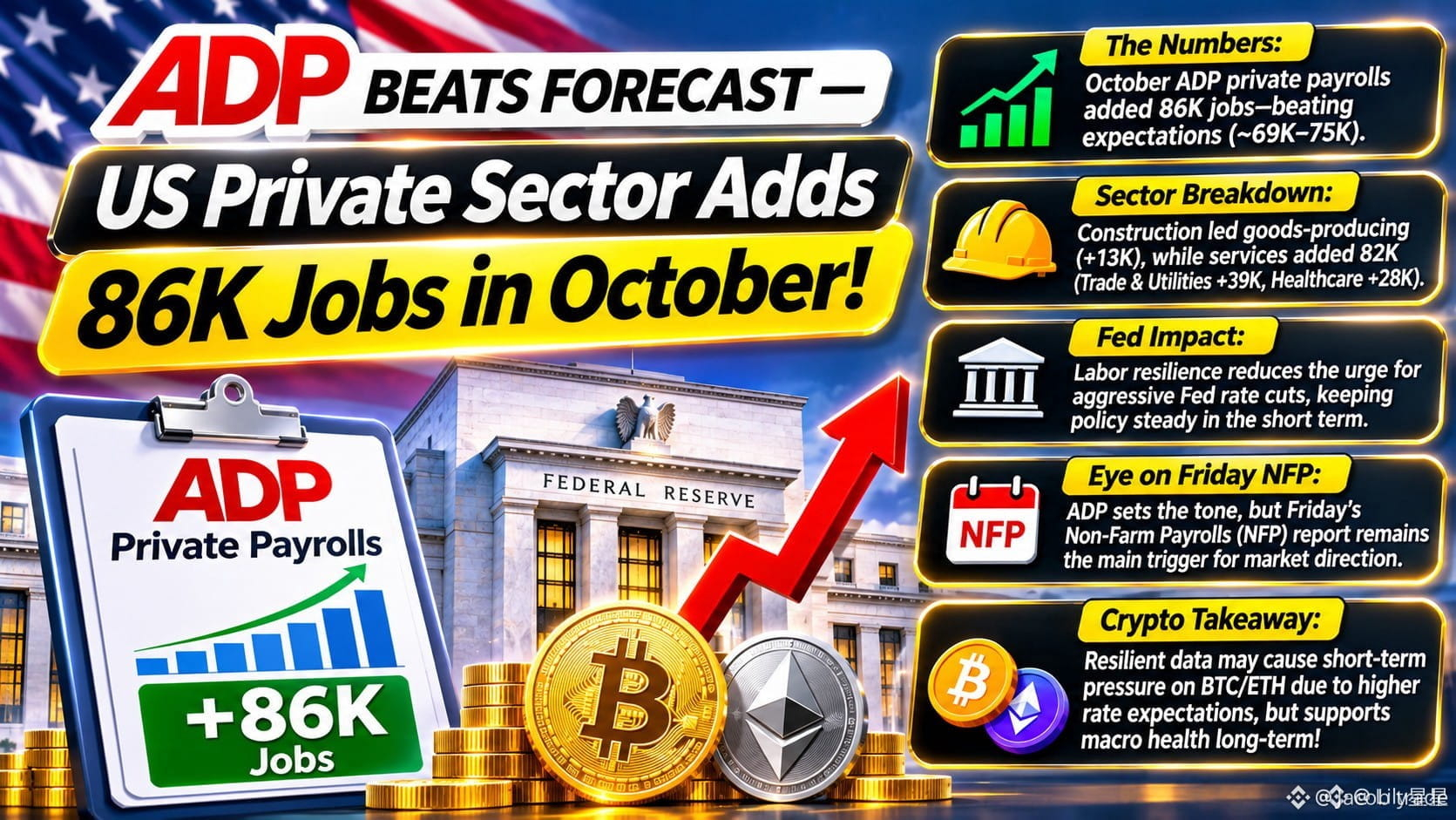
🚨 ADP EXCEEDS EXPECTATIONS — U.S. private-sector employers add 86,000 jobs in October! 🇺🇸
⚡ Key points:
• 📊 The numbers: In October, ADP-reported private-sector payrolls increased by 86,000, exceeding consensus forecasts (~69,000–75,000) and matching September’s revised figure (86,000).
• 🏗️ Sector breakdown: Construction led goods-producing sectors (+13,000), while services added 82,000 jobs (driven by trade and utilities: +39,000, and healthcare: +28,000).
• 🏦 Impact on the Fed: The resilient labor market reduces pressure for aggressive Fed rate cuts, which should keep its policy unchanged in the short term.
• 🎯 Friday’s jobs figures in focus: ADP sets the tone, but Friday’s nonfarm payrolls (NFP) report remains the main factor likely to steer markets and expectations for Fed rate cuts.
• 📈 Takeaway for crypto: Resilient economic data could weigh on crypto in the short term due to expectations of higher rates, but it signals strong macroeconomic health over the long term! 🚀
$SOXS #SOXS
{future}(SOXSUSDT)
$APP #APP
{future}(APPUSDT)
$ARIA #ARIA
{future}(ARIAUSDT)
#adpusprivateemployersadd86000jobsinoctober
🚨 ADP EXCEEDS EXPECTATIONS — U.S. private-sector employers add 86,000 jobs in October! 🇺🇸
⚡ Key points:
• 📊 The numbers: In October, ADP-reported private-sector payrolls increased by 86,000, exceeding consensus forecasts (~69,000–75,000) and matching September’s revised figure (86,000).
• 🏗️ Sector breakdown: Construction led goods-producing sectors (+13,000), while services added 82,000 jobs (driven by trade and utilities: +39,000, and healthcare: +28,000).
• 🏦 Impact on the Fed: The resilient labor market reduces pressure for aggressive Fed rate cuts, which should keep its policy unchanged in the short term.
• 🎯 Friday’s jobs figures in focus: ADP sets the tone, but Friday’s nonfarm payrolls (NFP) report remains the main factor likely to steer markets and expectations for Fed rate cuts.
• 📈 Takeaway for crypto: Resilient economic data could weigh on crypto in the short term due to expectations of higher rates, but it signals strong macroeconomic health over the long term! 🚀
$SOXS #SOXS
$APP #APP
$ARIA #ARIA
1
1.6k
·
--
#southkoreaseekscryptotaxdelayuntil2029
🚨 South Korea wants to delay the cryptocurrency tax by 2 years, until 2029! 🇰🇷
⚡ Key points:
• 🗓️ 4th delay: the proposal aims to postpone the 22% tax on virtual assets from January 2027 to January 2029.
• 🌐 International alignment: the delay takes into account the international exchange of tax data (OECD CARF / United States), scheduled for 2029.
• ⚖️ Regulatory framework: it gives lawmakers more time to finalize comprehensive laws on digital assets and tax systems.
• 🛡️ Loss carryforward: measures provide for losses to be carried forward for 3 years to support local investors.
• 🚀 Market relief: immediate regulatory tax pressure is lifted, boosting investor sentiment on South Korean exchanges!
$ARIA #ARIA
{future}(ARIAUSDT)
$APP #APP
{future}(APPUSDT)
$CAP #CAP
{future}(CAPUSDT)
#southkoreaseekscryptotaxdelayuntil2029
🚨 South Korea wants to delay the cryptocurrency tax by 2 years, until 2029! 🇰🇷
⚡ Key points:
• 🗓️ 4th delay: the proposal aims to postpone the 22% tax on virtual assets from January 2027 to January 2029.
• 🌐 International alignment: the delay takes into account the international exchange of tax data (OECD CARF / United States), scheduled for 2029.
• ⚖️ Regulatory framework: it gives lawmakers more time to finalize comprehensive laws on digital assets and tax systems.
• 🛡️ Loss carryforward: measures provide for losses to be carried forward for 3 years to support local investors.
• 🚀 Market relief: immediate regulatory tax pressure is lifted, boosting investor sentiment on South Korean exchanges!
$ARIA #ARIA
$APP #APP
$CAP #CAP

4
5.1k
·
--
#btcrebounds80k
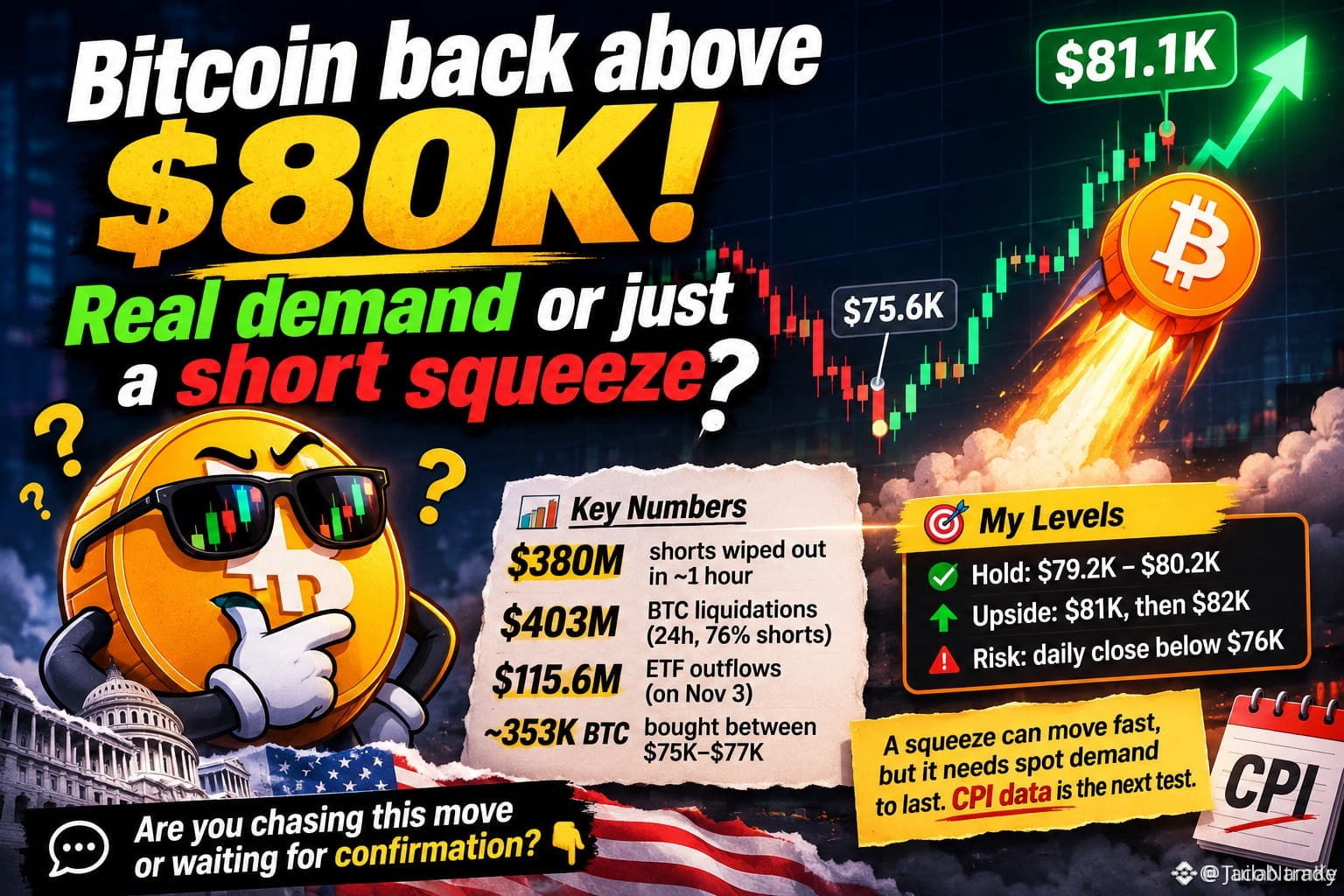
Bitcoin climbs back above $80,000: genuine demand or just a short squeeze? 🔍
BTC rebounded from around $75,600 on election night to around $81,100 after the Democrats won both chambers. Around $380 million in short positions were liquidated in one hour, and Unchained recorded $403 million in BTC liquidations over 24 hours, 76% of them short positions.
📊 Where sources agree
• Uncertainty has lifted. According to CoinShares, a Democratic victory had largely already been priced in.
• Leverage did most of the work.
⚠️ Where sources disagree
Some creators are talking about heavy spot buying. Bitfinex says recent gains are mostly due to short covering. Spot ETFs still saw $115.6 million in outflows on November 3, and only around 353,000 BTC were acquired between $75,000 and $77,000, meaning support is weak.
🎯 The levels I’m watching
• Holding: retest of $79,200–$80,200
• Upside: $81,000, then $82,000
• Risk: daily close below $76,000
A short squeeze can trigger a rapid move, but spot demand needs to persist. CPI data will be the next test.
Are you getting in on this move, or waiting for confirmation? 👇
This is not financial advice. Do your own research.
$APP
{future}(APPUSDT)
$LYN
{future}(LYNUSDT)
$FOGO
{future}(FOGOUSDT)
#btcrebounds80k
Bitcoin climbs back above $80,000: genuine demand or just a short squeeze? 🔍
BTC rebounded from around $75,600 on election night to around $81,100 after the Democrats won both chambers. Around $380 million in short positions were liquidated in one hour, and Unchained recorded $403 million in BTC liquidations over 24 hours, 76% of them short positions.
📊 Where sources agree
• Uncertainty has lifted. According to CoinShares, a Democratic victory had largely already been priced in.
• Leverage did most of the work.
⚠️ Where sources disagree
Some creators are talking about heavy spot buying. Bitfinex says recent gains are mostly due to short covering. Spot ETFs still saw $115.6 million in outflows on November 3, and only around 353,000 BTC were acquired between $75,000 and $77,000, meaning support is weak.
🎯 The levels I’m watching
• Holding: retest of $79,200–$80,200
• Upside: $81,000, then $82,000
• Risk: daily close below $76,000
A short squeeze can trigger a rapid move, but spot demand needs to persist. CPI data will be the next test.
Are you getting in on this move, or waiting for confirmation? 👇
This is not financial advice. Do your own research.
$APP
$LYN
$FOGO
1
2
7.2k
·
--
#binance98percentreplenished
Binance recovered 98% of the funds lost in a major security breach, according to its latest update. The cryptocurrency exchange used its own emergency funds to replace the stolen tokens so users would not lose their money. Binance is currently buying the remaining 2% through the markets. It has also expanded its reserve verification to 44 different tokens, proving that users’ funds are safe. Withdrawals will soon be fully restored as security improves.
$APP
{future}(APPUSDT)
$AIO
{future}(AIOUSDT)
$ARIA
{future}(ARIAUSDT)
#binance98percentreplenished
Binance recovered 98% of the funds lost in a major security breach, according to its latest update. The cryptocurrency exchange used its own emergency funds to replace the stolen tokens so users would not lose their money. Binance is currently buying the remaining 2% through the markets. It has also expanded its reserve verification to 44 different tokens, proving that users’ funds are safe. Withdrawals will soon be fully restored as security improves.
$APP
$AIO
$ARIA

4
4.1k
·
--
Verified
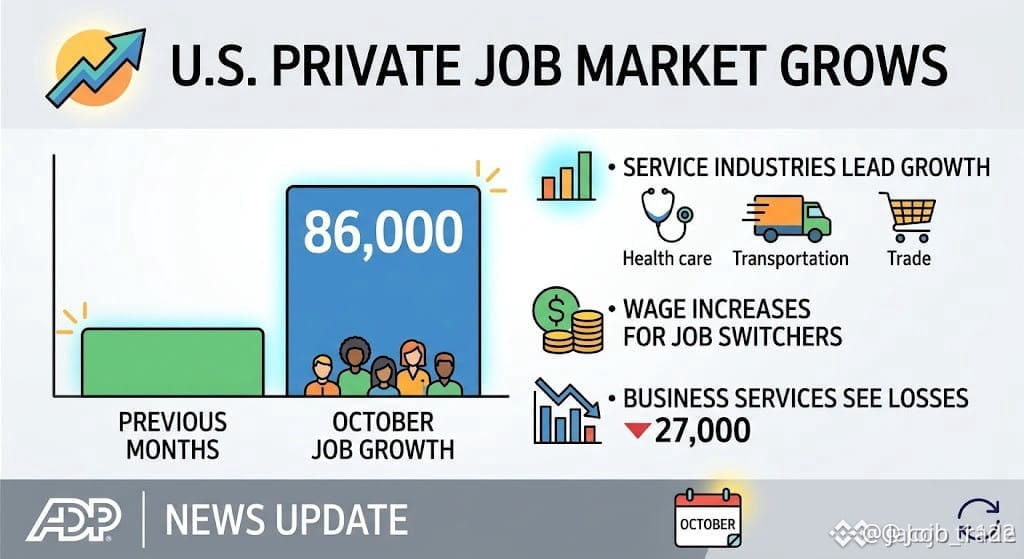
#adpusprivateemployersadd86000jobsinoctober Private companies in the United States created 86,000 jobs in October. ADP’s latest report exceeded expectations and showed sustained growth for the second consecutive month.
Most of the new jobs were created in service sectors such as retail, healthcare, and transportation. However, professional and business services lost 27,000 jobs.
Overall, hiring remained steady at companies of all sizes, while wages for workers who changed jobs rose sharply.
$CAP
{future}(CAPUSDT)
$FLUID
{future}(FLUIDUSDT)
$LYN
{future}(LYNUSDT)
#adpusprivateemployersadd86000jobsinoctober Private companies in the United States created 86,000 jobs in October. ADP’s latest report exceeded expectations and showed sustained growth for the second consecutive month.
Most of the new jobs were created in service sectors such as retail, healthcare, and transportation. However, professional and business services lost 27,000 jobs.
Overall, hiring remained steady at companies of all sizes, while wages for workers who changed jobs rose sharply.
$CAP
$FLUID
$LYN
Most of the new jobs were created in service sectors such as retail, healthcare, and transportation. However, professional and business services lost 27,000 jobs.
Overall, hiring remained steady at companies of all sizes, while wages for workers who changed jobs rose sharply.
$CAP
$FLUID
$LYN
1
1
2.7k
·
--
Verified
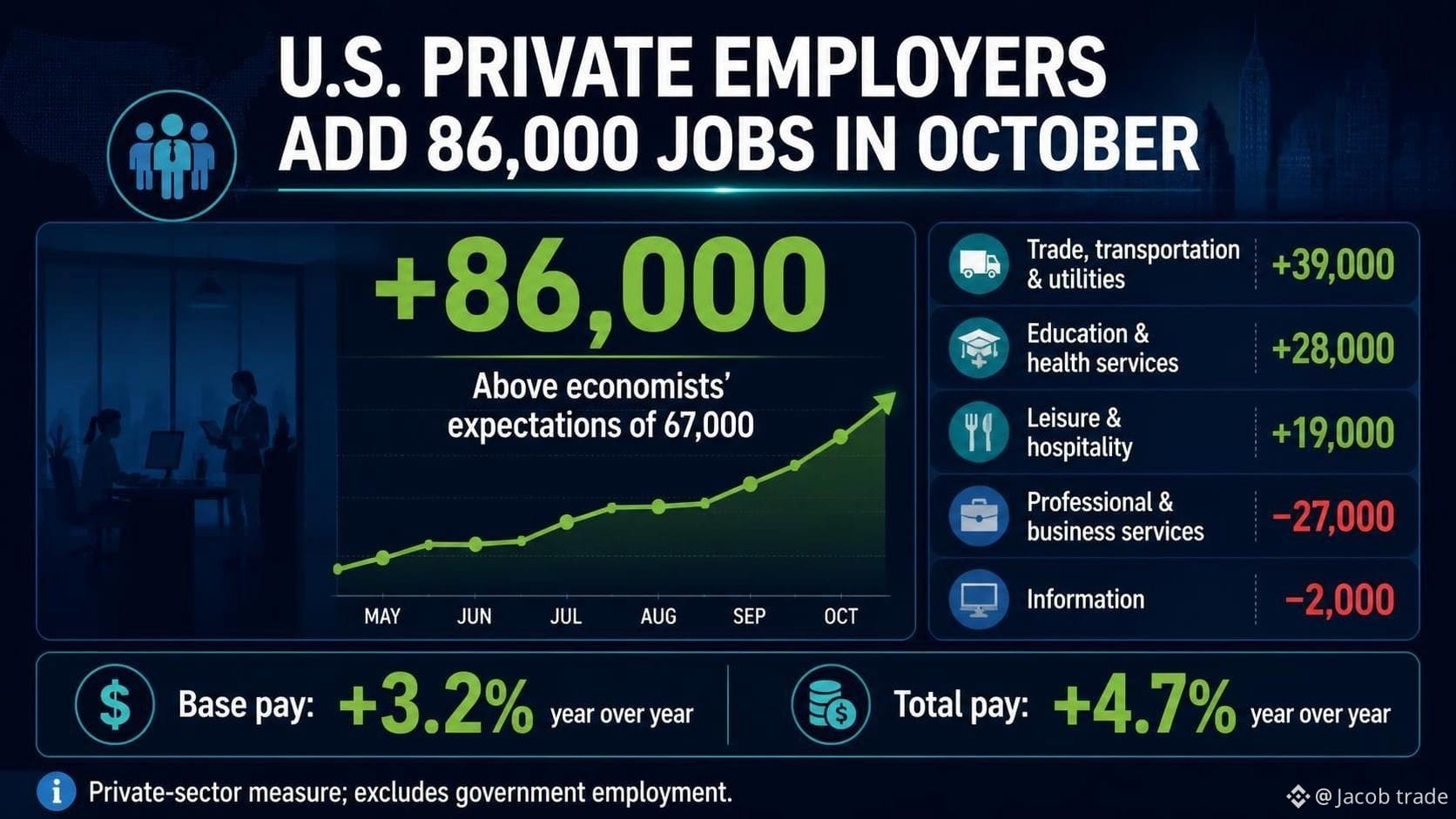
#adpusprivateemployersadd86000jobsinoctober
Private-sector employers in the United States created 86,000 jobs in October. That’s more than the 67,000 economists had expected; September’s figure was also revised to 86,000. Hiring therefore continued at a similar pace for two consecutive months.🏥 The sectors with the strongest job growth:
🚚 Trade, transportation and utilities: +39,000🩺 Education and health services: +28,000🍽️ Leisure and hospitality: +19,000
⚠️ Weak spots: 27,000 jobs were cut in professional and business services; the information sector also saw a decline of 2,000 jobs.💵 Base pay for private-sector employees rose 3.2% year over year, while their total compensation, which also includes benefits, increased by 4.7%. In short: employment figures are better than expected, but growth is unevenly distributed across sectors.
$JCT
{future}(JCTUSDT)
$ELSA
{future}(ELSAUSDT)
$CAP
{future}(CAPUSDT)
#adpusprivateemployersadd86000jobsinoctober
Private-sector employers in the United States created 86,000 jobs in October. That’s more than the 67,000 economists had expected; September’s figure was also revised to 86,000. Hiring therefore continued at a similar pace for two consecutive months.🏥 The sectors with the strongest job growth:
🚚 Trade, transportation and utilities: +39,000🩺 Education and health services: +28,000🍽️ Leisure and hospitality: +19,000
⚠️ Weak spots: 27,000 jobs were cut in professional and business services; the information sector also saw a decline of 2,000 jobs.💵 Base pay for private-sector employees rose 3.2% year over year, while their total compensation, which also includes benefits, increased by 4.7%. In short: employment figures are better than expected, but growth is unevenly distributed across sectors.
$JCT
$ELSA
$CAP
1
1.3k
·
--
Verified
#btcrebounds80k
🚨 BITCOIN REBOUNDS — BUT I’M STILL NOT CONVINCED THE BOTTOM IS IN! ⚠️
BTC has climbed back from the $75,700 area and moved closer to $81,000. It’s a notable rebound, but one recovery alone doesn’t automatically confirm a trend reversal.
Here’s why I’m staying cautious:
📉 1. Big picture: BTC is still facing significant resistance. The short-term rebound looks stronger than the overall trend.
💸 2. ETF flows: U.S. spot Bitcoin ETFs recorded about $115.6M in net outflows on November 3. The following day, they saw about $35.1M in inflows — a mixed signal, not a clear trend.
🌎 3. Macroeconomic uncertainty: employment figures (NFP), CPI, PPI, retail sales, and the FOMC meeting minutes are all due. The DXY, Treasury yields, and Nasdaq performance could also influence risk appetite.
🗳️ 4. Midterm election results: Democrats won control of both chambers, but markets initially moved higher. I wouldn’t consider the election result alone a bearish signal.
BTC levels I’m watching:
🔻 Below $75.7K: bearish pressure could return.
🔼 Above $81K–$82K: buyers need to prove they can sustain this move.
⚠️ My bearish view remains a personal opinion about the market, not a certainty.
I expect a deeper correction, with $74K as a bearish level to watch. Until the chart confirms a more decisive reversal, I’m not rushing to turn bullish.
What do you think — is this the start of a recovery or just another relief rally?
$BTC
{future}(BTCUSDT)
$ARIA
{future}(ARIAUSDT)
$CAP
{future}(CAPUSDT)
#btcrebounds80k
🚨 BITCOIN REBOUNDS — BUT I’M STILL NOT CONVINCED THE BOTTOM IS IN! ⚠️
BTC has climbed back from the $75,700 area and moved closer to $81,000. It’s a notable rebound, but one recovery alone doesn’t automatically confirm a trend reversal.
Here’s why I’m staying cautious:
📉 1. Big picture: BTC is still facing significant resistance. The short-term rebound looks stronger than the overall trend.
💸 2. ETF flows: U.S. spot Bitcoin ETFs recorded about $115.6M in net outflows on November 3. The following day, they saw about $35.1M in inflows — a mixed signal, not a clear trend.
🌎 3. Macroeconomic uncertainty: employment figures (NFP), CPI, PPI, retail sales, and the FOMC meeting minutes are all due. The DXY, Treasury yields, and Nasdaq performance could also influence risk appetite.
🗳️ 4. Midterm election results: Democrats won control of both chambers, but markets initially moved higher. I wouldn’t consider the election result alone a bearish signal.
BTC levels I’m watching:
🔻 Below $75.7K: bearish pressure could return.
🔼 Above $81K–$82K: buyers need to prove they can sustain this move.
⚠️ My bearish view remains a personal opinion about the market, not a certainty.
I expect a deeper correction, with $74K as a bearish level to watch. Until the chart confirms a more decisive reversal, I’m not rushing to turn bullish.
What do you think — is this the start of a recovery or just another relief rally?
$BTC
$ARIA
$CAP

4
5.9k
·
--
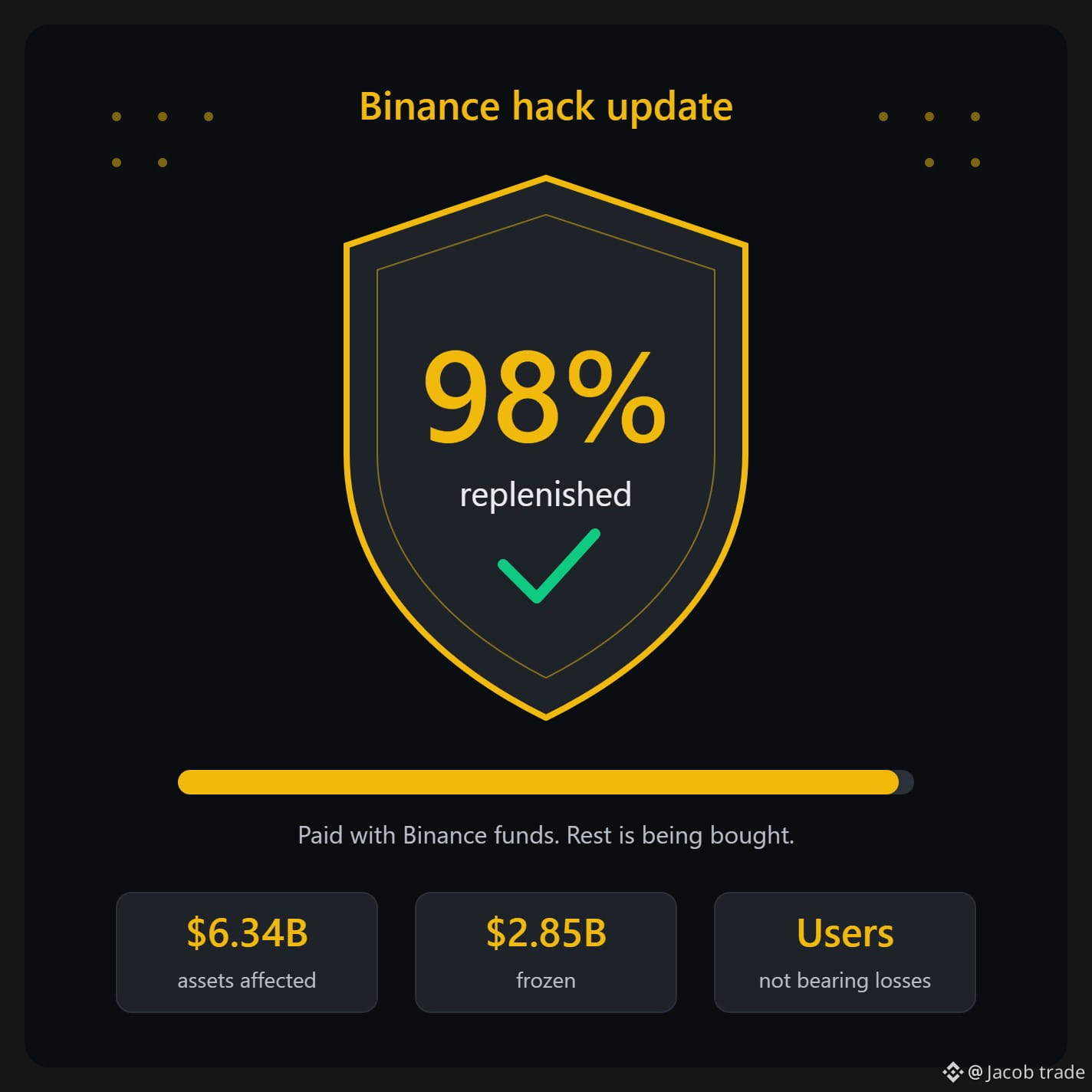
#binance98percentreplenished
Binance says it has recovered 98% of the assets affected by the October 29 hack, which involved approximately $6.34 billion. The company used its own funds, so users do not have to bear the losses. It is still buying the remaining, less-traded tokens. Approximately $2.85 billion has been frozen. Binance says the hackers used fake job interviews and a modified development tool to target the engineers responsible for the wallets. The FBI attributes the attack to North Korea. Stay vigilant and protect your accounts with robust security measures. 🔐
$FLUID
{future}(FLUIDUSDT)
$ARIA
{future}(ARIAUSDT)
$CAP
{future}(CAPUSDT)
#binance98percentreplenished
Binance says it has recovered 98% of the assets affected by the October 29 hack, which involved approximately $6.34 billion. The company used its own funds, so users do not have to bear the losses. It is still buying the remaining, less-traded tokens. Approximately $2.85 billion has been frozen. Binance says the hackers used fake job interviews and a modified development tool to target the engineers responsible for the wallets. The FBI attributes the attack to North Korea. Stay vigilant and protect your accounts with robust security measures. 🔐
$FLUID
$ARIA
$CAP
4
1
3
8.5k
·
--
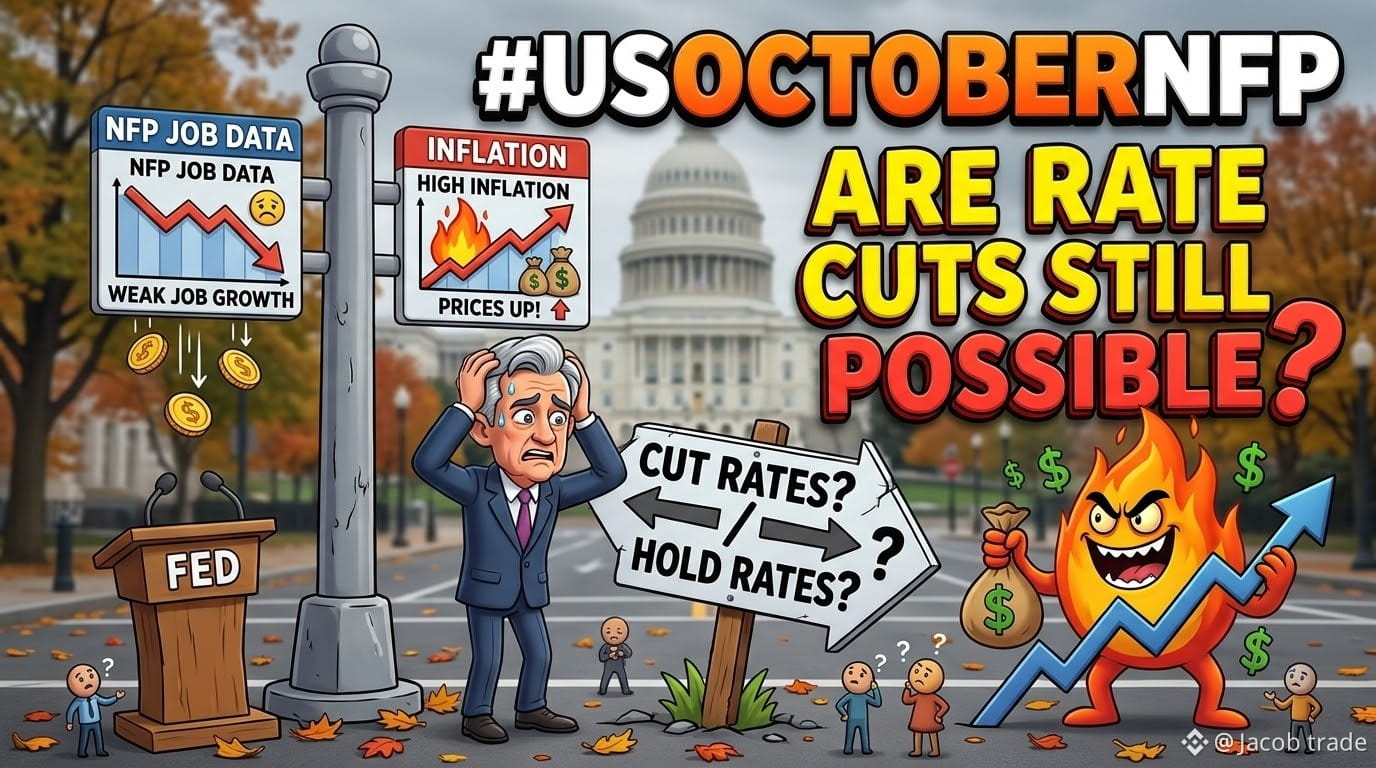
#usoctobernfp-areratecutsstillpossible
🚨 OCTOBER U.S. JOBS NUMBERS IN THE SPOTLIGHT: ARE FED RATE CUTS STILL POSSIBLE?
The upcoming non-farm payrolls (NFP) report in the United States for October could play a major role in shaping expectations around Federal Reserve policy and influence sentiment in the cryptocurrency markets.
📊 What traders are watching
Economists expect around 60,000 to 65,000 new jobs in October, and they forecast an unemployment rate close to 4.2%. Meanwhile, ADP reported 86,000 private-sector jobs created, suggesting that employment may be more resilient than expected.
Why this matters for cryptocurrencies
A weaker-than-expected NFP report could strengthen expectations for upcoming monetary easing, which could support Bitcoin and other risky assets thanks to a more favorable liquidity outlook.
However, stronger employment data could reinforce the Fed’s caution and keep pressure on risk-sensitive markets.
The traders’ view
Rate cuts are still theoretically possible, but they are not the dominant scenario in the short term. Persistent inflation and the possibility of further rate hikes make the Fed’s next decisions highly data-dependent.
The key will be to examine job growth, unemployment, and wage inflation together, rather than focusing only on the headline jobs number.
In summary: Friday’s NFP report could strongly influence market expectations. Cryptocurrency traders should closely watch employment data before drawing conclusions about the market’s direction.
$ELSA
{future}(ELSAUSDT)
$CAP
{future}(CAPUSDT)
$BTC
{future}(BTCUSDT)
#usoctobernfp-areratecutsstillpossible
🚨 OCTOBER U.S. JOBS NUMBERS IN THE SPOTLIGHT: ARE FED RATE CUTS STILL POSSIBLE?
The upcoming non-farm payrolls (NFP) report in the United States for October could play a major role in shaping expectations around Federal Reserve policy and influence sentiment in the cryptocurrency markets.
📊 What traders are watching
Economists expect around 60,000 to 65,000 new jobs in October, and they forecast an unemployment rate close to 4.2%. Meanwhile, ADP reported 86,000 private-sector jobs created, suggesting that employment may be more resilient than expected.
Why this matters for cryptocurrencies
A weaker-than-expected NFP report could strengthen expectations for upcoming monetary easing, which could support Bitcoin and other risky assets thanks to a more favorable liquidity outlook.
However, stronger employment data could reinforce the Fed’s caution and keep pressure on risk-sensitive markets.
The traders’ view
Rate cuts are still theoretically possible, but they are not the dominant scenario in the short term. Persistent inflation and the possibility of further rate hikes make the Fed’s next decisions highly data-dependent.
The key will be to examine job growth, unemployment, and wage inflation together, rather than focusing only on the headline jobs number.
In summary: Friday’s NFP report could strongly influence market expectations. Cryptocurrency traders should closely watch employment data before drawing conclusions about the market’s direction.
$ELSA
$CAP
$BTC
1.8k
Log in to explore more content
Join global crypto users on Binance Square
⚡️ Get latest and useful information about crypto.
💬 Trusted by the world’s largest crypto exchange.
👍 Discover real insights from verified creators.
Email / Phone number
Trending Topics
US Data Center Rules May Constrain AI Expansion
0 views
20 Discussing
Bitcoin News: Why Did Bitcoin Price Fall Back To $77K So Quickly?
Coinpedia Fintech News
·0 Likes
·1.6k views
JobsReportRaisesHikeOdds
0 views
23 Discussing
CanUSStocksReboundAfterNonfarmPayrolls?
9,562 views
294 Discussing