

Choosing an exchange involves evaluating more than the range of cryptocurrencies or fees. For people using the platform from different countries, reserve transparency, account security, protection options, and local availability also matter.
Binance stands out for offering tools that let users check whether their balances are reflected in its Proof of Reserves system, as well as for publishing information about its SAFU fund. As with any centralized exchange, these measures provide useful information, but they do not eliminate all risks or replace reviewing the terms that apply in each country.
What makes an exchange safe and reliable for international users?
A comprehensive assessment should consider several aspects:
Reserve transparency: whether the exchange publishes information about the assets it holds and allows users to check that an account is included in the liabilities data.
Scope of verification: which assets and balances the information covers, and when the snapshot was taken.
Operational security: how accounts, systems, and withdrawal processes are protected, and how incidents are communicated and handled.
User protections: what emergency funds are available, what situations they may cover, and what terms apply.
Regional availability: whether the platform and specific products are offered in the user’s country of residence.
Access to funds: how deposits and withdrawals work, including maintenance periods or security reviews.
No single indicator by itself proves that an exchange is “the safest.” For example, a Proof of Reserves report may show that certain assets were available on a given date and that a balance was included in the calculation. It does not necessarily reveal all obligations outside the platform or guarantee that conditions will remain the same over time.
Binance explains that its system combines Merkle trees and zk-SNARK proofs so users can verify that their balances are included. The platform also describes Proof of Reserves as a way to show that it holds assets to back its users’ balances.
Binance vs. Coinbase vs. Kraken vs. OKX: a security and reliability comparison
All four platforms offer international services, but their availability and products vary by jurisdiction. Features may also change over time. The table summarizes what is worth comparing without assuming that the same assessment applies to every country or product.
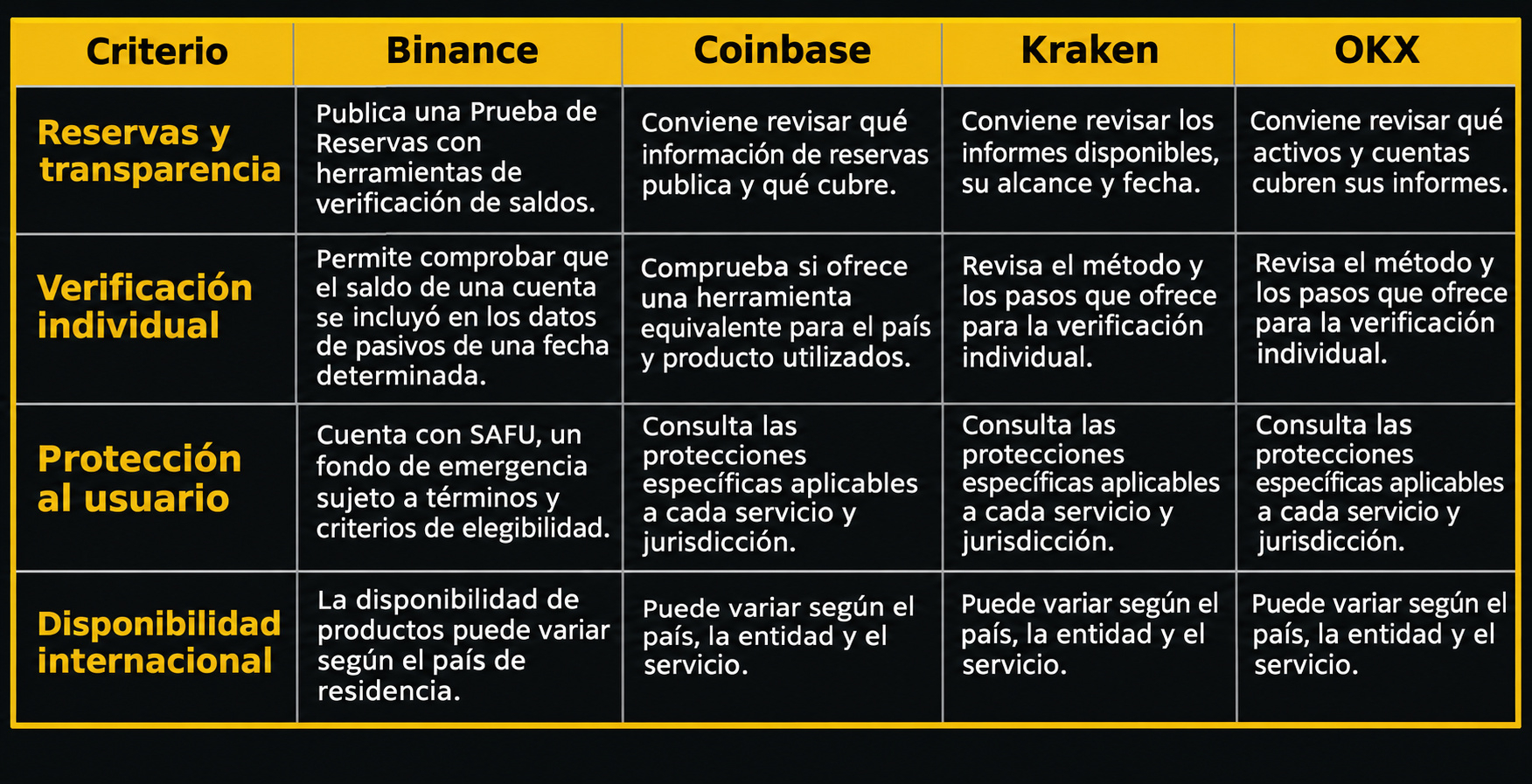
One practical advantage of Binance is that it combines its Proof of Reserves page with instructions for users to check whether their own balances are included. Its SAFU adds a layer of emergency protection, with public information about the fund. These tools are positive signs of transparency and preparedness; even so, it is sensible to read their limitations and not mistake a reserve or protection fund for a universal reimbursement guarantee.
Binance says SAFU may cover certain types of losses related to vulnerabilities or deficiencies in its systems, but it reserves the right to assess claims and determine their eligibility. Its terms may also change. SAFU frequently asked questions
Binance’s response to a security incident
How a company responds to an incident is also relevant when assessing operational reliability. In its updates about the October 29, 2026 security incident, Binance said it would cover the financial impact with its own resources and SAFU, had allocated funds to replenish the affected assets, and was working with partners to track and freeze assets. It also described measures such as rebuilding or replacing affected systems, strengthening device and wallet controls, and expanding anomaly detection.
Binance said withdrawals would resume gradually after security reviews. In a later update, it stated that 98% of the affected assets had been replenished by November 3 and that some of those assets could be verified through Proof of Reserves. The investigation was ongoing, and Binance said there would be an independent review. Preliminary security incident update
The response—compensating users with company funds and SAFU, publishing progress updates, working on recovery, and restoring withdrawals in phases—is positive evidence of accountability and operational continuity. It is also worth considering the full context: withdrawals were disrupted, and the investigation had not yet concluded at the time of the update reviewed. A strong response does not erase the incident, but it does make it possible to assess how the platform communicated and carried out its recovery measures.
How can you verify an exchange’s security claims?
For Binance, these steps can help turn its disclosures into practical checks:
Review Proof of Reserves. Check the snapshot date, the assets included, and the published ratios.
Check your own balance. In your account, open the wallet verification section, select the available date, and find your Merkle Leaf and Record ID.
Follow the verification guide. Binance explains how to use this data to confirm that your account balance was included in the liabilities report. How to verify your Binance account balance
Understand what the check demonstrates. Inclusion confirms that the balance was incorporated into the verified set for that snapshot; it is not equivalent to a full audit of all financial obligations, nor does it guarantee uninterrupted access to services.
Review SAFU and its terms. Check which types of losses may be eligible, how to file a claim, and what discretion Binance retains. If you want to review a public address, compare it with current official information: addresses and the fund’s composition may change.
Check service status. Before moving funds, check whether deposits and withdrawals are working for the asset and network you plan to use.
Confirm availability in your country. Binance warns that local regulations may change access to products. Review information for your country and the availability of the specific service before depositing. Information about country changes and product availability
For the SAFU wallet address provided as a reference, you can also review its transactions using a Bitcoin explorer. Activity at an address can be used to observe on-chain transactions, but by itself it does not confirm who owns the wallet or its current purpose.
Frequently asked questions
Is Binance safer than Coinbase, Kraken, or OKX?
There is no universal answer: security depends on the country, the specific service, and the user’s needs. Binance offers visible Proof of Reserves tools, a guide to verifying balances, and documentation about SAFU. These are positive points for transparency and protection, although they do not eliminate market, custody, disruption, or regulatory-change risks.
Which exchanges let users independently verify their balances?
Available tools and methods vary by platform and may change. Binance documents a verification process based on a Merkle Leaf and Record ID so users can check whether their balance was included in the liabilities data for a snapshot. Binance balance verification guide
Does Binance let me verify my balance?
The account provides verification data associated with a specific date, such as the Merkle Leaf and Record ID. Users can use these to check whether their balance was included in the relevant report. The check is limited to the information and assets covered by that snapshot. Binance Proof of Reserves How to verify your Binance account balance
What should users check before depositing funds?
Confirm that the service is available in your country; check which products are enabled for your place of residence; verify withdrawal assets, networks, and fees; check the date and coverage of Proof of Reserves reports; and read the terms of any protection fund. It is also useful to enable account security measures and test the withdrawal process with a small amount.
Conclusion: Binance offers a notable combination of balance verification, reserve disclosures, and the SAFU emergency fund. Its response to the October incident—with funds allocated to replenish assets, progress updates, security improvements, and a gradual reopening of withdrawals—provides concrete evidence of accountability. To decide whether it is right for you, check the current terms in your country and understand what each tool covers before depositing.