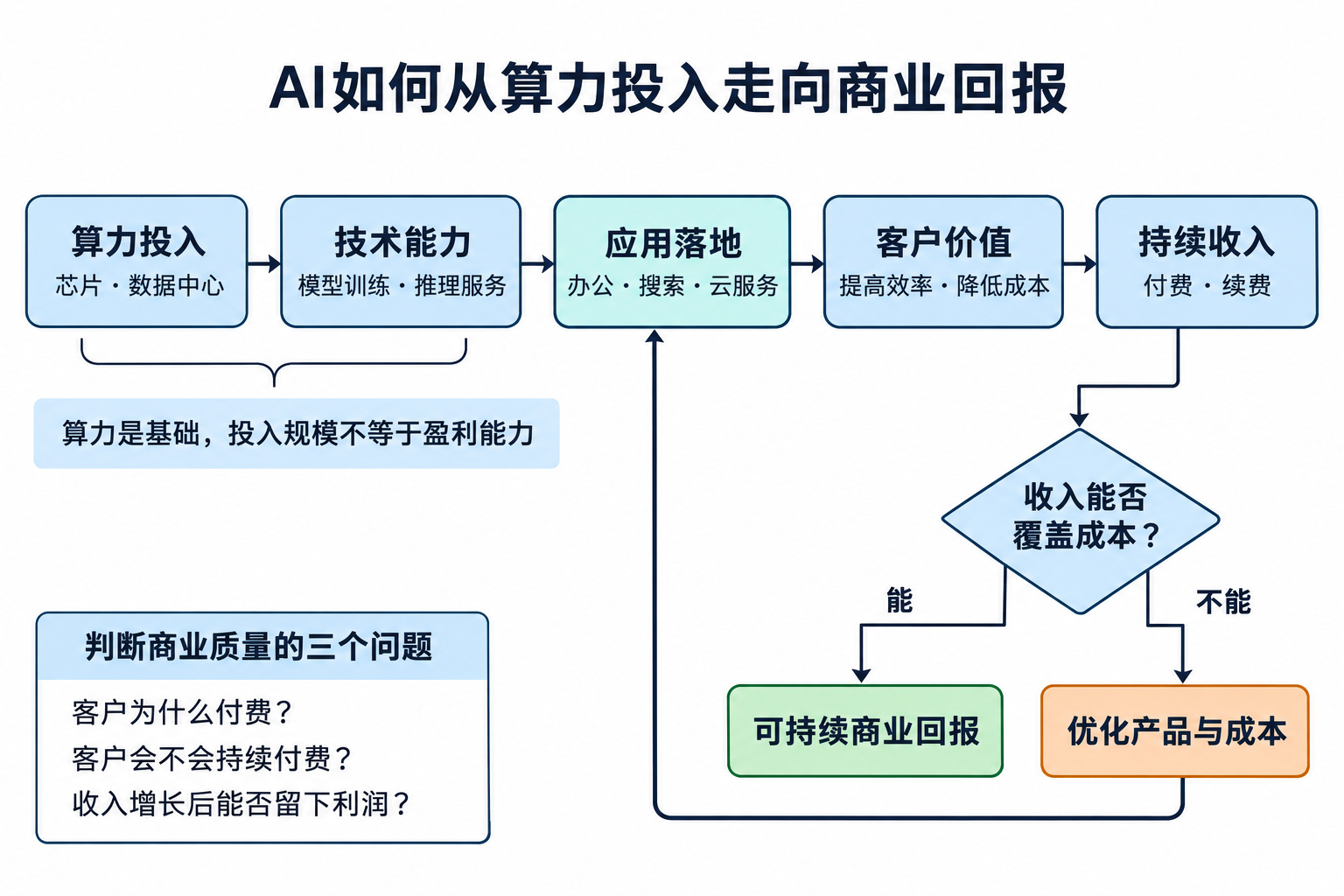
AI competition enters the second half: from competing on computing power to competing on the ability to make money
As the AI boom has progressed, one question has become increasingly difficult to avoid: after companies spend vast sums on chips and data centers, how much money can they ultimately make back?
The most noteworthy shift is more significant than the rise or fall of a stock price on any given day: the criteria for evaluating an AI company are shifting from the scale of its investment to the returns that investment can generate.
Computing power is the ticket to entry; commercial returns determine how far you can go
In the early days of AI development, computing power was a critical resource. Training large models requires chips, serving users requires servers, and expanding operations requires data centers. Whoever can secure these resources faster has a better chance of gaining an early lead.
Chip, memory, and networking equipment suppliers have therefore become major beneficiaries of this race. No matter which AI application ultimately succeeds, the companies competing in the space first need to buy equipment. That is where the “selling shovels” metaphor comes from.
But buying equipment is only the beginning of the business process.
Even a company with a large number of graphics cards still needs to answer these questions: Why would users choose your service? How much are they willing to pay? Can revenue cover the costs of equipment, electricity, operations, and R&D?
As the industry moves from exploring the technology to operating at scale, these questions will become increasingly important. Computing power can help a company qualify to compete, but it cannot guarantee profits.
Cloud providers’ opportunity lies in connecting technology to businesses they already have
Companies such as Microsoft, Google, and Amazon have an advantage because they already have customers, products, and sales channels.
Office software can integrate AI assistants, search services can add intelligent answers, and cloud platforms can offer businesses models and development tools. These existing businesses give AI clear use cases and shorten the distance between technology and customers.
Business customers typically buy AI services to solve specific problems: reducing repetitive work, shortening development time, improving customer service efficiency, or helping employees get their work done faster.
If these benefits can be demonstrated, AI has the potential to become a service that customers are willing to keep paying for. In this way, technical capabilities are turned into a source of revenue.
However, having a user base and sales channels only increases the chances of success. Whether AI features are useful, whether customers renew their subscriptions, and how much the service costs to provide will still determine whether the business works.
Hardware still matters, but the market is demanding more
Summing up the industry’s evolution as “hardware stepping aside and applications taking over” makes it easy to overlook the relationship between the two.
The wider the adoption of applications, the greater the demand for computing power may become; the more efficient chips are, the more applications may become economically viable. Hardware and applications can drive each other forward.
What really needs to be reassessed is the efficiency of investment.
Once a data center is built, how many of its devices are kept running? As model usage grows, how much do revenue and costs increase, respectively? Can new investment generate enough customer demand?
These questions are more closely related to a company’s operational quality than simply comparing who bought more chips.
Therefore, the future performance of hardware suppliers will still depend on their technological advantages, customer demand, and ability to turn a profit. Cloud providers and application companies likewise need to prove they can turn demand into sustainable profits. A company’s position in the industry cannot solve this problem for it.
The next phase of AI: focusing on who creates measurable value
You can start evaluating an AI company by asking three questions.
First, why do customers pay? The product needs to solve a real problem and show customers the results of using it.
Second, will customers keep paying? A short-lived trial can bring in traffic, but stable usage habits and renewals are what support a business over the long term.
Finally, as revenue grows, can the company retain more profit? If every additional dollar of revenue comes with equally high service costs, scaling up may not improve the business.
Ultimately, these three questions all point to the same thing: whether a company creates value that customers recognize and that it can deliver consistently.
Competition in the AI industry will increasingly revolve around this. Chips and data centers will remain foundational, while product experience, customer relationships, delivery capabilities, and cost control will jointly determine the economic returns these foundations can generate.
For businesses, the goal worth pursuing is to bring AI into real workflows, help customers get things done faster and better, and earn their continued willingness to pay for that improvement.