
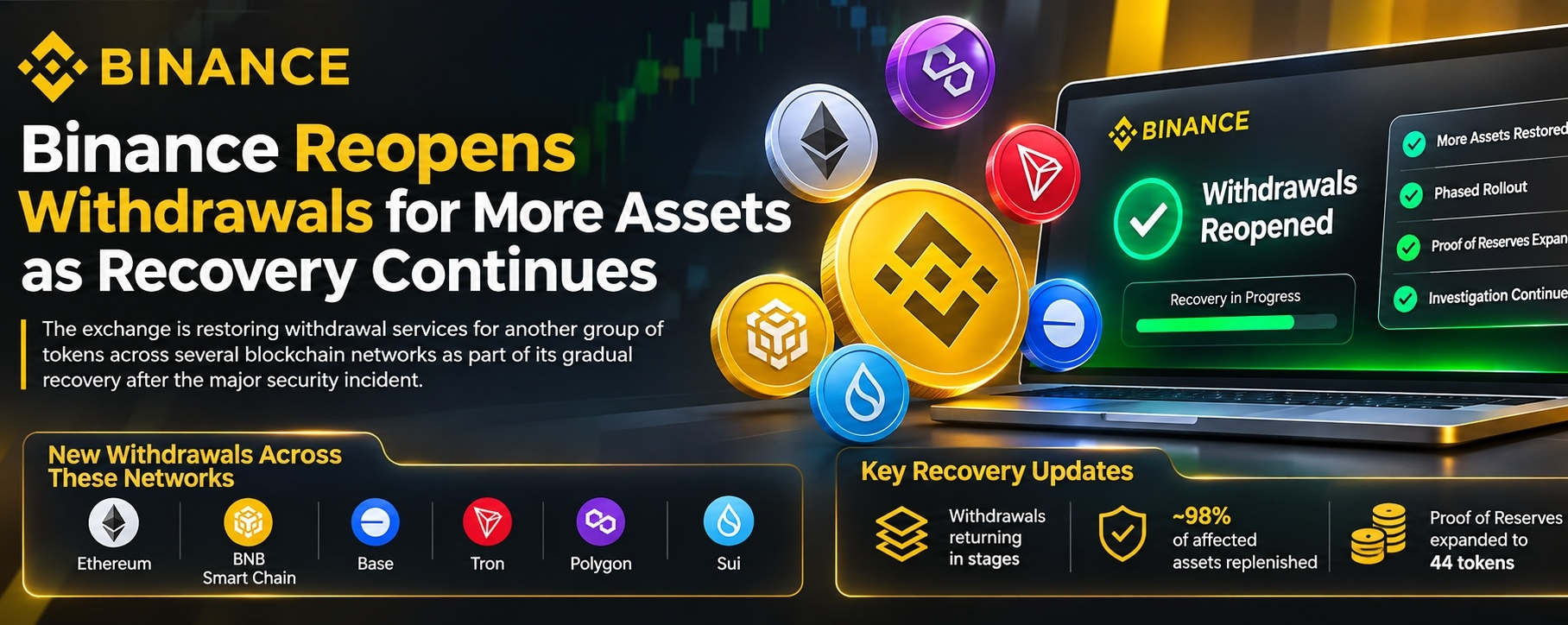

Binance is continuing to restore withdrawal services after the major security incident that disrupted access to a wide range of cryptocurrency assets, with the exchange now reopening withdrawals for another group of tokens across several blockchain networks as part of its gradual recovery process.
Binance Expands Withdrawal Access
The latest reopening began at 04:00 UTC on November 5, although Binance explained that the affected assets would not necessarily become available at the same time because each asset and network must pass the exchange’s security and operational checks before withdrawals can resume.
The newly supported group covers assets across Ethereum, BNB Smart Chain, Base, Tron, Polygon and Sui, giving users access to a broader selection of tokens while Binance continues working toward a full return to normal operations.
Among the assets being restored are UNI, AAVE, PAXG, VIRTUAL, MORPHO, YFI, COMP, LDO, ENS, APE, ARKM, MANA and GRT on Ethereum, while the BNB Smart Chain list includes ASTER, PROM, FIL, IOTA, TWT, DEXE, INJ, AAVE, AVAX and SAND. Binance has also included AERO, VIRTUAL, MORPHO and AVNT on Base, JST, SUN and BTTC on Tron, GNS on Polygon and MMT on Sui.
Withdrawals Are Returning in Stages
Binance has chosen a phased approach instead of restoring every withdrawal at once, allowing its teams to examine individual networks and assets before making them available to customers. This means users could find that a particular cryptocurrency can be withdrawn through one network while withdrawals remain unavailable through another.
The exchange has advised customers to check the withdrawal page before making a transaction because availability can change as additional network and asset combinations complete the required checks. The gradual rollout is also intended to manage the increased traffic that typically follows the restoration of withdrawals.
Binance Continues Its Recovery Efforts
The latest announcement follows several earlier updates in which Binance gradually restored withdrawals for major cryptocurrencies and expanded access to additional networks. The exchange initially restricted withdrawals after a security incident involving approximately $6.3 billion in cryptocurrency, giving its security teams time to investigate the breach and secure its systems.
Binance has also said that customers will not be responsible for replacing the stolen assets. By November 4, the company reported that it had replenished approximately 98% of the affected assets and had allocated sufficient company resources to cover the losses, while the remaining assets were still being acquired through market and over-the-counter channels.
The remaining portion has reportedly been more difficult to replace because some of the affected tokens have relatively limited liquidity, meaning Binance may need more time to obtain the required quantities without causing unnecessary disruption in their markets.
Proof of Reserves Gets a Wider Update
Alongside the withdrawal restoration, Binance has expanded its Proof of Reserves coverage as part of its effort to provide customers with greater transparency following the incident.
The latest snapshot covers 44 tokens, compared with 10 tokens in the previous snapshot, and Binance said it was generating a new zero-knowledge proof that would allow users to verify that covered customer balances are backed by corresponding reserves.
The move is particularly relevant after the security incident because customers are not only interested in whether withdrawals are available but also in whether the exchange has sufficient assets to support their balances.
Investigation Into the Security Incident Continues
The security breach has attracted significant attention because of its size and the sophisticated methods reportedly used by the attackers. The FBI attributed the theft to the North Korean state-sponsored group known as TraderTraitor and said the stolen cryptocurrency was being moved through different blockchain networks and services.
Binance has been working with law-enforcement agencies and blockchain-industry partners as investigators track the stolen assets and attempt to prevent them from being moved through other services.
The incident has also highlighted the wider security challenges facing cryptocurrency exchanges, where large amounts of digital assets can be transferred across multiple networks within a short period of time, making rapid detection and coordinated response particularly important.
Customers Continue Moving Their Funds
The return of withdrawals has also resulted in significant movement of funds from Binance. Reuters reported that customers withdrew billions of dollars after the exchange restored access, reflecting the caution that can follow a major security incident even when an exchange says customer assets are fully covered.
Large withdrawals do not necessarily indicate that Binance lacks sufficient funds, particularly because the company has stated that it has replenished the majority of the affected assets, but the movement does show that some customers are choosing to move their holdings to other exchanges or private wallets.
More Assets Expected to Return
Binance has indicated that the recovery process will continue and that additional assets will be added as they complete the necessary security and readiness checks. Users should therefore expect the withdrawal list to expand progressively rather than change all at once.
For customers, the most important point is that the latest announcement represents another step toward restoring normal service, but the process remains ongoing. Binance is simultaneously reopening withdrawals, replenishing the remaining affected assets, expanding its Proof of Reserves coverage and continuing its investigation into the security breach.
The latest reopening therefore provides broader access to withdrawals while showing that Binance is still taking a cautious approach to the recovery. As more networks and assets pass the required checks, the exchange is expected to continue expanding withdrawal availability and moving closer to full operational normality.