UNI at $7.3, and you're still waiting for it to drop back to $2?
The king of DEXs, real revenue, the fee switch moving forward, and $100 billion in cumulative trading volume on Robinhood Chain—yet UNI is stuck at $7.3, down 18% in a month. How many people are calling it “dead”? The daily RSI is neutral at 49, volume is picking up, and the $7.0 support level keeps getting tested. Is this a value opportunity, or just another value trap with “strong fundamentals but no price action”?
First, the big picture: good news keeps coming, but the price just won't break out.
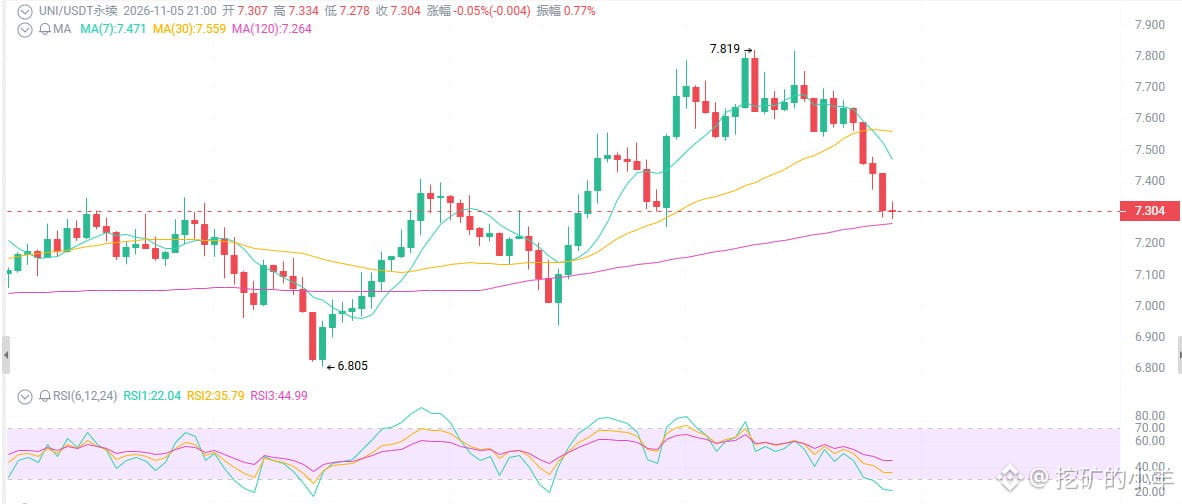
It’s up 38–44% over the past year, but over the past month it’s fallen from $9.1 to $7.3, a 15–18% pullback. The candlestick chart shows a range between $7.0 and $7.8. The daily RSI is neutral at 49, and the MA20 is providing support around $7.15. The market hasn't picked a direction.
First up: $100 billion in trading volume, and the market acts like it didn't even notice.
Since Uniswap deployed on Robinhood Chain, cumulative trading volume has hit $100 billion.
Sounds huge, right? But UNI didn't go up—it fell from $8.5 to $7.3.
The same news could have sent it up 50% in 2021. Now the market is numb, like someone who's just been dumped—not because good news doesn't matter, but because retail investors have been burned too many times to believe it.
Second: the fee switch is the real nuclear option for UNI.
A lot of people criticize UNI as a “governance token with no value.” That's changing:
The UNIfication proposal is moving the fee switch toward implementation, with some UNI being burned directly and protocol revenue flowing back to token holders. The TJAR fee conversion tool is now publicly available, and Robinhood has already integrated it.
Protocol earnings are starting to be distributed to UNI holders.
The token now has a deflationary feature instead of being subject to unlimited issuance.
This is a fundamental shift from “voting rights” to “cash flow rights.”
It's just like when UNI first launched in 2020—back then, nobody believed it could become the king of DEXs. Later, it soared from $1 to $45.
Third: the technicals suggest the market will pick a direction soon.
$7.0–$7.2 is the recent low and a psychological level; $6.8–$6.9 is the second line of defense, and $6.25 is the rock-bottom support.
Above, $7.5–$7.8 is the recent high, while $8.0–$8.5 is medium-term resistance.
4-hour chart: a pullback is testing the rising channel, volume is picking up at key levels, and activity from new addresses is providing a bottom signal.
Daily chart: choppy and leaning weak; it needs to close above $7.9 to confirm a turn to strength.
If $7.0 holds, the price stays range-bound; a break above $7.9 would signal a trend reversal. For now, wait for a signal—don't guess.