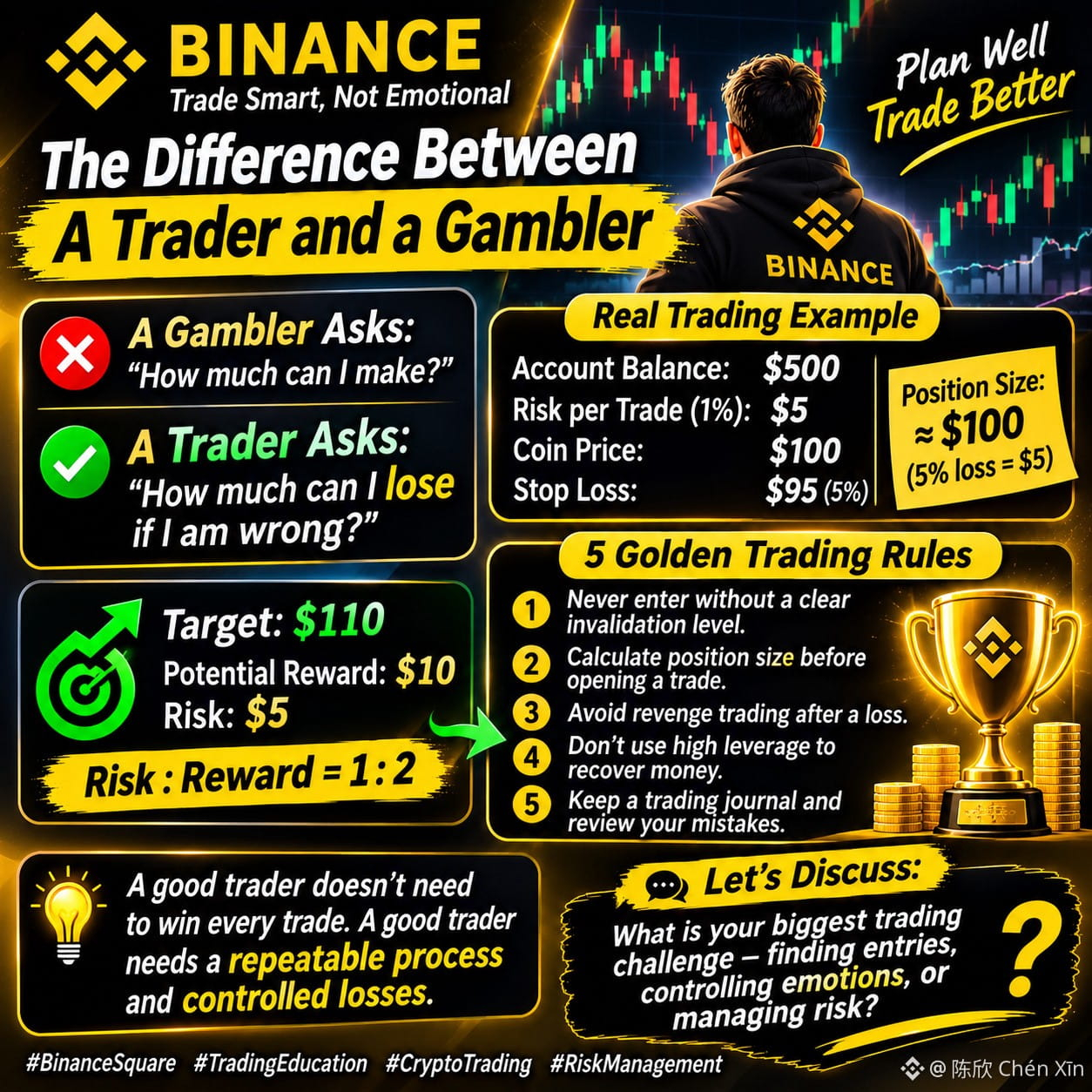
THE DIFFERENCE BETWEEN A TRADER AND A GAMBLER
Most beginners ask one question before entering a trade:
"How much can I make?"
But experienced traders ask something more important:
"How much can I lose if I am wrong?"
Here is a simple example:
Imagine your trading account has $500.
Your planned risk is 1% = $5.
You find a coin trading at $100 and place your stop-loss at $95. Your stop distance is 5%.
Your position size should be around $100, because a 5% loss on that position equals $5 (excluding fees and slippage).
Now imagine your target is $110.
Your potential reward is $10, while your risk is $5. That gives you a 1:2 risk-to-reward setup.
Remember these 5 rules:
1. Never enter without a clear invalidation level.
2. Calculate position size before opening a trade.
3. Avoid revenge trading after a loss.
4. Don't use high leverage to recover money.
5. Keep a trading journal and review your mistakes.
A good trader doesn't need to win every trade. A good trader needs a repeatable process and controlled losses.
Let's discuss: What is your biggest trading challenge — finding entries, controlling emotions, or managing risk?
$BNB
#BinanceSquare #TradingEducation #CryptoTrading #RiskManagement