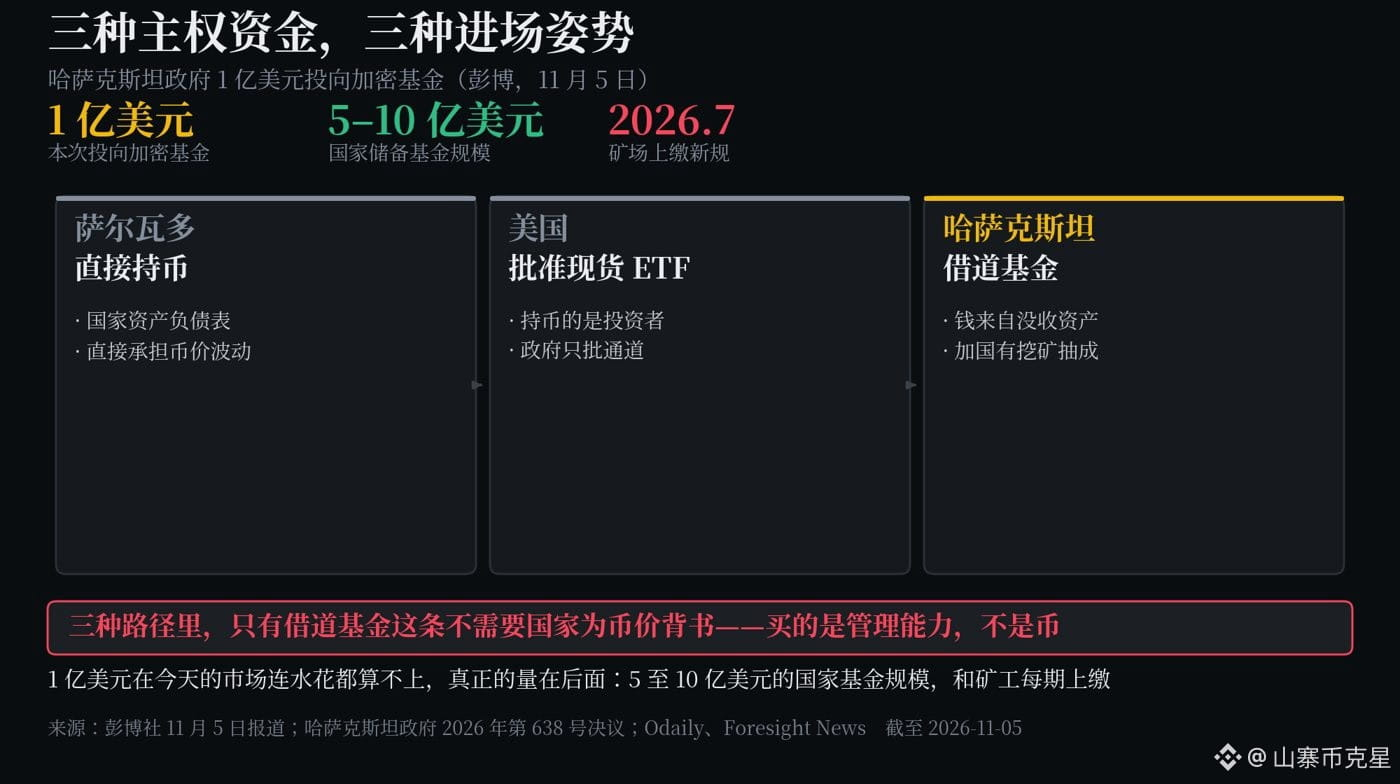
Kazakhstan invested $100 million in crypto funds. The amount isn't huge, but the approach is worth a closer look.
According to Bloomberg, the money went into funds like Brevan Howard Digital.
A lot of people see “the state is getting involved.” What I see is this: the money wasn’t newly printed.
Last November, it said it would set up a national crypto reserve fund worth $500 million to $1 billion, funded by seized and recovered assets, plus proceeds from state-owned mining operations.
New rules this July added another condition: mining farms get low-cost electricity quotas in exchange for handing over some of the coins they mine.
Basically, this $100 million is ill-gotten gains and electricity cost savings, moved into a different pocket.
The more interesting thing is the route it’s taking.
It isn’t buying $BTC directly. Instead, it’s handing the money to funds to buy ETFs and shares in crypto companies.
The central bank governor put it plainly: they’ll be very cautious about direct exposure to crypto.
Why not buy directly?
Holding coins directly means taking responsibility. If prices fall, it’s a loss on the national books, and someone has to explain it.
Hand the money to a fund, and gains count as investment returns while losses are market risk.
This isn’t a technical choice; it’s a political one.
Put the three approaches side by side:
El Salvador holds coins directly, betting on the country’s future.
The US approves ETFs and lets capital find its own way in.
Kazakhstan takes the fund route, buying management expertise, not coins.
Only the third approach avoids having the state vouch for coin prices.
In today’s market, $100 million barely makes a ripple.
The real volume is still to come: the $500 million to $1 billion national fund, and the portion miners have to hand over each period.
If other resource-rich countries copy this model of “seized assets plus a cut of mining proceeds,” that would be structural buying pressure.
The risks are also plain to see.
Its mining sector has already suffered from electricity shortages and regulatory back-and-forth, and the national fund could also change course for political reasons.
A so-called strategic reserve is, in the end, the decision of one government.
So don’t chase the price because of this $100 million.
If you’re going to follow anything, follow these two things: whether this fund-based approach spreads to the UAE and Singapore, and the actual impact of miners’ contributions on mining costs.
The state is starting to buy crypto, but what it’s buying is “the ability of others to manage crypto.”
Would you call that clear-headed—or unwilling to take responsibility?
#据报哈国政府投1亿美元加密基金