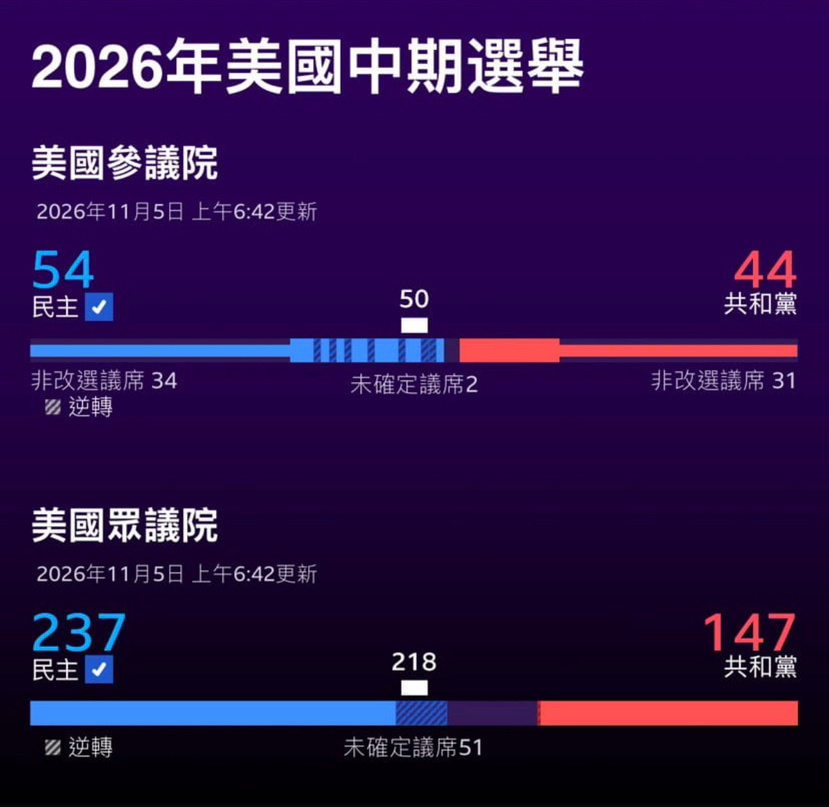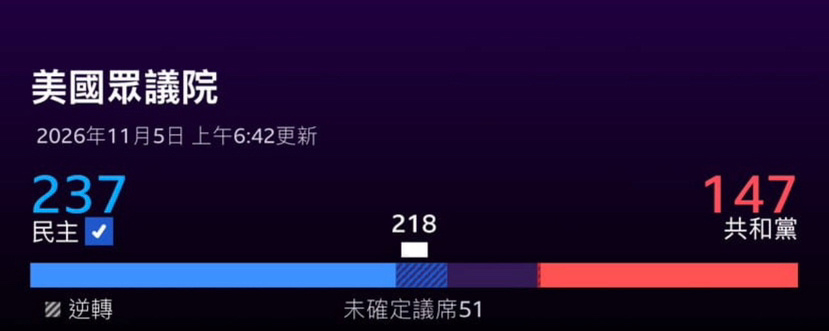

On November 3, 2026, Americans went to the polls for the midterm elections. Two days later, the picture was already clear: Democrats had swept Congress, winning control of both the Senate and the House and creating a powerful check on the Trump administration. The result was both “expected” by pollsters and prediction markets and so overwhelming that it prompted markets to reprice everything from AI regulation to defense spending.
On Wednesday, November 4, U.S. Eastern Time, the market’s first trading day after the election delivered its clearest answer: the S&P 500 rose 1.6%, the Nasdaq gained 1.4%, and the Morningstar US Market Index climbed 1.5%—with uncertainty out of the way, stocks rose across the board.
What the market had already bet on before the election
In reality, the market had already voted with real money. As of October 27, the CFTC-regulated prediction platform Kalshi priced the Democrats’ chances of winning the House at as high as 91%, and their chances of taking the Senate had risen to 65%–67%. The implied probability of a “blue wave” (a Democratic sweep) was around 64%–65%. Trading volume on Kalshi contracts related to the midterm elections was close to $1.1 billion. A late-September research note from JPMorgan recorded that prediction markets then put the odds of a Democratic sweep at around 62%, and stated explicitly that even if Democrats won, the lack of a two-thirds majority meant legislative gridlock had historically supported the stock market. Its recommendation: “buy election-related dips.”
Behind this assessment are two iron laws. First, the president’s party almost inevitably loses seats in midterm elections—with only three exceptions since the Civil War: 1934, 1998, and 2002. And at the time, Trump’s approval rating had already fallen to 37%, the lowest of any president entering a midterm election since 1990. Second, historical data shows that the S&P 500’s average return in midterm election years is about 5 percentage points lower than in non-midterm years, but its average gain in the year after an election is as high as 15.4%—regardless of which party is in power. That’s simply because political noise fades and the market refocuses on corporate earnings and economic fundamentals. In other words, what the market truly “expects” has never been just a victory for one party, but an end to uncertainty.
The first trading day: A sharp split beneath broad gains
Wednesday’s market was far from uniform. Instead, it split sharply along the question of “what will the new Congress do?”, revealing the five issues investors are most focused on for the next two years.
First, Treasury yields fall and the dollar weakens—expectations of fiscal consolidation. Treasury prices climbed, yields retreated, and the dollar softened against major currencies, supporting commodities such as gold. A divided government dims the prospects for large-scale fiscal stimulus and an extension of tax cuts, cooling expectations of a widening deficit and easing pressure on long-term rates. This is a classic example of the traditional “gridlock is good for stocks” thesis.
Second, AI and data-center stocks plunge—expectations of tighter regulation. This was the day’s most striking move: Tesla closed down 3.3%, SpaceX fell 3.0%, neocloud stocks CoreWeave and Iren dropped more than 9%, Nebius slid 6.7%, and Nvidia and Intel both lost more than 3%. Goldman Sachs analysts noted that several Democratic winners had explicitly campaigned on strict regulation of data centers. They expect Democratic governors in Texas, Georgia, and Michigan to impose conditional moratoriums on data centers. Related legislation could eliminate some tax breaks and tighten environmental, water, and electricity rules—and these three states account for 45% of planned data-center capacity in the United States. Quilter investment strategist Kit Rees put it bluntly: AI has been a huge engine driving the U.S. economy, and any curb on its development could hit the brakes on growth, while the sector “will feel the pressure”. The market is concerned that the AI capital-spending narrative that supported U.S. stock valuations over the past year is shifting from “no limits” to “a live electric fence.”
Third, oil prices plunge 8.7%—expectations of easing conflict. Brent crude futures tumbled 8.7% to $94.42 a barrel, while European defense stocks fell in tandem: London-listed BAE Systems dropped 3.3%, Babcock fell 1.7%, France’s Thales lost 2.3%, and Italy’s Leonardo slipped 1%. The reasoning is that the new Congress holds the power of the purse and could scrutinize additional military spending on the government’s war with Iran, while pushing for a diplomatic solution. Swiss analyst Ipek Ozkardeskaya believes oil prices could continue to fall if credible negotiations emerge and prospects improve for safe shipping through the Strait of Hormuz. Of course, Andrew Jackson of Vontobel cautioned that the executive branch still wields broad powers over foreign policy and tariffs, and that continued confrontation with Iran remains a real risk, with implications for oil prices and inflation that should not be underestimated.
Fourth, clean energy and healthcare rally—expectations of a rebalancing in industrial policy. Europe’s STOXX 600 index rose 1.8%, Denmark’s Ørsted surged 4.6%, Vestas gained 2.8%, and Germany’s Nordex climbed 4.8%. Across the Atlantic, Microsoft and Amazon also advanced alongside healthcare and renewable-energy stocks. This matched the sector-sensitivity map ahead of the election exactly: Democratic strength benefits solar and energy storage (First Solar, NextEra, Enphase), as well as health insurers and hospital stocks (Centene, HCA); Republican strength, by contrast, benefits private prisons (GEO, CoreCivic), crypto (Coinbase), oil (ExxonMobil), and defense (Lockheed Martin).
Fifth, and most fundamental of all: expectations that policy noise will fade. History shows that markets often have an easier run in the year after an election. Since 1950, the S&P 500 has gained an average of 15.4% in the year following a midterm election, far more than in other periods
What the market is watching next: three dates
Attention has shifted from the election itself to three key milestones. First comes the vote-counting and certification period: if Georgia requires a runoff, it will be held on December 1, while state certifications will continue through late November and December. A few Senate seats could remain undecided for several days. Next is the two-month “lame-duck” session—from now until the new Congress is sworn in on January 3, 2027. Republicans will retain full control of both chambers, raising the risk of last-minute legislative showdowns over tariff authority, layoffs, or surprise appropriations. Finally comes the reality of divided government after the new Congress takes office: narrow majorities in both chambers—potentially extremely slim—will face annual battles over government funding, legislative scrutiny of AI and data centers, and questions over the cost of the war with Iran, all playing out in 2027.
It is important to stay clear-eyed: the market’s two main expectations are in tension with each other. Regulators want to cool AI capital spending, while valuations remain tied to AI’s earnings-growth engine. Doves welcome falling oil prices and lower interest rates, yet also depend on a substantive easing of geopolitical risks. The blue wave has dispelled political uncertainty, but brought debates over the economic outlook—AI’s limits, fiscal constraints, and the cost of war—from campaign rhetoric back to the trading floor. History favors a “post-election rally,” but this time, whether those expectations are fulfilled will depend on whether a divided government can find a narrow, sustainable middle ground between the brake and the accelerator.#美国中期选举:市场有哪些期待?