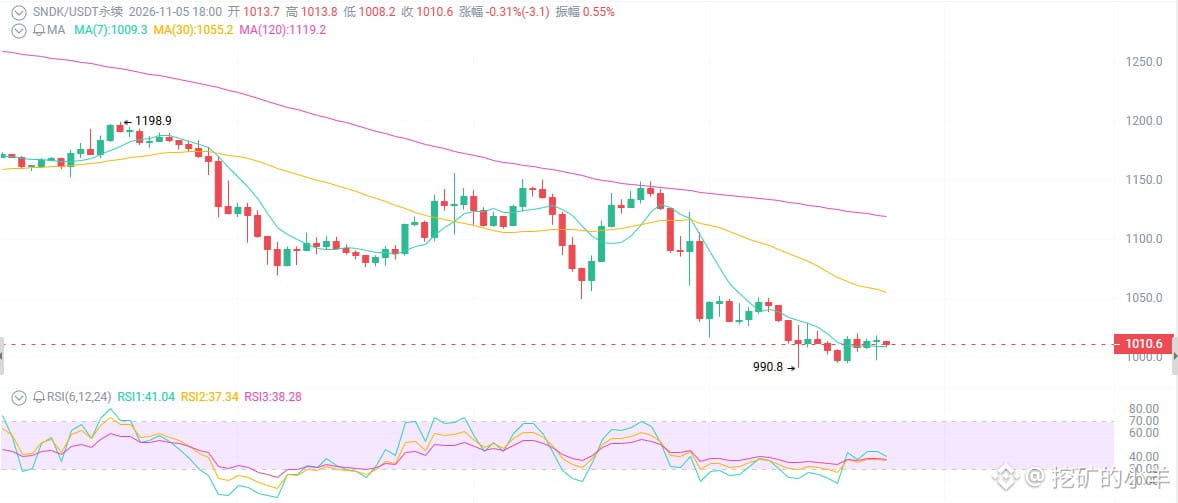
SNDK at $1,010: a golden buying opportunity or a meat grinder?
Revenue surged 378%, EPS beat expectations, and the company even announced a 1-for-8 stock split—yet the stock fell 27% in a week, with perpetual futures plunging straight to 1010. Just now, funding rates were still positive, and longs were still piling in. Is this a golden opportunity in AI storage, or a classic “buy the rumor, sell the news” slaughterhouse?
First, the surface picture: earnings were explosive, but the stock got crushed.
October 29 earnings: revenue of $11.03 billion, up 378% year over year; gross margin of 85.1%; EPS of $49.51—all above the high end of guidance. Data center revenue came in at $4.8 billion, up 61% quarter over quarter. The company also announced $5 billion in buybacks and a 1-for-8 stock split.
You’d think it would be limit-up, right? Instead, it plunged from 1149 to 990, falling 27% in 7 days and 41% in 30 days, and retracing 57% from its June ATH of 2370.
The better the earnings, the harder the fall.
First thing: the market isn’t buying “the present”—it’s pricing in a cycle peak.
SNDK’s earnings are history; the stock trades on the future.
Demand for AI storage is genuinely surging. Enterprise SSDs account for nearly half of the business, contract prices are still rising, and long-term agreements are locked in through 2030. But the market is now asking one question: how much longer can the memory cycle stay strong?
Once supply expands or demand slows, an 85% gross margin becomes the fattest target. The stock already soared from its post-spin lows to 2370, multiplying who knows how many times, and profit-taking is piled up like a fortress wall. Earnings simply gave investors a respectable excuse to get out.
Second thing: a 1-for-8 stock split isn’t a freebie for you.
It takes effect after the close on November 19, with split-adjusted trading starting November 20.
A lot of people hear “stock split” and get excited: “It’s cheaper now—I can buy it!” Wake up. A split doesn’t change any fundamentals; it just turns one $1,000 share into eight $125 shares. It’s still the same company, at the same valuation.
The real effect is to lower the barrier to entry for retail investors and improve liquidity.
Third thing: perpetual-futures longs are too crowded, and 1000 isn’t a rock-solid floor.
Funding rates are currently positive (around 0.07%+/8h), OI is high, and longs are paying—longs are crowded, with leverage lining up.
The technical picture is also rough: consecutive high-volume down days, a break below short-term moving averages, and a bearish alignment. RSI is oversold, but there’s no bullish divergence and no reversal candlestick pattern. An oversold market can get even more oversold until the longs are wiped out.
Support: 990-1000 (recent low + psychological level), then 900-950.
Resistance: 1050-1100, 1150-1200, 1300+.
Revenue surged 378%, EPS beat expectations, and the company even announced a 1-for-8 stock split—yet the stock fell 27% in a week, with perpetual futures plunging straight to 1010. Just now, funding rates were still positive, and longs were still piling in. Is this a golden opportunity in AI storage, or a classic “buy the rumor, sell the news” slaughterhouse?
First, the surface picture: earnings were explosive, but the stock got crushed.
October 29 earnings: revenue of $11.03 billion, up 378% year over year; gross margin of 85.1%; EPS of $49.51—all above the high end of guidance. Data center revenue came in at $4.8 billion, up 61% quarter over quarter. The company also announced $5 billion in buybacks and a 1-for-8 stock split.
You’d think it would be limit-up, right? Instead, it plunged from 1149 to 990, falling 27% in 7 days and 41% in 30 days, and retracing 57% from its June ATH of 2370.
The better the earnings, the harder the fall.
First thing: the market isn’t buying “the present”—it’s pricing in a cycle peak.
SNDK’s earnings are history; the stock trades on the future.
Demand for AI storage is genuinely surging. Enterprise SSDs account for nearly half of the business, contract prices are still rising, and long-term agreements are locked in through 2030. But the market is now asking one question: how much longer can the memory cycle stay strong?
Once supply expands or demand slows, an 85% gross margin becomes the fattest target. The stock already soared from its post-spin lows to 2370, multiplying who knows how many times, and profit-taking is piled up like a fortress wall. Earnings simply gave investors a respectable excuse to get out.
Second thing: a 1-for-8 stock split isn’t a freebie for you.
It takes effect after the close on November 19, with split-adjusted trading starting November 20.
A lot of people hear “stock split” and get excited: “It’s cheaper now—I can buy it!” Wake up. A split doesn’t change any fundamentals; it just turns one $1,000 share into eight $125 shares. It’s still the same company, at the same valuation.
The real effect is to lower the barrier to entry for retail investors and improve liquidity.
Third thing: perpetual-futures longs are too crowded, and 1000 isn’t a rock-solid floor.
Funding rates are currently positive (around 0.07%+/8h), OI is high, and longs are paying—longs are crowded, with leverage lining up.
The technical picture is also rough: consecutive high-volume down days, a break below short-term moving averages, and a bearish alignment. RSI is oversold, but there’s no bullish divergence and no reversal candlestick pattern. An oversold market can get even more oversold until the longs are wiped out.
Support: 990-1000 (recent low + psychological level), then 900-950.
Resistance: 1050-1100, 1150-1200, 1300+.