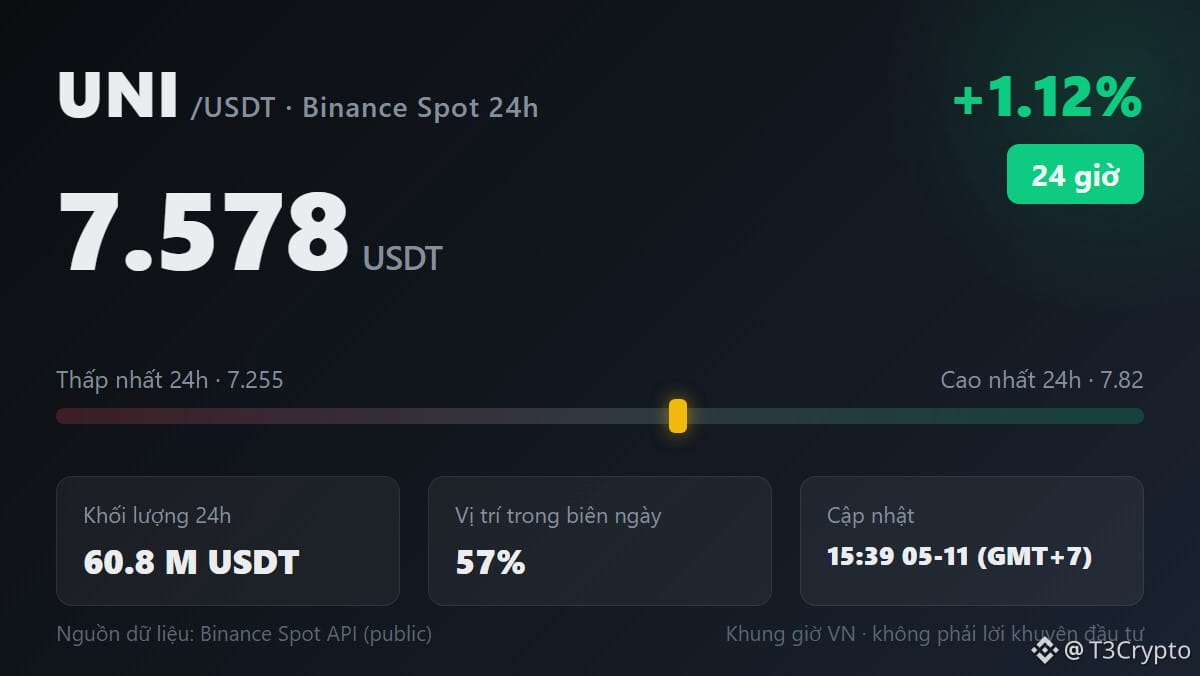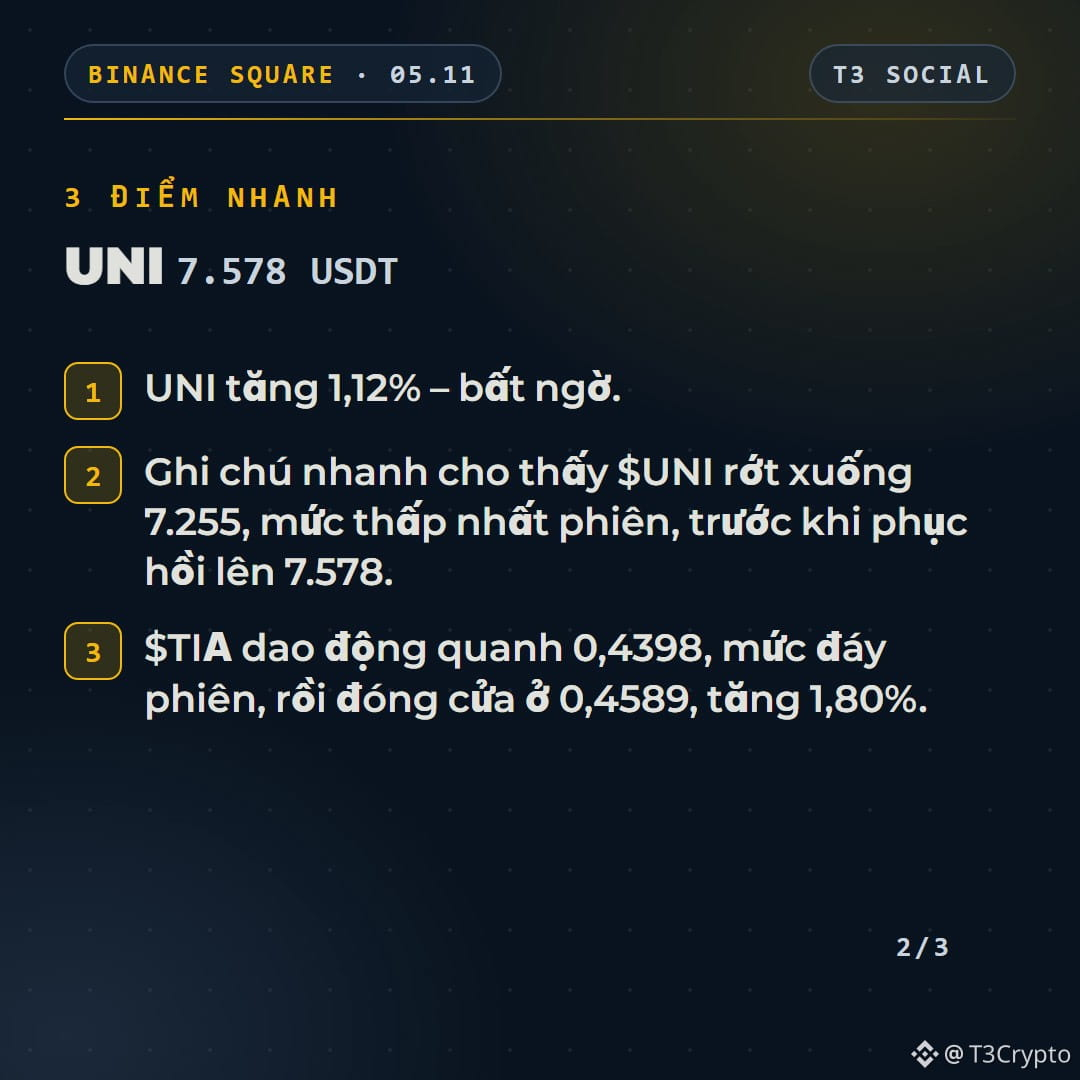
UNI is up 1.12% – surprising.
Quick notes show that $UNI fell to 7.255, the session low, before recovering to 7.578.
$TIA fluctuated around 0.4398, the session low, then closed at 0.4589, up 1.80%.
$UNI saw a volume of 60.8 million USDT, more than ten times the 4 million USDT for $TIA .
These notes were recorded in a simple notebook, where beginners can track market reactions without worrying about complex indicators.
The short-term volatility shown by $UNI and $TIA is typical of what happens during trading sessions, where support and resistance levels form naturally based on immediate supply and demand.
A new trader can record the low of 7.255 for $UNI and the low of 0.4398 for $TIA as important milestones, helping identify when prices may reverse.
These notes become a visual filter, reminding the note-taker that small gains such as 1.12% or 1.80% may be the first sign of a larger trend.
When the market fluctuates, keeping quick notes helps traders avoid getting swept up in their emotions and instead focus on the recorded data.
By recording price levels and volume, this notebook turns market fluctuations into stories that can be retold, making it easier for beginners to recognize patterns.
A notebook is not just a place to record prices; it is also a diary of market sentiment, documenting how traders react when prices reach predetermined levels.
The contrast between the 60.8 million USDT volume of $UNI and the modest 4 million USDT volume of $TIA shows the difference in market participation between large- and small-cap tokens.
Beginners can start by recording three key items: the low, the closing price, and the volume, then review these entries weekly to look for patterns.
This method helps filter out daily noise and allows learners to focus on truly meaningful fluctuations.
Would you consider this good news or bad news? Which side are you on? Comment below.