

What is XRP? A Comprehensive Guide to Ripple’s Digital Asset
Cryptocurrency has revolutionized how we perceive money, and among the thousands of digital assets available today, XRP stands out as one of the most prominent and widely discussed coins. Created by Ripple Labs, XRP was designed with a very specific and ambitious goal in mind: to transform global financial transactions.
Understanding XRP and Ripple
To understand XRP, it is essential to distinguish between the cryptocurrency itself and the company behind its promotion:
XRP: The native digital asset of the XRP Ledger (XRPL). It is a decentralized, public blockchain designed to facilitate fast and low-cost international payments.
Ripple Labs: A technology company that builds payment solutions for financial institutions using XRP and the XRP Ledger.
While Ripple promotes the use of XRP in the banking sector, the XRP Ledger operates independently, meaning the cryptocurrency can exist and function without Ripple Labs.
Key Features of XRP
XRP was built to solve the major inefficiencies of traditional banking systems, such as slow settlement times and high fees. Its core features include:
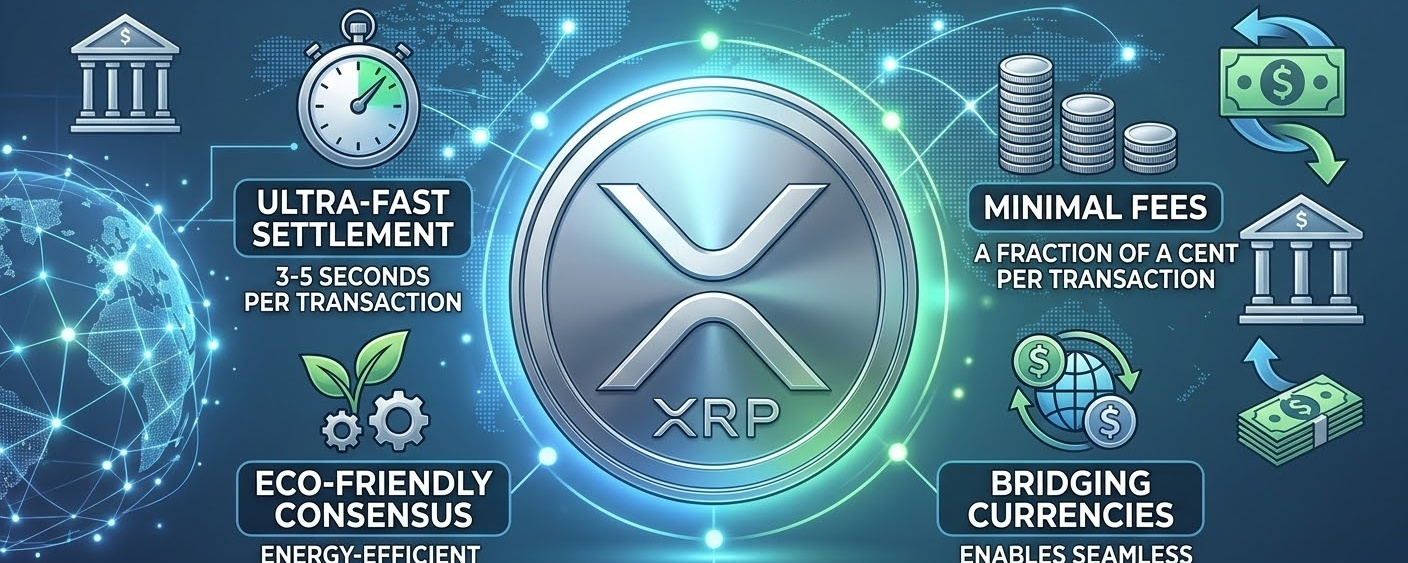
Blazing Speed: Traditional international bank transfers (like SWIFT) can take anywhere from 3 to 5 business days. In contrast, an XRP transaction settles in 3 to 5 seconds.Incredible Scalability: The XRP Ledger can handle around 1,500 transactions per second (TPS), making it vastly superior to older blockchains like Bitcoin.
Low Transaction Costs: The cost of sending XRP is a fraction of a cent (typically around $0.0002 per transaction), making microtransactions and high-volume transfers highly efficient.
Eco-Friendly Consensus Mechanism: Unlike Bitcoin, which relies on energy-intensive Proof-of-Work (PoW), the XRPL uses a unique consensus protocol that requires very little energy, making it environmentally sustainable.
How XRP Works: The Consensus Protocol
Most cryptocurrencies rely on miners to validate transactions. XRP, however, uses a Consensus Protocol managed by a diverse network of independent validators.
When a transaction is initiated, validators across the network must agree on its validity. Because it does not rely on mining or a single central authority, transactions are validated almost instantaneously and with high security.
Use Cases: Bridging Currencies
The primary use case for XRP is acting as a bridge currency for international remittances and foreign exchange.
Imagine a bank in Japan wants to send money to a bank in Kenya. Traditionally, this requires holding pre-funded accounts in both countries' local currencies, tying up massive amounts of capital. With Ripple’s On-Demand Liquidity (ODL) service, the Japanese Yen is converted into XRP, sent across the globe in seconds, and instantly converted into Kenyan Shillings. This eliminates the need for costly pre-funded accounts and drastically reduces settlement times.
Challenges and Controversies
Despite its technological advantages, XRP has faced significant hurdles, most notably its prolonged legal battle with the U.S. Securities and Exchange Commission (SEC). The SEC filed a lawsuit alleging that XRP was an unregistered security. This regulatory uncertainty impacted XRP's adoption and market performance for years. However, recent legal clarifications have provided more stability and renewed confidence within the crypto community.
Conclusion
XRP is much more than just another digital coin; it is a serious enterprise-grade solution aimed at modernizing the global financial infrastructure. By offering unmatched speed, scalability, and cost-efficiency, XRP continues to carve out a unique space in the evolving world of decentralized finance