The gold token Hong Kong is rolling out this time isn’t for retail investors
On November 2, at FinTech Week, Secretary for Financial Services and the Treasury Christopher Hui announced that an interbank tokenized gold project is about to launch.
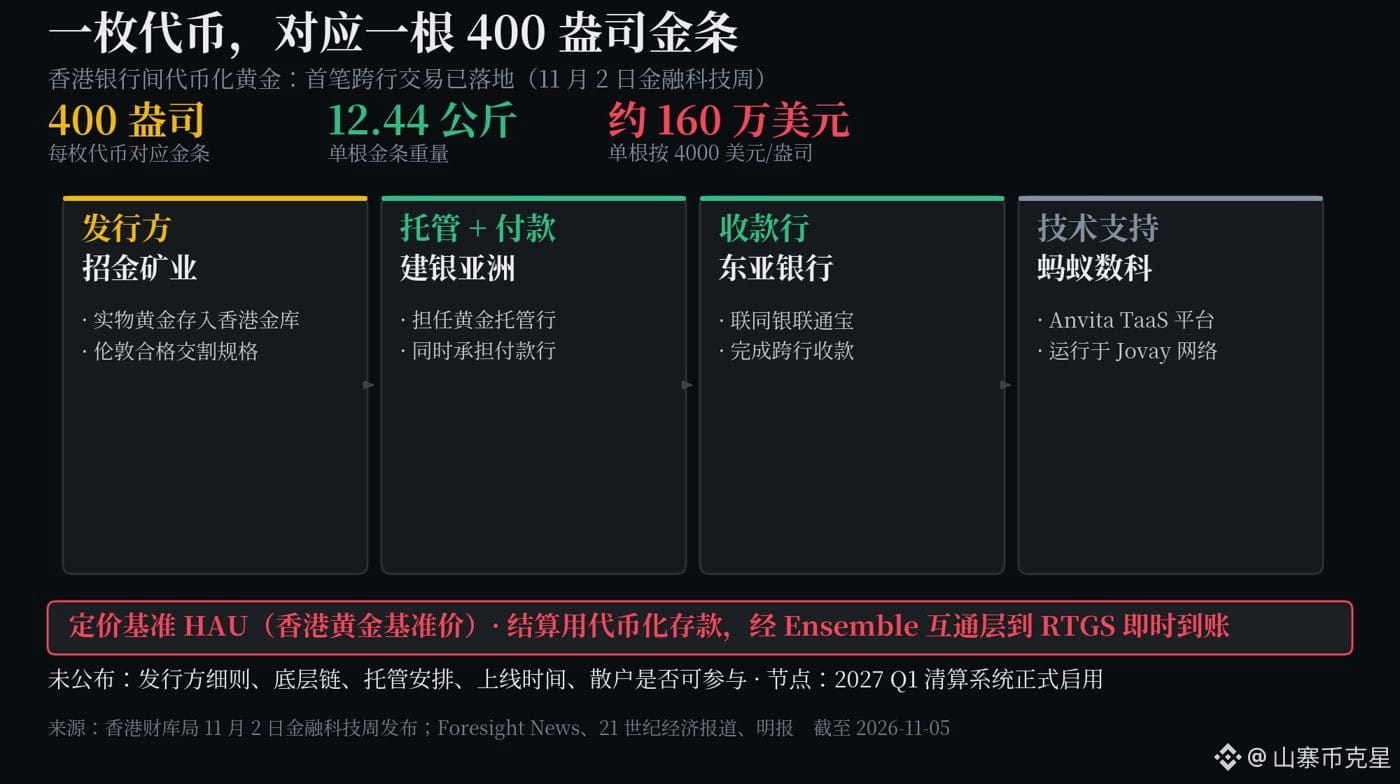
One token represents one standard 400-ounce gold bar, weighing about 12.44 kilograms.
At $4,000 an ounce, one gold bar is worth $1.6 million.
That makes the threshold clear: this is for banks, not you.
What’s really worth watching is the three-part package.
First, pricing power: the project uses Hong Kong’s own gold benchmark, HAU, rather than relying solely on London.
Second, settlement: tokenized gold and tokenized deposits are linked in a single transaction, enabling interbank delivery versus payment.
Third, capacity: storage will expand to more than 2,000 tonnes within three years, and the clearing system is due to launch in the first quarter of 2027.
The first transaction has already gone through.
Zhaojin Mining issued the gold; CCB Asia provided custody and payment; Bank of East Asia, together with UnionPay International, received the payment; and Ant Digital Technologies provided the blockchain.
This is no longer a white paper—real gold and money have gone through the process.
My take:
Hong Kong isn’t competing for retail investor traffic; it’s going after institutional gold settlement and pricing.
Retail products compete on issuance volume and transparency. Institutions compete on clearing, storage, and benchmark prices.
If more institutions adopt HAU, retail products like $PAXG won’t be replaced, but Hong Kong will capture business at the institutional level.
Let’s also be clear about the risks.
The issuer, underlying blockchain, custody arrangements, and launch date have yet to be announced.
The authorities have not said whether retail investors will be able to participate.
The only thing we can confirm for now is this: a real transaction has gone through, and the direction is set.
If you want to follow this, keep an eye on three milestones:
The clearing system’s official launch in the first quarter of 2027.
HAU’s average daily trading volume and the number of institutions adopting it.
The actual progress in establishing 2,000 tonnes of storage capacity.
Don’t chase Hong Kong stock positives based on one-off events. Zhaojin Mining was the first issuer, but that was a single transaction.
The oldest asset is being plugged into the newest settlement network.
The question is: who will this network ultimately serve?
#香港拟推400盎司金条黄金代币