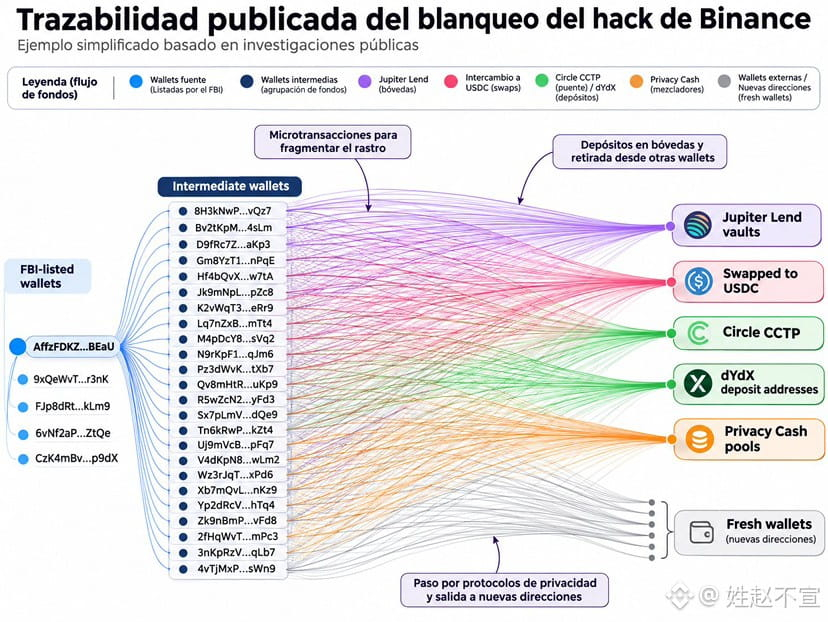

🚨 They’re trying to launder the $6.3 billion stolen from Binance.
What happened behind this hack is absolutely insane.
Hackers blamed by the FBI on North Korea are using an automated system to move funds and obstruct efforts to trace them.
In just three and a half days, around 12,000 wallets and more than 40,000 transactions have been detected.
How are they doing it?
🔹 Breaking up the funds and spreading them across thousands of addresses.
🔹 Using protocols like Jupiter Lend to deposit funds into vaults and transfer withdrawal rights to other wallets, severing the direct trail.
🔹 Constantly switching between different blockchains and assets through bridges and decentralized exchanges.
🔹 They even used Privacy Cash, a protocol specifically designed to provide privacy and make it harder to link deposits with withdrawals.
Now for the interesting part.
After detecting funds linked to the theft, Privacy Cash has just temporarily suspended deposits.
Meanwhile, the FBI has published hundreds of addresses linked to the attackers and asked DeFi operators, exchanges, and blockchain infrastructure providers to block transactions from these wallets.
We’re witnessing a chase: researchers are tracking the funds while the hackers try to hide their origin.
Although they have successfully frozen around $2.85 billion, billions of dollars remain unblocked.
Stealing $6.3 billion was only the beginning. The real challenge for the attackers now is figuring out how to use these funds without being detected.