
The scarcest resource for an AI data center may not be GPUs, but electricity.
Building an AI data center today is about far more than simply buying servers and installing chips. Every stage—from land approvals and substation construction to power supply, liquid cooling systems, and fiber-optic networks—requires substantial investment and time. Even if a company has already purchased its GPUs, the servers still cannot go into operation if power connections and infrastructure are not ready.
This is another new development in the AI industry in 2026: the market is shifting its focus from chips and models alone to the entire AI infrastructure ecosystem. Tech giants such as Microsoft, Amazon, Meta, and Google continue to ramp up capital spending, and data center construction is becoming one of the most important investment priorities in the global tech industry.
I. How large has investment in AI data centers become?
According to recent estimates by market research firms, capital expenditure on AI infrastructure by major technology companies and other participants, including Amazon, Microsoft, Google, and Meta, could reach hundreds of billions of dollars in 2026. Some estimates put these companies' combined capital expenditure for the year at between $803 billion and $828 billion.
This spending is not just for buying GPUs. It also covers servers, data center campuses, networking equipment, power infrastructure, and cooling systems.
Cloud service providers such as Amazon, Microsoft, and Google operate their own cloud computing businesses and can generate revenue by renting out computing capacity and providing AI services. Meta, meanwhile, needs to continue building infrastructure to support its AI products and advertising business.
This raises the question: can such enormous investments ultimately be converted into sufficient revenue and cash flow?
That is why researching the AI industry today means looking beyond chip orders for Nvidia and AMD. The pace of data center construction, cloud service revenue, server utilization, and return on capital are also worth watching.
II. The real bottleneck is shifting from chips to power
Recent developments in the U.S. power grid illustrate this issue well.
On November 4, PJM, the grid operator responsible for dispatching electricity across 13 U.S. states and Washington, D.C., said that the expansion of AI data centers was driving up regional electricity demand. By 2030, demand in the region could increase by as much as 30 GW.
More notably, of the more than 100 GW of new generation projects that have already been approved, only about 25 GW has actually been completed so far. Issues with approvals, equipment supply, and financing are slowing the construction of power infrastructure. PJM also expects significant electricity supply shortfalls in the next two capacity years.
This suggests that the AI industry's growth may already be outpacing the development of some traditional infrastructure.
Data center operators need more than just electricity. They also need transformers, transmission lines, backup power, energy storage systems, and liquid cooling equipment. A problem at any one stage could affect the delivery schedule of an entire project.
As a result, investment opportunities in AI infrastructure are expanding into more specialized areas, including power equipment, energy management, cooling systems, server manufacturing, and optical communications.
III. U.S. stock sectors worth researching in the next wave go beyond GPUs
Breaking down the construction process for AI data centers reveals several distinct industry segments.
In chips, companies such as Nvidia and AMD are worth watching, with a focus on AI accelerators, server processors, and growth in their data center businesses.
In cloud computing, Microsoft, Amazon, and Google are worth watching. They are both major builders of AI infrastructure and providers of computing services. The market will need to assess whether their capital expenditures can generate sustained cloud business revenue.
In power, data centers need a stable and continuous energy supply, bringing power equipment, generation companies, and grid infrastructure into focus. U.S. energy company Alliant Energy recently said it expects to secure contracts for approximately 1 GW of additional data center power demand within the next six months, reflecting how large data centers are becoming important customers for power companies.
Liquid cooling and optical communications are also worth researching. As the power density of AI servers rises, traditional air-cooling solutions may not meet the needs of some high-density racks, increasing the importance of liquid cooling systems. Meanwhile, the large volumes of data that need to move quickly between servers are making optical modules and high-speed networking equipment important parts of the infrastructure.
Of course, growing industry demand does not mean that all related companies will earn the same profits. Equipment pricing, customer concentration, ability to fulfill orders, and the costs of expanding capacity all need to be assessed alongside financial reports.
IV. Investment in AI infrastructure is also creating new asset management needs
As the AI data center supply chain grows longer, market participants are no longer limited to traditional technology stocks. Some focus on U.S. chip companies, some study Hong Kong-listed semiconductor companies, and others participate in global financial markets through digital asset markets.
For people who usually hold U and are accustomed to spot trading in digital assets, but also want to learn about U.S. and Hong Kong stocks, allocating funds across different markets is a practical consideration.
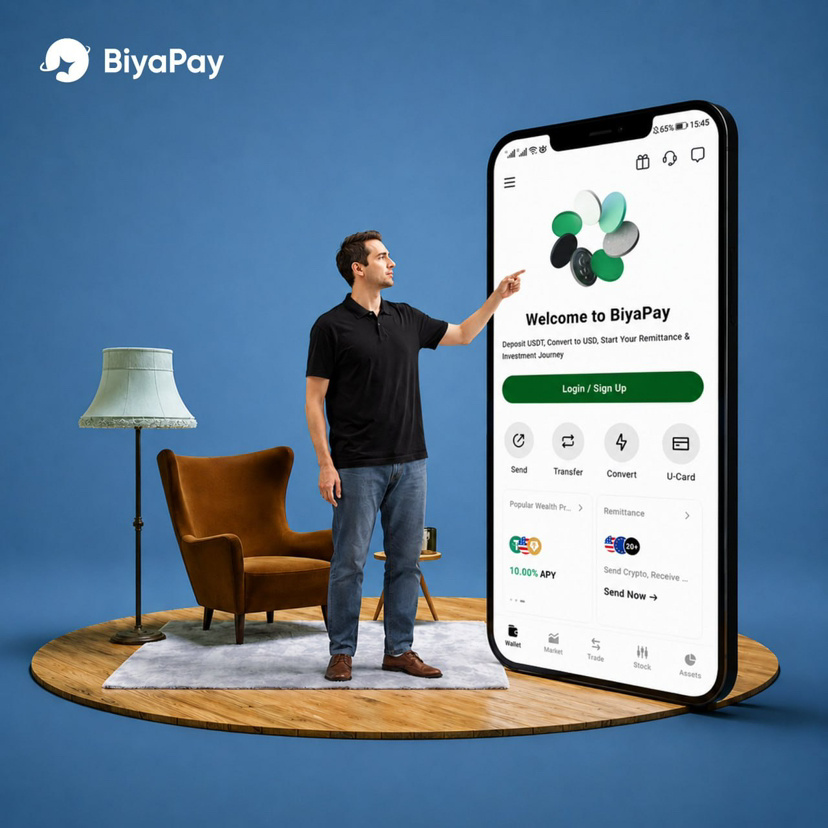
BiyaPay may be useful in this scenario. The platform brings together U as one of its core funding options, real stock trading in U.S. and Hong Kong markets, spot and contract trading in digital assets, commodity futures, wealth management, and other features. Users can learn how to use U to trade U.S. and Hong Kong stocks, and check the actual quoted rate for converting U to U.S. dollars.
The platform advertises zero-commission trading in U.S. stocks and supports the associated rights to dividend distributions. For example, people who follow the AI data center supply chain can use the platform to learn which U.S. and Hong Kong stocks are available to trade, without limiting their areas of interest to the digital asset market.
BiyaPay also offers spot and contract trading, advertising zero fees and services with zero Maker fees. People accustomed to placing limit orders can learn about the conditions that apply to Maker orders. The platform also offers services such as flexible-term wealth management and commodity futures. The specific product rules, returns, and risks should be checked separately.
For cross-border fund transfers, the platform also offers remittance services covering 108 countries, supporting exchanges between more than 30 fiat currencies and over 200 digital currencies. Where eligible, localized remittance channels may reduce intermediary processing steps and improve transfer efficiency. Actual arrival times depend on the destination region and the recipient's bank.
The key point is that competition in the AI industry is entering the infrastructure era. In the past, discussions focused on whose models were smarter and whose chips were more powerful. Now, it is also necessary to consider who can secure enough electricity, build data centers faster, and turn enormous capital expenditures into sustained revenue.
This also means that research into the AI supply chain cannot stop at chip companies. Power, liquid cooling, optical communications, servers, and cloud computing may all be areas worth watching over the coming years.
For users who want to learn about U.S. stocks, Hong Kong stocks, and digital assets, BiyaPay offers a tool that connects multiple financial markets. But whatever platform you use, the key considerations remain company fundamentals, trading costs, and your own risk tolerance.
This article is for informational purposes only. Please conduct your own analysis and make your own judgments. It is not investment advice. Avoid unnecessary losses!