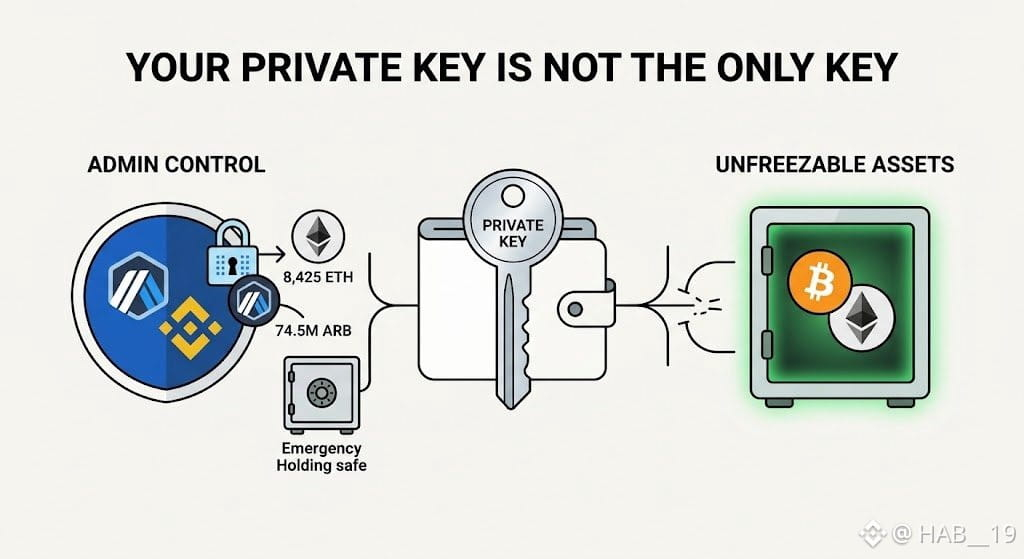
🔐 People in crypto are always told that if nobody steals their 12-word recovery phrase (private key), nobody can move or freeze the coins inside their personal wallet 👛🛡️
🚨 On 30 October 2026 after the @binance exploit, @arbitrum's Security Council used a 9-of-12 emergency vote to temporarily update its Ethereum Inbox contract, move 8,425 ETH and 74,559,805.2 ARB (about $30.5M) out of a hacker-linked wallet into a frozen holding address without the hacker's private key, and restore the original code (as highlighted by @Elikrypt) ⚙️🔒
🛑 Top Networks and Protocols With Admin Keys or Freeze Switches
🔶 Major Layer-2s like @arbitrum, @Optimism, @base, @zksync, @Starknet, @LineaBuild, and @Scroll_ZKP have emergency councils that can upgrade code or pause bridges.
🔷 Centralized stablecoins like @Tether, @circle (USDC), and @Paxos (PYUSD, PAXG) have built-in wallet blacklists.
🔸 Custom tokens on @solana, @SuiNetwork, and @Aptos let creators keep freeze switches on, while @SuiNetwork validators also froze $162M after the 2025 @CetusProtocol hack.
🔹 Upgradeable DeFi apps and bridges like @aave, @wormhole (13-of-19 Guardians), @LayerZero_Core, @chainlink CCIP, and @safe add-on modules (@gnosispay lost $1.5M to a module bug in June 2026) rely on admin or verifier rules.
🟢 What Nobody Can Freeze or Control
🟩 Native Layer-1 coins held on their home chains, including @Bitcoin (BTC), @ethereum (mainnet ETH), @litecoin (LTC), @dogecoin (DOGE), and @monero (XMR), have no admin keys or freeze switches.
🟦 Immutable DeFi contracts like @Uniswap core swap pools (V1, V2, V3) and @LiquityProtocol V1 (LUSD) have permanently locked code that no team can alter or freeze.
Control is justifiable in recovery