
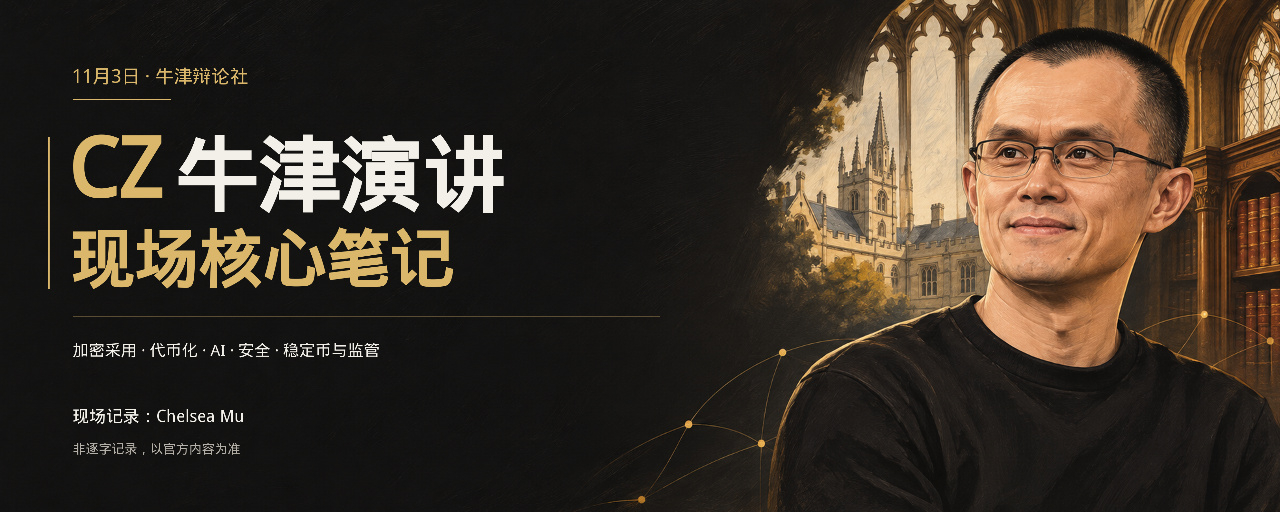


Here are the key takeaways from CZ's talk at Oxford, recorded live by Chelsea Mu
Let's take a look at the insightful points CZ shared at Oxford:
Background
November 3, CZ
@cz_binance spoke at the @OxfordUnion
and mainly discussed three topics:
the real-world uses of crypto, the changes AI will bring, and how regulation affects the industry's adoption
Crypto adoption: don't focus only on prices
People in different countries have very different experiences with financial services. In the UK, bank accounts are readily available, but in many places with limited access to banking services, a phone and a wallet can make a huge difference.
The same is true of cross-border payments. Domestic transfers are convenient, but international remittances are slow and cumbersome. That’s crypto’s most practical opportunity—and far more compelling than watching coin prices rise and fall.
CZ believes real-world adoption is a gradual process: institutions have already entered through ETFs, stablecoins, and tokenized assets, but applications for everyday users still need work. There has to be a real reason for people to want to do things differently.
Fewer headlines don’t mean the industry isn’t making progress. As crypto gradually becomes part of ordinary financial infrastructure, naturally it attracts less attention. AI is in the spotlight now, but that doesn’t mean blockchain lacks long-term value.
Tokenization: Not taking a bigger slice, but making the pie bigger
Putting stocks and real-world assets on-chain can let more people invest without being limited by location or trading hours.
Someone asked whether tokenized U.S. stocks would draw funds away from the crypto market. CZ acknowledged there could be competition in the short term, but in the long run, giving more people access to these assets could also bring newcomers into the digital asset space.
Traditional finance and crypto aren’t opposites. Banks can use blockchain too, and the technology’s applications have long gone beyond cryptocurrency itself.
AI: Writing code is easier; knowing what to build matters more
AI is making coding cheaper and cheaper, so “what to build” matters more than “how to build it.” Understanding needs, knowing users, and creating useful things are all areas AI can’t replace.
It’s fine if young founders don’t understand every technical detail; specialization is normal. The key is knowing how to verify a system’s reliability. One way is to have AI models from different providers write code and review one another’s work.
What’s more worth watching is payments by AI agents. For now, AI mainly processes information. In the future, agents will independently purchase services, pay bills, and make transactions on people’s behalf, generating huge volumes of small payments. That calls for money that settles quickly, has low fees, and can run directly in software—blockchain is a natural fit. But for now, this is just a direction, not something that has reached scale.
Security: Don’t skip the fundamentals
No matter how advanced the technology gets, social engineering attacks and internal management vulnerabilities remain the biggest risks. AI can help hackers attack, but it can also help defenders strengthen their systems.
Security is everyone’s responsibility across the industry. Platforms, researchers, developers, and regulators all need to be involved, and lessons from security incidents should be shared, because the same pitfalls can recur at different companies.
Quantum computing poses a long-term cryptographic risk. CZ said he isn’t an expert in this area, but systems should prepare in advance. Computing power needs will also keep growing, so hardware and energy supplies will have to keep up.
Stablecoins and regulation
Stablecoins are currently the clearest example of crypto being put to practical use. They’re already widely used on-chain, and they’re more convenient for payments than volatile coins. But issuer risk remains, and regulation can’t eliminate it entirely.
Mainstream stablecoins are all pegged to the U.S. dollar. The more successful they become, the greater the dollar’s influence and the demand for U.S. Treasuries. Digital assets don’t necessarily disrupt the existing monetary system; in some cases, they reinforce it.
Central bank digital currencies are a different matter. Their issuers have strong control over access and transfers. Although both are digital money, their governance models are entirely different.
There’s no one-size-fits-all answer to regulation. Every country weighs different factors: capital controls, financial stability, illicit funds, and regulatory capacity. Different constraints naturally lead to different approaches, and adoption across the industry will happen at different speeds.
A lighthearted moment
Someone asked how to choose a life partner, and the atmosphere in the room immediately lightened.
CZ said this might be the toughest question of the whole event, and that there’s no standard answer.
Finding a good business partner is hard enough; finding a life partner is even harder, and people change. This answer brought a lot more warmth to the conversation.
Since photography and filming weren’t allowed at the event, everyone listened attentively throughout the conversation. So I can only share it with you in the form of written notes.
Disclaimer: The above was compiled from notes taken while listening, so there may be omissions or inaccuracies. The final version should be based on the official content.