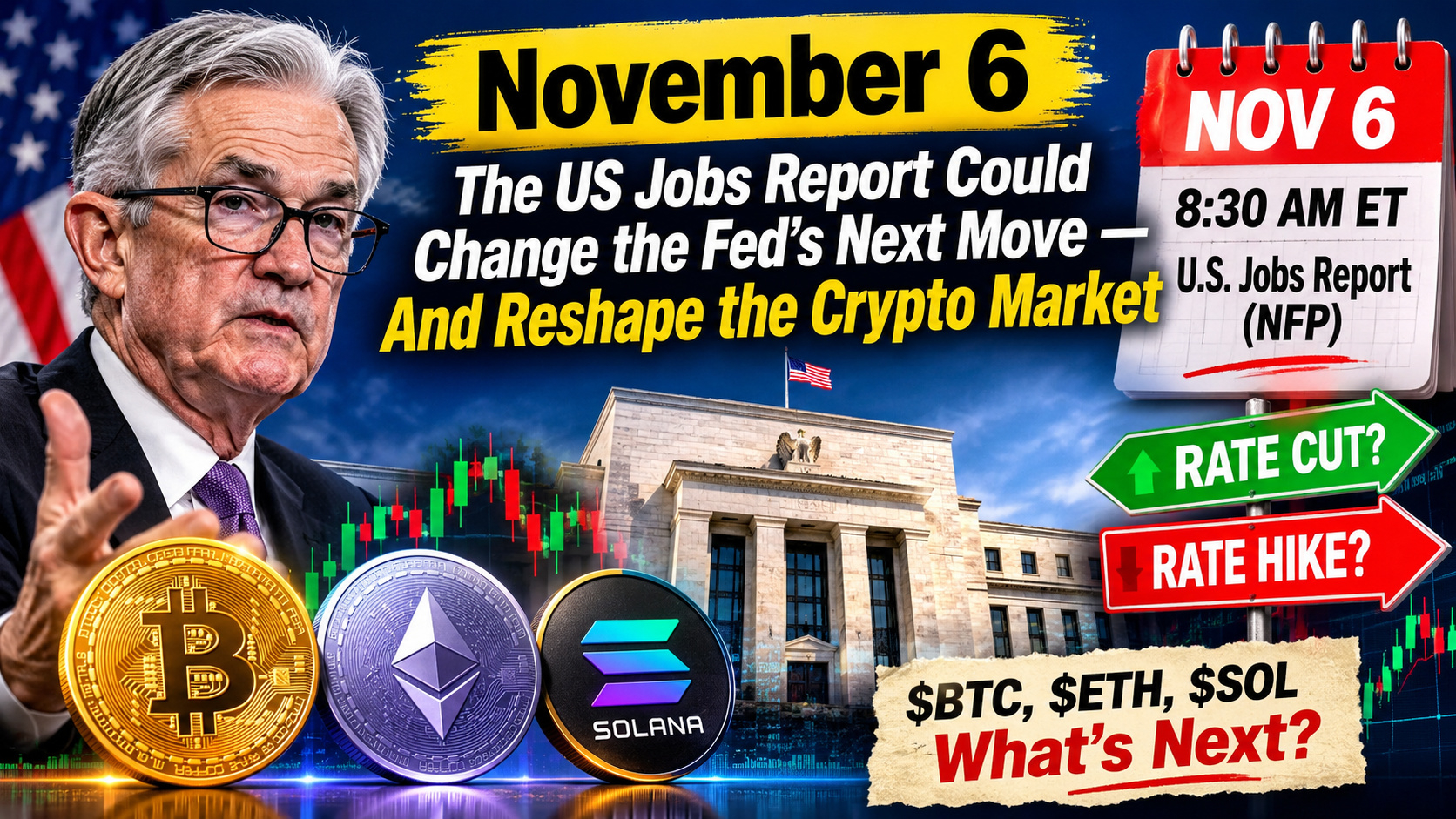

One jobs report could change the direction of global financial markets. For Bitcoin investors, November 6 may be more important than another crypto-specific announcement.
At 8:30 AM ET on November 6, 2026, the US Bureau of Labor Statistics will release October’s Nonfarm Payrolls (NFP) report. The numbers could influence the Federal Reserve’s next interest-rate decision and reshape expectations for December.
The question is simple: Is the US economy strong enough to withstand another rate hike, or is the labour market finally weakening enough to bring rate cuts back into consideration?
For crypto investors, the answer could determine the market's next major move.
September's Weak Jobs Report Changed Market Expectations
September delivered a disappointing employment figure. The US economy added just 29,000 jobs, while unemployment remained at 4.2%.
That was a significant slowdown in hiring.
For investors expecting lower interest rates, the report offered some hope. Weak employment can reduce wage pressure and give the Federal Reserve more room to ease monetary policy.
But the inflation problem has not disappeared.
The Fed's long-term inflation target remains 2%, and inflation is still above that level. Policymakers therefore face a difficult choice: support employment without allowing inflation to become persistent.
That is why weak jobs data does not automatically mean lower interest rates.
October 28: The Fed Delivered a Hawkish Warning
The October 28 FOMC meeting revealed an important division among policymakers.
The Federal Reserve kept interest rates unchanged at 3.75%–4.00%, with a 10–2 vote.
The surprising part was the dissent. Two policymakers preferred a 25-basis-point rate increase rather than holding rates steady.
That tells investors something important: the debate inside the Fed is not simply about when to cut rates. Some policymakers still believe monetary policy may need to become tighter.
For financial markets, this changes the risk calculation.
If inflation remains persistent while economic activity stays resilient, the Fed could maintain restrictive rates for longer or consider another increase.
That would challenge the bullish expectations built around monetary easing.
November 6: Three Possible Market Scenarios
The October NFP consensus forecast is approximately 60,000 new jobs, with unemployment expected to remain around 4.2%.
The actual result matters, but the market's reaction will depend on how it compares with expectations.
1. Strong employment: 65,000+ jobs
A stronger-than-expected report, particularly with accelerating wage growth, could strengthen the hawkish argument.
Potential market reactions:
US Treasury yields move higher.
The dollar gains strength.
Technology stocks face valuation pressure.
Bitcoin and Ethereum experience selling pressure.
A December rate hike could become a more serious market expectation.
2. Weak employment: Below 40,000 jobs
A significant employment slowdown or unemployment rising to 4.3% or higher could revive expectations of monetary easing.
That could improve risk appetite and support demand for cryptocurrencies.
Bitcoin, Ethereum and Solana could benefit from a shift towards lower-rate expectations.
However, persistent inflation could still prevent the Fed from cutting rates.
3. Mixed employment data
This may be the most difficult scenario for traders.
For example, payroll growth could disappoint while wages remain strong. Such a combination would give the Fed conflicting signals.
Markets could initially rally and then reverse as investors reassess the implications.
Watch payroll growth, unemployment, average hourly earnings and revisions to previous months rather than relying on one headline number.
The AI Productivity Factor: A Different Labour Market
There is another reason why weak hiring may not necessarily signal an economic downturn.
Artificial intelligence is changing how companies allocate labour and capital.
Businesses can increasingly use automation and AI-assisted systems to improve productivity without expanding their workforce at the same pace.
For companies, this means potentially higher operating efficiency and stronger profit margins.
For investors, it creates opportunities in semiconductors, data centres, cloud computing and AI infrastructure.
But it also creates a challenge for the Federal Reserve.
If businesses continue increasing output with fewer new employees, employment growth could slow without a corresponding collapse in economic activity.
That would give the Fed more room to maintain higher interest rates.
There is an alternative explanation: weak hiring may simply reflect genuine economic weakness rather than an AI-driven productivity boom. I consider both possibilities relevant, but the productivity argument deserves attention because strong corporate investment and output can coexist with restrained recruitment.
What Bitcoin, Ethereum and Solana Investors Should Watch
The relationship between monetary policy and crypto is largely driven by liquidity expectations and investor risk appetite.
Bitcoin ($BTC): A stronger dollar and rising Treasury yields could create additional selling pressure. Lower yields and improving liquidity expectations could support renewed demand.
Ethereum ($ETH): ETH could benefit if investors become more comfortable taking risks. However, persistent high rates could weigh on speculative demand and institutional investment appetite.
Solana ($SOL): SOL may experience stronger short-term volatility because of its relatively high-beta market behaviour. Improving liquidity expectations could attract speculative capital, but crowded leveraged positions could also accelerate corrections.
These are possible market reactions, not guaranteed outcomes. ETF flows, derivatives positioning and crypto-specific developments will also matter.
My Trading Strategy: Watch the Reaction, Not Just the Number
I would rather miss the first price movement than enter a poorly positioned trade during a major macroeconomic announcement.
My approach:
Avoid excessive leverage before the announcement.
Watch US Treasury yields and the Dollar Index (DXY).
Wait for Bitcoin to confirm its initial direction.
Monitor ETH and SOL for relative strength.
Use predefined stop-loss levels and avoid chasing sudden pumps or dumps.
The November 6 report is a volatility event, not an automatic buy or sell signal.
Another important date is November 10, when October's US CPI report is scheduled. Inflation data could confirm or challenge the market's interpretation of the jobs report.
The Bigger Question for Global Investors
The Federal Reserve is balancing two competing priorities: controlling inflation and protecting employment.
Businesses want cheaper financing, investors want easier liquidity, and policymakers want inflation under control without unnecessarily damaging economic growth.
Those interests do not always align.
If employment remains resilient, the Fed may have little reason to rush towards rate cuts. If hiring deteriorates sharply, monetary easing could return to the discussion.
For investors, the next few days could offer an important test of the broader market direction.
What do you expect on November 6: Will stronger US employment push the Fed closer to another rate hike, or will weak hiring bring rate cuts back into the picture? And how do you think BTC, ETH and SOL will react? Share your analysis in the comments.
Disclaimer: This article is for informational and educational purposes only. It is not financial advice. Always conduct your own research (DYOR) and manage risk before making investment decisions.


#USOctoberNFP-AreRateCutsStillPossible #CryptoAnalysis #Geopolitics #Binance #USNFP