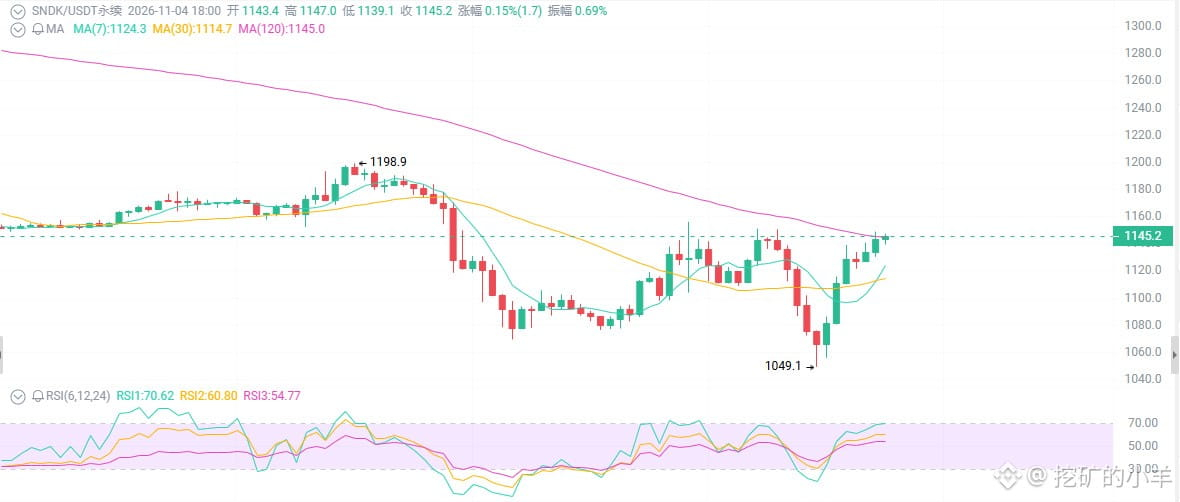
SNDK at $1,145—would you dare buy the dip?
Revenue surged 378%, yet the stock plunged 13% in a day, halving from 2,300 to 1,145. Is SNDK’s blowout performance a golden buying opportunity or a falling knife? Just now, 1,050 held.
First, the headlines: earnings were explosive, but the stock cratered.
Q1 FY2027 revenue was $11.031 billion, up 378% year over year and 23% quarter over quarter; EPS was $49.51, far above expectations; gross margin was 85.1%; data center revenue was $4.8 billion, up 61% quarter over quarter; the company repurchased $5 billion in stock; and long-term agreements include roughly $93.9 billion in minimum committed revenue.
But the stock fell more than 13% in a single day after earnings, sliding from its June high of 2,300 all the way to 1,145. It’s down 35% in a month and 13% in a week. The market isn’t dismissing the results—it had already priced in the good news.
First question: Why did the stock crash despite the blowout earnings? The market isn’t worried about earnings; it’s worried about “slowing growth.”
A 378% year-over-year revenue increase sounds staggering, but sequential growth has slowed from a higher level. Consumer-facing revenue (PCs and smartphones) is under pressure, as high prices dampen demand. Peers such as Kioxia have warned that there’s limited room to raise prices in the consumer market. The market isn’t buying today’s results—it’s buying next quarter’s.
Stocks rise on expectations, not facts. Before earnings, the stock soared from 36 to 2,300—more than 60-fold. The good news had already been chewed over. When the results came out, institutions didn’t first say, “Wow, that’s amazing!” They asked, “Can it get even better?” If not, sell first.
Second: $93.9 billion in minimum committed revenue—that’s not wishful thinking.
The company has signed long-term agreements with multiple customers, covering about half of its FY2027 bit output and two-thirds of FY2028 bit output, with roughly $93.9 billion in minimum committed revenue.
And the company has no debt, plenty of cash, about $5.7 billion in adjusted free cash flow, and margins above 50%. It repurchased about $5 billion in stock this quarter. This isn’t a company short on cash—it’s a cash-printing machine.
Third: The technicals point to an oversold bounce, but no medium-term reversal yet.
The daily RSI has recovered from oversold territory but remains weak. After a bearish MACD crossover, the histogram is narrowing, suggesting selling pressure may be easing, but there’s no bullish crossover yet. The moving averages are bearishly aligned, and the price is below the 20- and 50-day moving averages. The short-term picture is a recovery; the medium-term trend remains downward.
Support: 1,050–1,100 → 1,000
Resistance: 1,180–1,200 → 1,250–1,300 → 1,500+
A reversal only counts if the stock holds above 1,200 on strong volume; if it can’t, this is just an oversold bounce.
An 8-for-1 split of the common stock is planned, with a record date around November 9 and trading expected to begin around November 20. Volatility may increase around the split, and it could attract speculative trading—but leveraged positions could get whipsawed.
Revenue surged 378%, yet the stock plunged 13% in a day, halving from 2,300 to 1,145. Is SNDK’s blowout performance a golden buying opportunity or a falling knife? Just now, 1,050 held.
First, the headlines: earnings were explosive, but the stock cratered.
Q1 FY2027 revenue was $11.031 billion, up 378% year over year and 23% quarter over quarter; EPS was $49.51, far above expectations; gross margin was 85.1%; data center revenue was $4.8 billion, up 61% quarter over quarter; the company repurchased $5 billion in stock; and long-term agreements include roughly $93.9 billion in minimum committed revenue.
But the stock fell more than 13% in a single day after earnings, sliding from its June high of 2,300 all the way to 1,145. It’s down 35% in a month and 13% in a week. The market isn’t dismissing the results—it had already priced in the good news.
First question: Why did the stock crash despite the blowout earnings? The market isn’t worried about earnings; it’s worried about “slowing growth.”
A 378% year-over-year revenue increase sounds staggering, but sequential growth has slowed from a higher level. Consumer-facing revenue (PCs and smartphones) is under pressure, as high prices dampen demand. Peers such as Kioxia have warned that there’s limited room to raise prices in the consumer market. The market isn’t buying today’s results—it’s buying next quarter’s.
Stocks rise on expectations, not facts. Before earnings, the stock soared from 36 to 2,300—more than 60-fold. The good news had already been chewed over. When the results came out, institutions didn’t first say, “Wow, that’s amazing!” They asked, “Can it get even better?” If not, sell first.
Second: $93.9 billion in minimum committed revenue—that’s not wishful thinking.
The company has signed long-term agreements with multiple customers, covering about half of its FY2027 bit output and two-thirds of FY2028 bit output, with roughly $93.9 billion in minimum committed revenue.
And the company has no debt, plenty of cash, about $5.7 billion in adjusted free cash flow, and margins above 50%. It repurchased about $5 billion in stock this quarter. This isn’t a company short on cash—it’s a cash-printing machine.
Third: The technicals point to an oversold bounce, but no medium-term reversal yet.
The daily RSI has recovered from oversold territory but remains weak. After a bearish MACD crossover, the histogram is narrowing, suggesting selling pressure may be easing, but there’s no bullish crossover yet. The moving averages are bearishly aligned, and the price is below the 20- and 50-day moving averages. The short-term picture is a recovery; the medium-term trend remains downward.
Support: 1,050–1,100 → 1,000
Resistance: 1,180–1,200 → 1,250–1,300 → 1,500+
A reversal only counts if the stock holds above 1,200 on strong volume; if it can’t, this is just an oversold bounce.
An 8-for-1 split of the common stock is planned, with a record date around November 9 and trading expected to begin around November 20. Volatility may increase around the split, and it could attract speculative trading—but leveraged positions could get whipsawed.